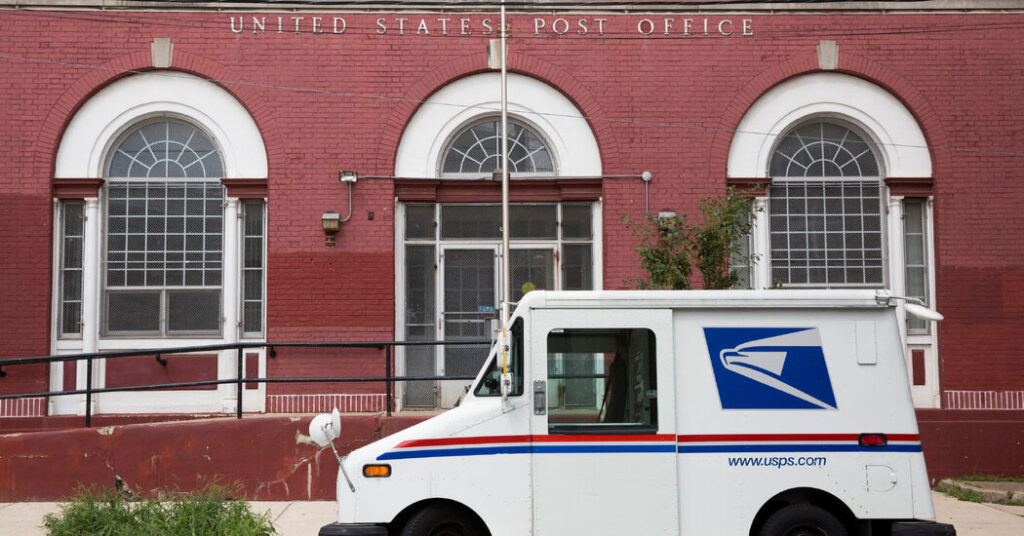
The Postal Service plans to impose a temporary 8 percent surcharge on packages to offset rising fuel and transportation costs that have further strained the agency’s dire finances.
The price increase comes amid a spike in fuel prices since the war in Iran began nearly four weeks ago. The surcharge, which will not be applied to mail prices, is slated to take effect on April 26 and end on Jan. 17, 2027. The agency will then determine if a “different long-term approach is needed,” the service said in a statement on Wednesday.
The announcement of the increase comes barely a week after its postmaster general, David Steiner, told lawmakers that within a year the agency would be out of cash and unable to deliver the mail unless Congress allowed it to borrow more and charge more for postage.
The surcharge is intended to serve as a “necessary bridge” to a permanent solution that could allow the agency to carry out its operations in a “more financially sustainable manner,” according to the statement.
The agency said it had tried to avoid imposing surcharges, even as climbing energy costs have compelled competitors like FedEx and UPS to raise their fuel surcharge rates. “This charge is less than one-third of what our competitors charge for fuel alone,” the Postal Service’s statement said.
Before the price increase takes effect, it must be reviewed and approved by the Postal Regulatory Commission, an independent agency that oversees the post office.
The agency has long struggled to shore up its finances, in large part because it has been unable to offset declining mail volume and higher operating costs. The agency’s “universal service obligation” requires it to deliver to everyone in the United States at a reasonable price. The agency delivers to roughly 168 million addresses, covering every state, city and town.
In fiscal years 2024 and 2025, the service incurred net losses of $9.5 billion and $9 billion. During the first quarter of fiscal year 2026, it lost nearly $1.3 billion.
The Postal Service, which is supposed to be self-sustaining, in 2021 instituted a 10-year plan that it hoped would advance the agency past its financial crisis.
Although the Postal Service has received some federal relief in recent years, it generally does not receive tax dollars for operating expenses and instead relies on revenue from its sales.
Madeleine Ngo covers immigration and economic policy for The Times.
The post Postal Service Plans to Impose 8% Surcharge on Packages to Offset Rising Transportation Costs appeared first on New York Times.