A Brussels court this month ordered Étienne Davignon, a 93-year-old former Belgian diplomat, to stand trial for war crimes related to the 1961 assassination of Patrice Lumumba, the first democratically elected leader of Congo. Human rights groups cheered. The Lumumba family called it “the beginning of a reckoning that history has long demanded.” After decades of equivocation, Belgium finally seemed willing to confront its colonial past.
If only it were so simple.
The desire for accountability is entirely legitimate. Mr. Lumumba’s overthrow and assassination was one of the Cold War’s great crimes — a conspiracy involving White House officials, C.I.A. spooks, U.N. diplomats, Congolese separatists, and, yes, Belgian envoys. It cut short the life of a young and charismatic leader, installed a kleptocratic dictator in his place and set what is now the Democratic Republic of Congo on a ruinous path from which it has never entirely recovered.
No one apart from the Congolese people has ever paid a price. Neither the United States nor the United Nations has formally apologized. In 2002, Belgium’s foreign minister expressed “profound and sincere regrets” for Mr. Lumumba’s death, but hedged by pinning blame on “some members of the government, and some Belgian actors at the time.” A 2020 letter from Belgium’s king to Congo’s president about the early colonial period, when his great-great-granduncle King Leopold II ran an ivory- and rubber-producing slave state, merely observed that “acts of violence and cruelty were committed.”
The Belgian court’s decision is a poor substitute for a true reckoning. The accused nonagenarian, Mr. Davignon, was a bit player in the events. He is the sole survivor among a list of a dozen or so Belgian officials whom the Lumumba family alleges bore responsibility for Mr. Lumumba’s death.
The legacy of Mr. Lumumba’s assassination is weighty and enduring. Early meddling distorted Congo’s politics, and in the 65 years since Mr. Lumumba’s killing, his country has been ruled by corrupt, unresponsive leaders of various stripes, often with the backing of foreign patrons. The vast majority of Congo’s population lives on less than $3 a day. Outside powers still treat it as little more than a source of violence and misery — and minerals, in which Congo is extraordinarily wealthy.
Mr. Lumumba’s death was the culmination of a coordinated, largely foreign effort to remove him from power. An uncompromising nationalist whose party won Congo’s first free democratic elections, he became prime minister of the newly independent country in June 1960. Within weeks, an army mutiny and the Belgian-backed secession of the mineral-rich province of Katanga plunged Congo into crisis.
The Eisenhower administration, worried that Mr. Lumumba was aligning with the Soviet Union, authorized a C.I.A. scheme to assassinate the prime minister. A C.I.A. chemist flew to Congo with poison, but the plot was never carried out — in part because by then, a different scheme was in motion.
On Sept. 5, 1960, President Joseph Kasavubu, Mr. Lumumba’s chief rival, announced that he had dismissed Mr. Lumumba. Nine days later, Col. Joseph Mobutu, the country’s 29-year-old army chief, seized power in a C.I.A.-backed coup, marking the beginning of decades of misrule.
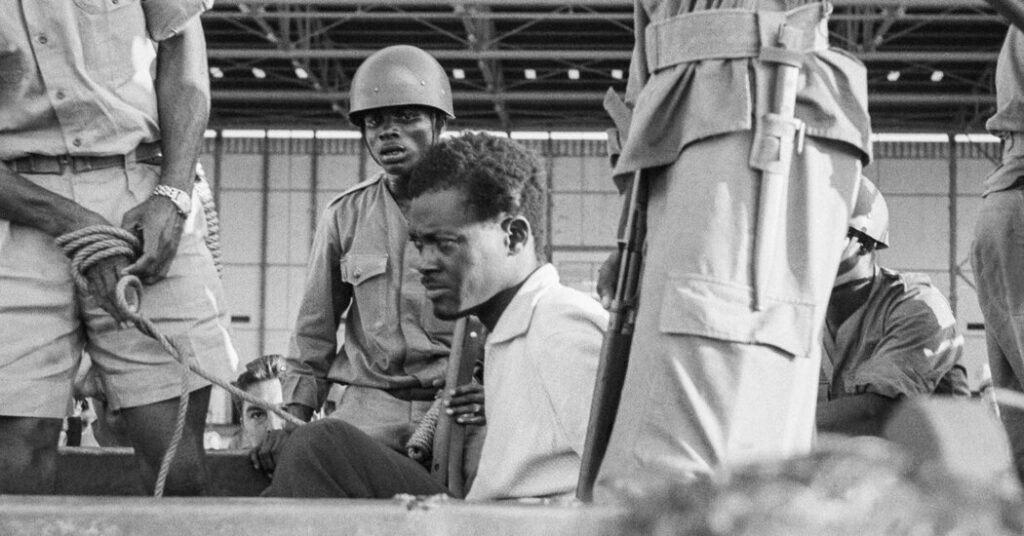
Mr. Lumumba was eventually detained at a military camp outside the capital, Léopoldville. But by the end of 1960, his supporters in the country’s east were amassing power, and the incoming Kennedy administration seemed poised to shift toward a less hard-line U.S. policy that might involve a deal restoring his government. Among Mr. Lumumba’s opponents, a search was underway for a more permanent solution that could offer some plausible deniability.
As Colonel Mobutu’s cabal developed plans to send Mr. Lumumba somewhere it was certain he would be killed, the C.I.A. station chief effectively gave a green light. Belgian officials lobbied Moise Tshombe, the leader of the breakaway province of Katanga and a sworn enemy of Mr. Lumumba, to accept the prisoner. On Jan. 17, 1961, Colonel Mobutu’s security chief arranged for Mr. Lumumba to be transferred from military detention and flown to Katanga. That evening, after hours of torture, he was executed by a firing squad of Congolese soldiers commanded by Belgian officers. His body was later dissolved in a barrel of sulfuric acid.
Mr. Davignon’s role in this atrocity was, by all accounts, limited, and he has denied the charges against him. In the summer of 1960, he was a 27-year-old trainee diplomat at the Belgian Embassy in Léopoldville, junior in rank but with direct access to Congolese political leaders.
Like his superiors, Mr. Davignon apparently considered Mr. Lumumba an erratic, hostile leader and worked to remove him from power. He and a Foreign Ministry colleague were tasked with providing the legal pretexts the president would use to dismiss Mr. Lumumba. In a cable to Brussels, they explicitly referred to their goal as the “overthrow of the government according to our wishes.” After that had been accomplished, Mr. Davignon lamented that Mr. Lumumba had “not yet been neutralized.”
As Mr. Lumumba languished in prison, Mr. Davignon was back in Brussels. By then, he was a valued member of “the Congo cell” at the Belgian Foreign Ministry, helping to draft the foreign minister’s correspondence on the crisis. The record shows that Mr. Davignon knew that Mr. Lumumba was being transferred somewhere he would surely be killed. If there is evidence that Mr. Davignon’s role went beyond this, it has not appeared in the extensive public records now available.
That’s not to say that Mr. Davignon bears no responsibility. He was, at the very least, a cog in a machine that helped topple an elected prime minister and send him to his death — or, as Mr. Lumumba’s family put it, “one of the links in the chain.”
But an ordinary criminal court in Brussels is an awkward vehicle for delivering restorative justice of this scale. The Congolese people will gain little from prosecuting a man who drafted cables.
What would actual atonement look like? For Belgium, it would entail a forthright apology and an admission of institutional responsibility. For the United States, it could mean the same, as well as investing in Congo’s governance, its institutions and its people, instead of merely racing to secure its cobalt. In other words, Washington could treat Congo as a nation with aspirations of its own rather than a mine to be managed.
The U.S. government could also open up the Congo files. Sixty-five years on, C.I.A. documents about the agency’s role in Mr. Lumumba’s demise are still studded with redactions related to bribes, collaborators and other important information.
Mr. Lumumba’s daughter Juliana once told me that she is often asked, after Belgium’s various quasi-apologies, what more she wants. Her answer: “We want the truth.”
Stuart A. Reid is a senior fellow at the Council on Foreign Relations and the author of “The Lumumba Plot.”
The Times is committed to publishing a diversity of letters to the editor. We’d like to hear what you think about this or any of our articles. Here are some tips. And here’s our email: [email protected].
Follow the New York Times Opinion section on Facebook, Instagram, TikTok, Bluesky, WhatsApp and Threads.
The post It Was One of the Cold War’s Greatest Crimes. No One Has Paid a Price. appeared first on New York Times.