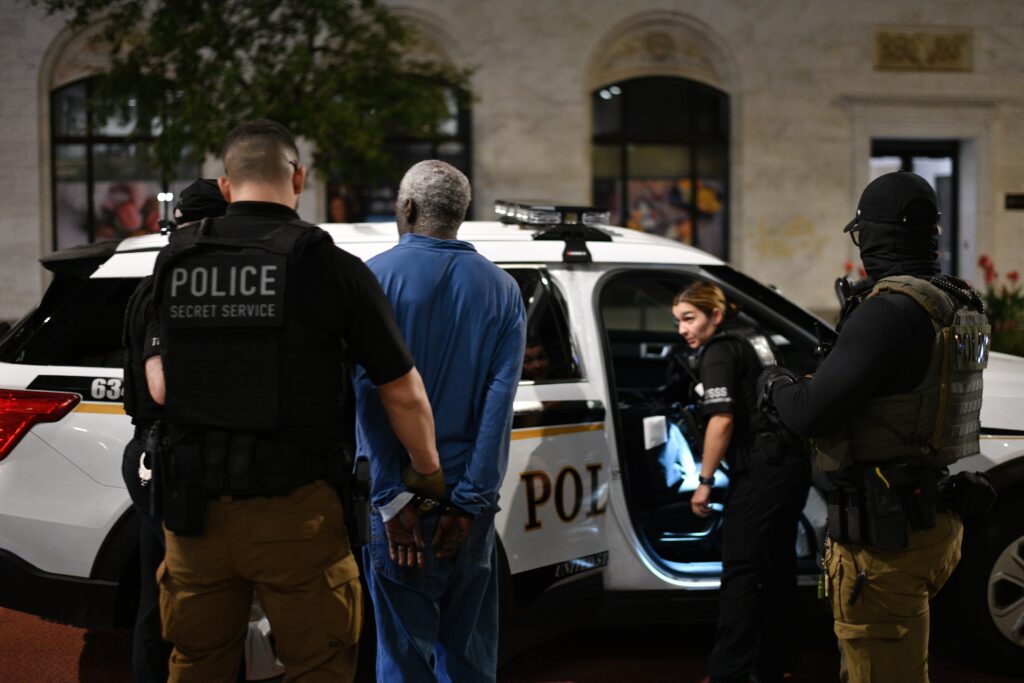
President Donald Trump’s task force to make D.C. “safe and beautiful,” which ramped up federal law enforcement and immigration arrests in the District, would be extended for the remainder of his four-year term under a bill the House passed Wednesday.
The legislation, which must still pass the Senate, seeks to codify the executive order Trump signed last March creating the D.C. Safe and Beautiful Task Force. Trump directed the task force to coordinate with D.C. police, do beautification projects across the city and carry out “maximum enforcement” of federal immigration law — igniting fear in the city’s immigrant communities as detentions increased.
Trump’s executive order was one of the earliest signs of how he planned to exert more control over the nation’s capital, peaking with his unprecedented seizure of the D.C. police department in August after declaring a 30-day crime emergency while also deploying the National Guard to the city. Since then, the effort has transformed policing in the District, with the Guard troops becoming ever-present at Metro stations and joint patrols with federal officers the status quo.
Trump has also been fixated on “beautifying” the nation’s capital ahead of the United States’ 250th birthday celebration this summer, efforts that have included the restoration of dry, broken fountains and the removal of graffiti and homeless encampments from federal property.
Rep. John McGuire (R-Virginia), the sponsor of the bill, said it was about “ensuring there isn’t a backslide into lawlessness in the city,” while he blamed the D.C. Council for “reckless” criminal justice policies.
“When people visit D.C. they should feel safe taking in the scenery and historic landmarks, not scared to walk two blocks because of the crime or confronted with a homeless encampment while walking on the National Mall,” McGuire said.
The legislation passed by a vote of 218-206, with five Democrats joining Republicans.
Violent crime — which was already decreasing in D.C. from a historic spike in 2023 at the time Trump created the task force — continues to decline, down 12 percent from this time last year, according to D.C. police data.
Abigail Jackson, a White House spokeswoman, said the Trump administration is continuing to “coordinate closely with local officials to enhance operations and keep all members of the community safe.” In a statement, she credited the crime task force for more than 10,000 arrests and over 1,000 illegal-gun seizures since last year, as of February.
“President Trump’s bold actions in DC have made the city safer and more beautiful for all residents and visitors, with crime rates rapidly declining across the board in all categories,” she said.
A spokesman for Mayor Muriel E. Bowser (D), whose office is the only local D.C. entity formally invited to be on the task force under the legislation, declined to comment.
While D.C. police have long worked with federal agencies to track guns and execute warrants, it is now common for them to patrol neighborhoods jointly with officers from a smattering of federal agencies. D.C. police crime-suppression teams, which proactively patrol crime hot spots, regularly go out with officers from agencies including the FBI, U.S. Marshals Service and Homeland Security Investigations, a branch of Immigration and Customs Enforcement.
Bowser, the police chief and other local officials have previously said the augmented manpower for D.C. police, particularly from agencies such as the FBI and Drug Enforcement Administration, has been helpful. The department is having serious officer staffing and retention challenges. That is in part due to D.C. officers’ being poached by federal law enforcement agencies that are growing.
At the same time, D.C. officials have acknowledged the significant trust issues among city residents, especially in heavily immigrant areas, that has stemmed from the presence of the Department of Homeland Security — which enforces immigration law — on the task force.
“D.C. does not want masked federal agents terrorizing communities, separating families and destroying the community trust needed for effective local policing, or more guns on the streets,” Del. Eleanor Holmes Norton (D), the District’s nonvoting delegate, said on the House floor. The legislation also seeks to speed up the process to secure a concealed carry license.
Testifying about coordination with federal law enforcement before the D.C. Council last month, D.C. interim police chief Jeffery Carroll said “it’s not a situation we particularly want to be in.” But, he added, he thought it was better for city police to be with the federal agents, who in many cases are not familiar with local neighborhoods.
“I do believe for the community it’s the best for the situation we find ourselves in,” he said, “so that we don’t have rogue federal agents.”
Federal police agencies have different rules than D.C. police related to transparency, car chases and immigration enforcement.
When federal agents shoot people or use force, for example, their agencies are not required to release body-camera footage to the public, while D.C.’s police department is required to do so. Officers with Homeland Security Investigations have twice shot into occupied cars while D.C. police were present — incidents that recently galvanized the D.C. Council to force the release of body-camera footage in cases where federal officers use serious force.
Among the most visible changes in the city has been in the area of immigration enforcement, which surged in the late summer and fall before quieting in recent months.
Austin Rose, an attorney at the Amica Center for Immigrant Rights, said that over the past year the Trump administration has “leveraged basically all federal law enforcement to directly do or at least facilitate immigration enforcement.”
“We see people arrested in manners in D.C. for immigration reasons that would never happen before, and obviously at a scale that we have never seen before,” Rose said.
Rep. James Walkinshaw (D-Virginia) pointed to the language in the legislation that directs the task force to develop and encourage policies facilitating maximum immigration enforcement — including the “redirection of federal, state or local law enforcement resources to apprehend and deport illegal aliens.”
“Redirect law enforcement from the worst of the worst and presumably toward detaining more hardworking folks and children,” he said.
Immigration arrests have involved other agencies that police the city — including Park Police officers, who have repeatedly made stops that led to immigration detention, court records show. D.C. police traffic stops have also in some cases led to immigration arrests, a move that has elicited scrutiny from advocates who have in response urged city officials to harden the fire wall between local police and federal immigration enforcement.
The city’s majority-Black communities also saw a surge of federal law enforcement. Some residents welcomed the extra attention, saying it made them safer. Others viewed the federal surge as an extension of harmful over-policing they say their neighborhoods have seen for generations — and noted the police presence came with no extra resources to address the root causes of crime.
“Our communities have been plagued with this long before the takeover,” said Jawanna Hardy, an anti-violence activist who works with young people in Southeast Washington.
McGuire’s legislation is part of a large package of bills Republicans advanced from the House Oversight Committee last year seeking to impose Trump’s agenda on the city, especially as it relates to policing and criminal justice. The committee also investigated the D.C. police department and accused former chief Pamela A. Smith of creating a toxic culture of fear in which officers were incentivized to downplay crime in their districts — findings D.C. officials have disputed.
Some of the D.C.-focused bills have already passed the House but have not received Senate consideration, including bills overhauling the city’s bail system, allowing 14-year-olds to be tried as adults, and curtailing a law allowing more lenient sentencing for offenders up to age 24.
On the House floor Wednesday, McGuire repeatedly bashed the D.C. Council, using the type of inflammatory language that has led city lawmakers to try to combat perceptions that they are soft on crime. Without being specific, McGuire charged that their policies have “caused citizens from all over the United States and in D.C. to be robbed, raped and murdered.”
“They’re reckless. That’s why we have to do this bill,” he said.
D.C. Council Chairman Phil Mendelson (D) said McGuire’s “extreme rhetoric shows there’s not an interest in what the facts actually are,” adding that Republicans were “stuck on 2023” despite the substantial reductions in crime since then.
“I’d say there’s still too much crime, but to say the city is unsafe is untrue, and to base it on statistics from three years ago is false advertising,” Mendelson said.
He said he was most concerned about the provisions in McGuire’s legislation that ramped up federal law enforcement, sped up the concealed handgun licensing process and directed maximum immigration enforcement. “I don’t think we want anther Minneapolis in the nation’s capital,” he said.
The five Democrats who voted for the legislation were Henry Cuellar (Texas), Don Davis (North Carolina), Jared Golden (Maine), Adam Gray (California) and Marie Gluesenkamp Perez (Washington).
The post House votes to extend Trump’s task force cracking down on D.C. to 2029 appeared first on Washington Post.