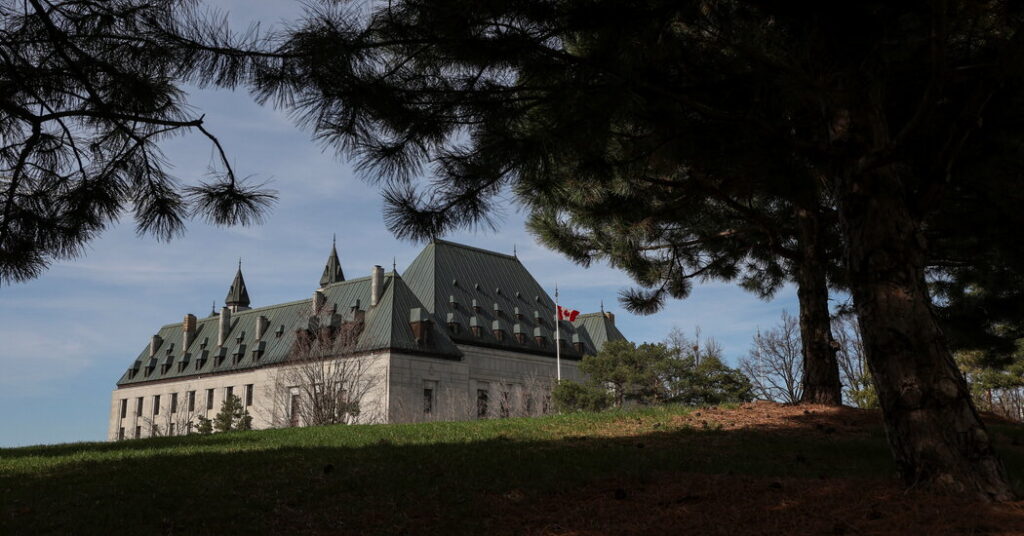
In a top court case with far-reaching consequences for Canadian unity, opposing sides clashed this week over an increasingly used measure to override constitutional rights that, one lawyer warned, could give rise to a “mini-Trump” in Canada.
The long anticipated case at the Supreme Court of Canada focuses on a 2019 Quebec law on secularism and religious symbols. But it also touches on many sensitive issues that have torn at Canada — the balance of power in its federation and the distinct nature of the French-speaking province of Quebec.
At issue is a measure in Canada’s 1982 Constitution — known as the notwithstanding clause — that allows governments at all levels to pass laws that suspend rights in the Constitution’s Charter of Rights and Freedoms.
The government of François Legault, the right-leaning premier of Quebec, used the clause to pass the 2019 law prohibiting public servants from wearing religious symbols at work. The provincial government argued that the law was intended to protect secularism in the province, where the Roman Catholic Church once exercised widespread control.
But some linguistic and religious minorities said the law was discriminatory and violated the Canadian Constitution, which guarantees religious freedom and equal rights.
After several groups sued the Quebec government, the case ultimately reached the nation’s highest court, which has devoted four days to hearings this week, one of the longest in its history.
Plaintiffs in the Quebec case are pressing the court to strike down the 2019 law and restrict the use of the notwithstanding clause. Quebec and other provinces oppose any changes to the clause.
Frédéric Bérard, a lawyer representing a major teachers’ union in Quebec, argued before the Supreme Court that the notwithstanding clause gives too much power to politicians.
“If there is ever a mini-Trump in Canada, like there are now in many places in the West, our only hope would lie in trust,” Mr. Bérard said.
The Canadian government asked the Supreme Court to restrict its use and allow courts to declare a law enacted under the clause to be a violation of rights.
The notwithstanding clause was never intended to be used so that “laws can be adopted by derogation and for these laws to eventually amend or even eliminate rights,” the lawyer representing Canada, Guy Pratte, said on Wednesday.
The day before, a lawyer representing the Quebec government, Isabelle Brunet, argued that the notwithstanding clause was the result of a political compromise that led to the 1982 Constitution and that it was not up to the court to alter it.
“It is not the court’s role to decide a political matter that is not under its jurisdiction,” Ms. Brunet said.
Ms. Brunet also pushed back against judges who asked whether courts should be allowed to declare a law a violation of rights even as the notwithstanding clause allowed it to stand.
That would “invite the Court to enter the political arena to deliver a ruling with the goal of influencing elected officials and voters,” Ms. Brunet said.
The lawyer for the Canadian government, Mr. Pratte, said courts must be allowed to say whether a law violated rights or not.
“Citizens have the right to know from the courts how things stand,” he said.
The Supreme Court usually issues judgments after several months. If its ruling is considered detrimental to Quebec by many French Québécois, it could help pro-separatist candidates in the general election scheduled in Quebec in the fall.
In the early 1980s, as negotiations took place to modernize Canada’s Constitution, the clause was adopted after provincial leaders objected that they would lose the authority to interpret rights. The clause allows a government to pass a law that suspends a right guaranteed by the Canadian Constitution for a period of five years, which can then be renewed.
The clause had been rarely used. But since Quebec used the measure to pass its 2019 law, other provinces have followed suit, using it to shut down a teachers’ strike, limit election advertising and bar children under 16 from changing their names or pronouns at school without parental consent.
In Quebec, the government has argued that the 2019 law is vital to protect its hard-won secularism. Religious symbols worn by public servants would undermine the neutrality of the state, it has said.
But critics say the law divides society and targets certain groups, especially Muslim women who choose to wear the hijab. Under the law, people wearing symbols out of religious conviction are effectively barred from certain government jobs, critics say.
Though governments at all levels can use the notwithstanding clause, it has never been used by the federal government. Pierre Poilievre, the leader of the opposition Conservative Party, has said that he would use the clause to pass laws to toughen sentences for murder.
Asked about Mr. Bérard’s Trump reference, Ms. Brunet, the lawyer representing the Quebec government, said, “We have to have trust in our democracy. We also have to assume that the government will govern in accordance with the public good. One can’t assume the opposite.”
Norimitsu Onishi reports on life, society and culture in Canada. He is based in Montreal.
The post A Canadian Supreme Court Case Could Test the Country’s Unity appeared first on New York Times.