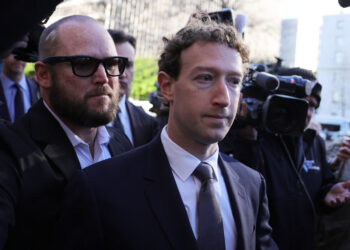
After deliberating for nine days—and emerging at one point to tell the judge that they were having a difficult time reaching a decision—a jury in Los Angeles finally returned its verdict today, finding both Meta and Google liable for creating addictive products that caused a young woman’s mental-health problems.
The two companies were ordered to pay $3 million in compensatory damages: 70 percent by Meta and 30 percent by Google. (Meta-owned Instagram played a larger role in the complaint than Google-owned YouTube, which explains the split.) This is hardly any money to either of these companies—Meta alone brought in nearly $60 billion in revenue over the last three months of 2025. But the verdict will lead others to pursue similar cases against tech companies (thousands are already pending), and possibly result in changes to the design of social-media apps.
Following the announcement of the verdict, Matthew Bergman, one of the plaintiff’s lawyers and the founding attorney of the Social Media Victims Law Center, sent a lengthy statement to reporters. “This verdict carries implications far beyond this courtroom,” it read in part. “It establishes a framework for how similar cases across the country will be evaluated and demonstrates that juries are willing to hold technology companies accountable when the evidence shows foreseeable harm.” A Meta spokesperson sent a shorter statement: “We respectfully disagree with the verdict and are evaluating our legal options.” And the Google spokesperson José Castañeda said that Google will appeal the verdict, adding, “This case misunderstands YouTube, which is a responsibly built streaming platform, not a social media site.”
The plaintiff in this case, a 20-year-old named Kaley, was referred to in case documents by her initials, KGM, because the events she was suing over happened when she was a minor. She originally filed against TikTok and Snap as well, but settled with them before the trial.
The core questions of the case were whether the social-media platforms had been designed to be addictive, and whether a social-media addiction could be said to have played a direct role in causing the mental-health issues that KGM suffered from as a child. In her complaint, she said she had a “dangerous dependency” on the platforms and that they had contributed to her “anxiety, depression, self-harm, and body dysmorphia.”
Today’s news comes right on the heels of a verdict against Meta in another case, brought by the New Mexico attorney general Raúl Torrez, which was announced yesterday. The jury for that trial agreed that Meta should pay a penalty of $375 million for thousands of violations of the state’s consumer-protection laws. The issue at stake there was relatively specific: The state argued that certain design and moderation choices left kids vulnerable to online predators on Meta platforms and indirectly enabled serious crimes. The facts were highly technical, and unlike in the Los Angeles case, didn’t involve qualitative assessments of young people’s personal lives or thorny debates about whether social media can be addictive.
Yet, it was a telling verdict and a massive judgment. Torrez emphasized its significance in a statement to reporters, writing, “New Mexico is proud to be the first state to hold Meta accountable in court for misleading parents, enabling child exploitation, and harming kids.” Meta plans to appeal the verdict, and sent its own statement to reporters yesterday, which read in part: “We work hard to keep people safe on our platforms and are clear about the challenges of identifying and removing bad actors or harmful content. We will continue to defend ourselves vigorously, and we remain confident in our record of protecting teens online.”
[Read: How Meta executives talked about child safety behind the scenes]
KGM’s case was novel because it treated YouTube and Instagram as fundamentally defective products. The issue wasn’t whether bad actors could exploit them, but whether the platforms themselves were dangerous. Online platforms are generally not legally responsible for the content that their users post; Meta, for example, would not be liable for bullying comments or imagery for self-harm posted onto Facebook. But the judge in this case, Carolyn Kuhl, decided that design features such as algorithmic feeds, auto-playing videos, and push notifications were valid targets. Members of KGM’s legal team successfully argued that Instagram and YouTube were created by companies that knew they were addictive and harmful and which chose not to warn consumers.
Though most people would usually think of product liability as applying to things like poisoned baby powder and cars without seat belts, the idea here is that social media can have effects as tangible as those of physical goods, and we should think about it in the same terms. Such metaphors abounded in the trial. Mark Lanier, a member of KGM’s legal team, described social-media companies as lions hunting gazelles, and compared their products to cigarettes, the free tortilla chips that patrons may mindlessly snack on at a restaurant, and the baking soda in a cupcake. The baking-soda metaphor was meant to underscore that Instagram and YouTube had an outsize effect on KGM’s life, the way a tiny teaspoon of baking soda competes with more substantial ingredients such as flour or eggs in a cupcake recipe. But it was KGM’s own account of her experiences that appeared to move members of the jury, some of whom reportedly cried during her testimony.
Coverage of the case had died down significantly after the newsy high-point of Mark Zuckerberg’s testimony in mid-February, but a handful of reporters provided updates from Los Angeles. Both sides found expert witnesses who offered competing accounts of whether social media can literally be said to be “addictive.” The lawyers also told competing stories about what caused this one girl’s mental-health problems.
Whereas Google’s closing arguments focused on whether KGM was actually addicted to YouTube and whether YouTube is more similar to television than it is to social media, Meta’s lawyers emphasized the other problems in KGM’s young life, including her fraught relationship with her mother and her older sister’s hospitalization for an eating disorder. They also called to the stand her former therapists, one of whom said that social media had rarely come up in their conversations. Another said that she believed social media was “a contributing factor” in KGM’s anxiety, though not its primary cause. In his closing argument, Meta’s lawyer Paul Schmidt insisted that KGM’s representation had needed to prove that taking Instagram out of her life would have made it “meaningfully different.” They didn’t do that, he said, though the jury apparently believed otherwise.
The case in Los Angeles was only the first of many—“a brick in a potential wall,” as the Cornell law professor James Grimmelmann put it when the trial began. In fact, Meta and other social-media companies are facing so much pending litigation that it can be hard to keep track of it all. Jury deliberations in Los Angeles were simultaneous with those in New Mexico. The company will be a defendant in another upcoming bellwether trial in the Los Angeles court, this one filed on behalf of a minor identified by the initials RKC, who similarly claims that he became addicted to social media and that it caused him to experience suicidal ideation, body dysmorphia, anxiety, depression, “among other harmful effects.” That one is expected to start this summer. And at the same time, an enormous multi-district litigation incorporating thousands of personal injury suits against major tech companies will proceed in Oakland, starting with a Kentucky school district’s complaint that social media has been so poorly age-gated and so distracting to young students that it has effectively become a public nuisance.
[Read: No one knows exactly what social media is doing to teens]
In these upcoming cases, new juries will be considering entirely new sets of personal facts, but they’ll also be considering the same basic questions about addiction, liability, and cause-and-effect. Of course, future juries may understand those issues differently than those who reported back this week. These questions are complicated, which is why we’ve ended up in the strange situation of hearing them argued in court rooms in the first place. Many have compared this succession of lawsuits to those that took down Big Tobacco in the 1990s; though experts have also pointed out that the comparison between social media and cigarettes is not very exact. (“We’re not talking about a biological substance that you can consume that has a demonstrable chemical effect,” Pete Etchells, a professor of psychology and science communication at Bath Spa University, in England, told me in January.)
Still, it’s clear that social media has reached a fork in the road. The existential questions that all these lawsuits are asking are whether it is possible for social media platforms to directly cause mental-health issues and other serious, life-changing problems for young people, and whether it is feasible to hold the companies behind them accountable for that. The upcoming trials likely will not bring us to a totally satisfying answer on the first, but they will certainly shed a lot of light on the second.
The post A Landmark Verdict Against Meta and Google appeared first on The Atlantic.