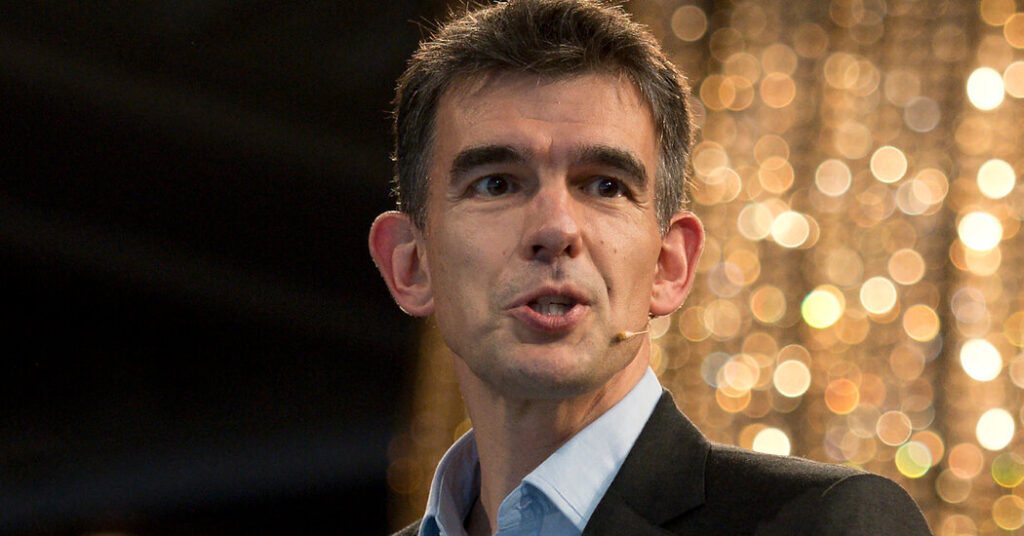
The former head of Google in Europe, Matt Brittin, has been named as the new leader of the BBC, taking the role at a time of immense challenge for the British public service broadcaster.
The BBC said in a statement on Wednesday that Mr. Brittin would start the role on May 18, following the departure of the director general, Tim Davie.
Mr. Davie announced his resignation in November amid a storm of public criticism over a BBC documentary about President Trump, one of a number of crises he managed during his time in the job.
In December, Mr. Trump sued the BBC for $10 billion over the editing of the 2024 documentary, “Trump: A Second Chance?” that the British broadcaster acknowledged had left the “mistaken impression” that he directly called for violent action before the storming of the U.S. Capitol.
The BBC is fighting the lawsuit, rejecting claims that Mr. Trump had reason to sue or that the error was evidence of a fundamental bias in the broadcaster’s news reporting. It recently urged a court in Florida to dismiss the case on the basis that the documentary never aired in the U.S.
With about 21,000 employees, the BBC is one of the world’s leading public service broadcasters and produces a huge range of material, from news and sports to drama and entertainment.
Its funding comes primarily from a license fee paid by Britons who watch TV, supplemented by commercial revenue.
Along with a salary of £565,000, the position of director general has a formidable to do list. Mr. Brittin, 57, arrives from a technology background rather than a broadcast one. The BBC board will hope that is a strength at a time when the broadcaster is competing for attention with digital platforms, including YouTube, which is owned by Google’s parent company.
The rapid shift of audiences to online video platforms has threatened to undermine support for the BBC’s current funding model, which effectively compels some who do not consume much of its output to contribute to its financing. In a significant move, the BBC announced a deal to produce content for YouTube earlier this year.
“This is a moment of real risk, yet also real opportunity,” Mr. Brittin said in a statement. “The BBC needs the pace and energy to be both where stories are, and where audiences are. To build on the reach, trust and creative strengths today, confront challenges with courage, and thrive as a public service fit for the future.”
His appointment also comes at a critical time: The royal charter under which the BBC operates, and which sets out its mission and governance, will expire at the end of 2027.
Under the current system, the agreement is renewed every decade, putting the broadcaster under regular pressure to justify its existence and raising the possibility of political interference. The British culture secretary, Lisa Nandy, suggested recently that a permanent charter would place the corporation on better footing to protect it from becoming “a lightning rod” for what she described as “ongoing, exhausting culture wars.”
Mr. Davie’s period at the helm illustrated how testing the broadcaster’s top job can be. He survived a number of crises — earning the nickname “Teflon Tim” — including the case of Huw Edwards, a prominent news anchor who was convicted of accessing indecent images of children.
The BBC was also criticized last year for having failed to cut away during live coverage of the Glastonbury music festival when the punk duo Bob Vylan led the crowd in chants against the Israeli military.
Mr. Brittin grew up in Britain and studied at Cambridge University, where he rowed three times in the annual Boat Race against Oxford University. He also won a bronze medal at the 1989 World Rowing Championships while competing for Great Britain.
After working for a chartered surveyor, earning a master’s degree at the London Business School and working for McKinsey & Company, he held management positions at Trinity Mirror, a publisher subsequently renamed Reach. In 2007 he joined Google and, in 2014, he became president of its operations in Europe, the Middle East and Africa.
After 18 years at the technology company, Mr. Brittin announced last year that he was taking a break, explaining in a social media post that he wanted to indulge his passion for learning and trying new things.
“I’ve already grown a beard, bought a single sculling boat and plan to learn scuba diving from my son when he qualifies as an instructor,” he added in a post on LinkedIn. He described himself in his profile as a “gap year student” and a “part time athlete” as well as a former Google executive.
On Wednesday his tone was more businesslike in the official statement about his new role. “I can’t wait to start this work,” he said.
Stephen Castle is a London correspondent of The Times, writing widely about Britain, its politics and the country’s relationship with Europe.
The post Former Google Executive Named New Head of the BBC appeared first on New York Times.