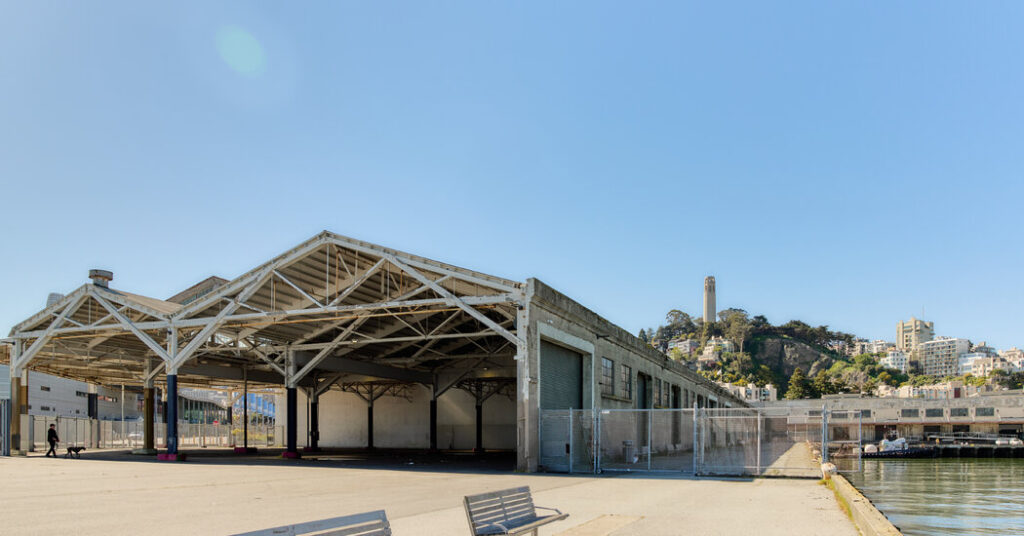
One day in 2022, the writer Dave Eggers was out on his battered bicycle, tooling around the Embarcadero, San Francisco’s waterfront fringe. Rounding a little-used pier with a hulking century-old building, he found an open garage door and peered inside. The building was cavernous, seemingly in good shape, and entirely empty.
That’s all it took for Eggers, the Pulitzer finalist and conjurer of offbeat endeavors, to spin his way into another. For a decade he had been talking with his friend JD Beltran, a San Francisco artist, administrator and educator, about starting their own version of an art school, an apprenticeship model where technique and proximity were priorities, community could build organically, and the price tag was well below the $400,000 that an M.F.A. can now cost.
At Pier 29, they found the home for that idea, and a few more, thanks to the available space: over 100,000 square feet, extending into a sunny pocket of San Francisco Bay. One recent afternoon, Eggers was back on his bike, giving a tour of the project, named Art + Water. The staff members who will run it — a curator, a building reuse specialist, and more — joined in.
Slated to open this fall, it will give free studio space for a year to 30 local artists, across all mediums: 10 who are more established, and 20 who enroll to learn from them, European atelier style, in a program with no tuition or fees. (The mentors were hand-picked by Art + Water leadership; student applications close next month.) It was, Eggers said, a way to tackle “a problem that everybody talks about endlessly here — the mass exodus of artists from San Francisco over the last 20 years.”
But in an artificial intelligence boom-fed city, where apartments are snapped up with envelopes of cash, a lack of studios is not the only stumbling block for an artful life. As Eggers described in an essay in McSweeney’s, plans for Art + Water also include a major exhibition space (the first show is devoted to the Bay Area filmmaker and musician Boots Riley, and curated by an Art + Water co-director, René de Guzman); free or low-cost talks, classes and family events; pop-up shops, and more. The hope is to serve as an example for other areas, in how to become an affordable artistic hub.
With open, interactive access, both San Franciscans and tourists wandering in from the nearby cruise ship terminal can see that they “are part of a creative environment,” said Nicole Avril, a co-director.
This waterfront cultural model is not exactly new — the popular Cherry Street Pier, in Philadelphia, has a similar blueprint — nor is it assured of success. Last year, a free photography museum on Pier 24 closed, stymied by costs and contracts.
Art + Water’s landlord is the Community Arts Stabilization Trust, or CAST, a nonprofit real estate organization that helps develop and maintain affordable places for artists. Though lease terms are not yet finalized, Art + Water expects to pay about 10 cents per square foot for its enormous facility, when the going rental rate for an industrial space is nearly $2 per square foot. (Art + Water plans to use a portion of the space, and CAST the rest, offering its own cultural programming with its partners.)
The two-year deal was negotiated through the Port of San Francisco, a city agency, which “played matchmaker,” said Ken Ikeda, the chief executive of CAST, to unite his group with Art + Water. Though the logistics remain complex, Ikeda said, “Art + Water has the depth of experience” and support that its vision requires.
As a longtime San Franciscan, Eggers is plugged-in; he got to know many local leaders through projects like 826 Valencia, the student writing nonprofit center he co-founded in 2002, which then expanded nationwide. (Beltran, a longtime member of the city’s arts commission, was well-placed too.) Art + Water, a nonprofit organization, will also be supported through donations; it has not yet fully raised the seven-figure sums it needs to outfit and operate the space, “but we have verbal commitments,” Avril said. And the expectation is that it will generate some revenue — like the 826 outposts, which are fronted by kid-favorite shops.
Though the Embarcadero is home to destinations like the Exploratorium museum and the Ferry Building, with its bustling restaurants and farmer’s market, the stretch by Pier 29 was sparsely used. A circa-1915 cargo warehouse, the structure was badly damaged in a 2012 fire, then rebuilt for the 2013 America’s Cup. Since then, it’s mostly served as parking for a lucky few — a waste, the Art + Water team suggested, of a building whose gabled, skylit roof and 33 giant windows allow light to pour in. Jet Martinez, a muralist and one of the teaching artists, already has his eye on a massive, blank back wall as a canvas. “To actually have something purposeful like that” to teach muralism “was super attractive,” he said.
The pitch for Pier 29’s reuse was well-timed, as the city is eager to transform its once-derelict or forgotten corners, especially under the year-old administration of its mayor, Daniel Lurie, who has made revitalization and construction a major goal. Michael Martin, the Port of San Francisco’s acting executive director, said one of its most important missions “is bringing new activity and energy to our historic piers.”
And Art + Water is arriving at a moment when traditional arts education in the area is in flux, or worse: the California College of the Arts, the city’s last remaining private art school, will close next year, to be replaced by an outpost of Vanderbilt University. The San Francisco Art Institute shuttered in 2022. Both had graduated prominent artists, and employed painters, sculptors and others as professors — a whole cultural ecosystem. In her career, Beltran said, that web of connections, along with formal residencies, was an example of “how to sustain my creative practice.”
Watching their institutions fold, and friends flee because of costs, commercially successful artists like Martinez — Facebook’s first artist-in-residence — felt a greater need to help cultivate a scene that newbies could plug into.
Otherwise, starting a creative life in San Francisco “seems like a practical impossibility,” said Ana Teresa Fernández, a multi-media artist and Art + Water’s head of faculty.
Eggers, who trained as a painter early on, was forever frustrated by the way that art has been siloed, or made to seem rarefied, when it didn’t need to be. To learn the techniques of drawing “all you need is a pencil and somebody willing to teach you.”
So the intention for Art + Water is to be “accessible on every level,” he said. “Economically accessible, demystifying, and welcoming — like, ‘Here, this is how we do this. You can do it, too.’”
Melena Ryzik is a roving culture reporter at The Times, covering the personalities, projects and ideas that drive the creative world.
The post A Free Home for San Francisco Artists, From Dave Eggers and Friends appeared first on New York Times.