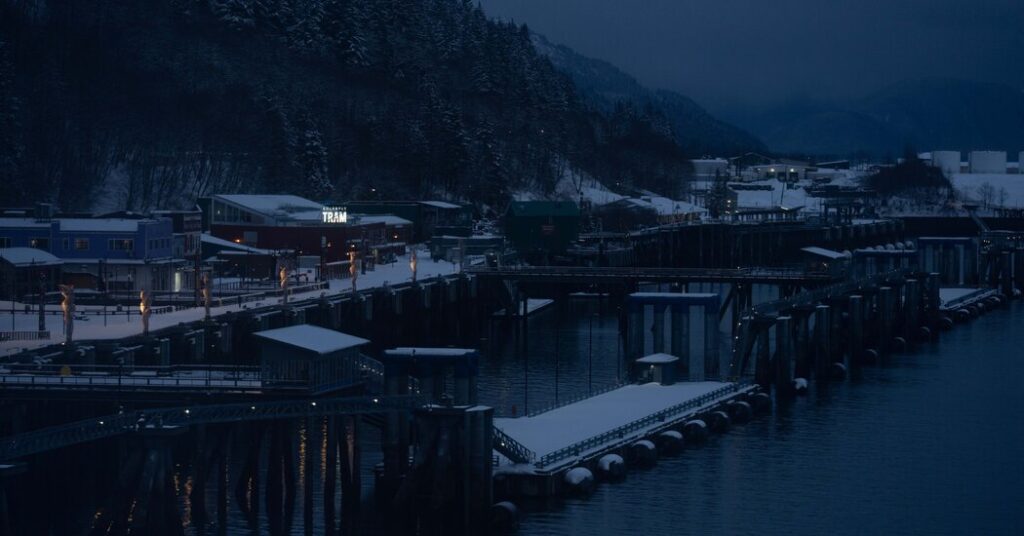
Juneau, Alaska, takes pride in providing services that some larger cities would shy away from — child care and housing assistance, arts grants, three libraries, two public pools, an arboretum, a ski area and a pledge that all 250 miles of borough roads will be plowed, if possible, within 48 hours after a snowstorm ends.
But the system that has made that possible — a steady flow of revenue from oil production — is cracking like Arctic ice in spring, not just in Juneau, Alaska’s capital, but across the state. Even with the war in Iran sending oil prices sky high, the oil-dependent model that has financed generous public services while giving Alaskans annual checks from a Permanent Fund can no longer keep both promises.
And a political year that will include a wide-open governor’s race and one of the most watched Senate contests in the country could help decide the future of what has become known in some circles as a “petrostate,” for its public reliance on oil production, on the brink.
“The petrostate hasn’t quite failed yet,” said Joseph Geldhof, a Juneau lawyer, but “it will if something does not change.”
Anything that increases global oil prices is good for Alaska’s finances, and state economists expect that the Iran war will mean a revenue bump of at least $500 million this fiscal year, as well as a similar windfall next year if the fighting continues.
But that money is essentially already accounted for to fill existing budget gaps, and short-term war gains won’t solve either the immediate problem for Alaska residents — rising gas prices hit them hard, too — or the long-term supply-and-demand fundamentals, such as the spread of electric vehicles in Europe and China, the freeing up of supply from Venezuela and the long-term decline in production along Alaska’s North Slope.
Gov. Mike Dunleavy, a Republican who has spent nearly eight years cutting state government services to protect Alaska’s Permanent Fund dividend, is leaving office this year with one of the lowest approval ratings of any governor, according to recent polls. The crowded race to succeed him coincides with Senator Dan Sullivan’s bid for re-election against a formidable Democratic challenger, former Representative Mary Peltola.
Those elections pose a fundamental question for Alaskans: Will voters opt for more financial austerity in the name of preserving their annual payments and almost nonexistent state taxation, or will they accept a more politically fraught reimagining of the state’s fiscal structure?
The governor called it “a philosophical debate over the role of government.”
“If you look at where we are and how expensive things are here, we just don’t have the ability to do the kinds of things you can do in Texas or Iowa,” Mr. Dunleavy said. “It’s not going to be roads everywhere, schools everywhere, services everywhere. Alaska is a different place.”
The math no longer works, even for the minimal level of services Mr. Dunleavy describes. Nils Andreassen, executive director of the Alaska Municipal League, estimated that one in 10 local governments are now “semi-functioning, unable to keep the doors open for a full year.” He predicted some will eventually close.
Brett Watson, an economist at the University of Alaska Anchorage, agreed.
“Practically speaking, we are probably at the end of our ability to continue to pay a dividend, provide the same level of state services and not broadly pay taxes,” he said.
Alaska’s financial dilemma started in 1968 with the discovery of oil at Prudhoe Bay. Voters and elected leaders created a sovereign wealth fund, whose principal cannot be touched without a vote of the people. They legislated an annual dividend for nearly every resident and abolished the state income tax.
But as oil production has risen, not only in the Middle East but in new parts of the United States, Russia and elsewhere, prices have become more volatile and Alaska’s revenues have plunged.
The war in Iran and Russia’s invasion of Ukraine have offered Alaska politicians reprieves, Mr. Watson said, “but waiting for global disruption isn’t a long-term strategy.”
Alaskan lawmakers now use interest, dividends and investment profits generated by the sovereign wealth fund for government operating costs, and for an annual dividend to residents. That payout peaked at $3,284 in 2022 after Russia invaded Ukraine and oil prices topped $100 a barrel, but it has averaged $1,370 over the last decade.
This year, even before the U.S.-Israeli attack on Iran, the governor asked legislators for $3,600 per person, and he proposed a constitutional amendment to guarantee a dividend in perpetuity.
But such payments now compete directly with core government work like road maintenance, education and prisons. Mr. Dunleavy has used his line-item veto hundreds of times to cut programs and preserve the annual dividend, which he views as “nonnegotiable” because “the people know what to do with their money better than politicians do.”
As state government shrank, local governments either had to go without many basic services or go it alone. Juneau has chosen the second option, using local money to help keep people in a region reachable only by plane or boat, and where prices reflect that remoteness.
“Go take a look at another town that’s 32,000 people, maybe in the Midwest,” said Laura McDonnell, who owns a store selling Alaska-made crafts and jewelry just steps from where cruise ships dock. “How many performing arts centers and libraries and museums and swimming pools do those communities have?”
Plenty of communities subsidize housing construction, said Neil Steininger, who is a Juneau city and borough assemblyman and a former state budget director, “and we extend that to other things because we believe they’re important for quality of life.”
“I don’t skate, and I don’t swim, and I don’t play hockey, but those things are a big part of why I’m here,” he said.
But Juneau has not been immune from Alaska’s anti-tax bug. Last fall, borough voters approved ballot measures that exempted food and utilities from the city’s 5 percent sales tax and capped property taxes. Both were pushed by older residents tired of what they viewed as a disconnect between borough leaders’ focus on offering ample public services and residents’ complaints about affordability.
“The party is over, guys,” said Mr. Geldhof, one of the leaders of the ballot effort. “Time to get serious.”
The consequences are coming into focus. An annual budget gap of $10 million to $12 million will start next year. Meantime, much of Juneau’s reserve funds may be needed to address flooding from the Mendenhall Glacier, the once solid wall of ice north of town that now routinely inundates Juneau’s most populous neighborhoods each summer.
The city is already shrinking. As state government jobs disappear or move to the “rail belt,” the state’s more urbanized interior, which includes Anchorage, tourism is now the town’s largest industry, mainly from cruise ships that come up the Gastineau Channel.
Ella Adkison, 25 and the youngest member of the Juneau assembly, said the dungeon master for her regular Dungeons & Dragons game recently left the state.
“That may sound silly,” she said, “but we’re talking about the things that make a community, the people.”
Many Republican leaders continue to maintain that Alaska is on fundamentally strong fiscal ground: Like a family that is house rich but cash poor, Alaska just needs to make some changes in its financial structure.
“We are as far from a failed petrostate as you can imagine, but we have a revenue problem,” said the co-chairman of the Alaska Senate Finance Committee, Bert Stedman, whose office is decorated with historical photos, maps and MAGA memorabilia.
Mr. Dunleavy said the dividend was created to ensure both that the natural resources fueling Alaska’s economy would belong to its residents and that future legislatures could not spend oil money recklessly.
But lawmakers have not approved his $3,600-an-Alaskan dividend request. Instead, politicians in both major parties hope upcoming elections for governor and Senate will clarify what voters actually want — changes to the dividend, a seasonal sales tax aimed at tourists, an income tax or still more cuts.
“It is going to take a governor willing to put it all on the line,” said Bryce Edgmon, who is the state House speaker and a former Democrat who is now an independent. “Just saying ‘protect the dividend’ is no longer an answer.”
Under Alaska’s ranked-choice-voting system, the top four candidates will advance from an Aug. 18 primary to the November general election. Most of the prominent Republican candidates, including Lt. Gov. Nancy Dahlstrom and the conservative activist Bernadette Wilson, echo Mr. Dunleavy’s calls to protect the dividend at almost any cost. Most of the Democrats support a more substantial remaking of the state’s fiscal structure, including by changing the formula for funding public schools and potentially making oil companies pay more in taxes.
In all, 17 people are seeking the governor’s mansion, which sits in the shadow of Mount Juneau and up a hill from the hard decisions facing Juneau’s civic leaders. As they ponder what to cut, they’re also worried that the current financial crisis, like others in the past, will not be enough to push through real structural change.
Alec Mesdag, who runs the local power company, was pessimistic that the state had learned any lessons from the boom-and-bust cycles of an oil-dependent economy. He grew up in Juneau, left for college and came back to raise a family with his wife, who farms oysters. Their eldest child is leaving soon for college and hopes to return.
“He was duck hunting every day last fall, he skis all winter, he’s outside whenever he’s not working, but he hasn’t had to pay rent here or get on a child care waiting list,” Mr. Mesdag said. “I just don’t know if the Juneau he loves is the Juneau we’re leaving him.”
Anna Griffin is the Pacific Northwest bureau chief for The Times, leading coverage of Washington, Idaho, Alaska, Montana and Oregon.
The post A Critical Political Season Could Decide if Alaska Is a Failed ‘Petrostate’ appeared first on New York Times.