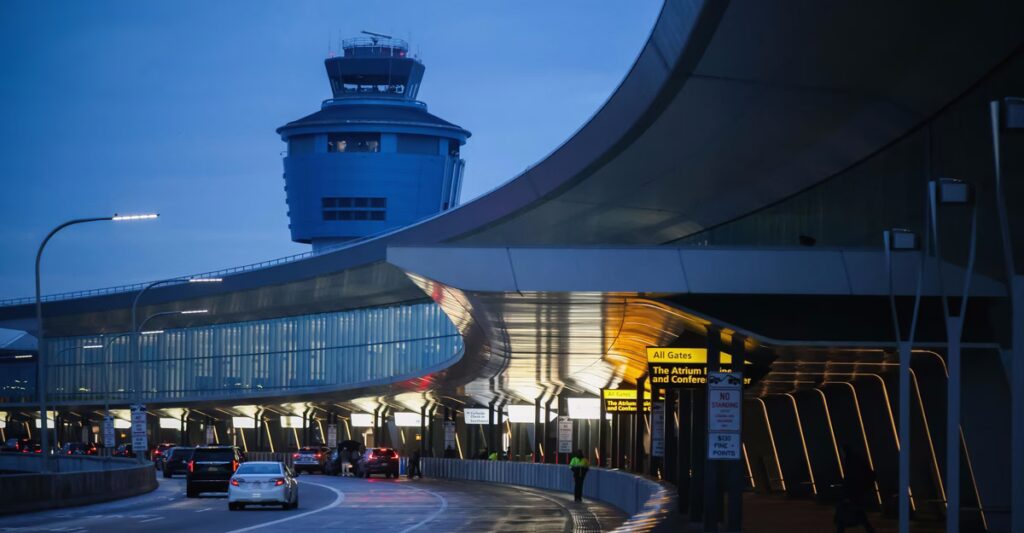
In 20 seconds on the night of March 22, the seamless sequence of arrivals, departures, and holds at LaGuardia Airport—along with all their required calls and responses—was upended. In that brief period, a Port Authority fire truck was cleared to cross runway 4, Frontier Flight 4195 was told to stop taxiing, Air Canada Express Flight 8646 was landing, and the fire truck was frantically told to stop—before it collided with the Air Canada flight, killing the pilot and co-pilot.
In air-traffic-control audio, the same controller is heard communicating with the aircraft and with the ground vehicles. Yesterday, the National Transportation Safety Board said in a news conference that two controllers were in the tower at the time of collision: a controller who was assigned to handle communications within the immediate airspace and for operations on the active runways, and a controller-in-charge who was providing clearance instructions for all departing aircraft. This was standard operating procedure for LaGuardia and other airports for the midnight shift—but which of the two controllers was responsible for ground-control duties, and whether that controller was also handling arrivals in the minutes surrounding the accident, remains unclear. The NTSB noted in the news conference that it has received conflicting information concerning who was covering ground control.
Jennifer Homendy, the NTSB’s chairperson, cautioned against attributing the collision to a controller being distracted. But, she said, the conditions at LaGuardia were “a heavy workload environment,” and the NTSB has raised concerns in other accident investigations about fatigue during lightly staffed midnight shifts.
However standard a two-person shift might be, that a single controller was responsible, even for a short time, for directing so many simultaneous operations is a stark reduction in acceptable safety margins for the airport. An environment like that, especially when diverse events occur in rapid succession as they did Sunday night, can cause what aviators know as “task saturation.”
There are moments in aviation called “critical phases of flight,” such as takeoff and landing, when flight crews have numerous tasks to precisely complete in rapid order. The addition of other duties or unexpected complications—no matter how small—can cause a crew to be overwhelmed and struggle to manage their duties. Air traffic controllers can experience the same sense of being overwhelmed as they direct a varying type and number of activities and operators; a rapid cascade of tasks can quickly become difficult, or even impossible. In these moments of saturation, accidents might happen, and it appears that, on March 22, the combination of arrivals, departures, a declared emergency, and a ground-vehicle response saturated the controller managing the bulk of LaGuardia’s ground and tower operations. In the audio, after the crash, he tells a pilot: “We were dealing with an emergency earlier, and I messed up.” Although the collision occurred at 11:37 p.m., the accident’s origins can be traced back an hour earlier, as both the air-traffic-control audio and early NTSB comments make clear. At 10:40 p.m., right around the time the midnight shift clocked in, United Airlines Flight 2384 aborted a takeoff on runway 13, after a warning light went on in the cockpit; the crew then taxied the Boeing 737 Max 8 around for a second attempt at takeoff, which was also aborted. At that point, a strange odor in the cabin was reported, and flight attendants complained of sudden illness. The crew taxied off the runway and sought clearance to a terminal gate; none was available. Unable to return, they parked on a taxiway and declared an emergency. For the controller handling both ground and tower communications in this period, the United flight’s distress was a significant situation that posed its own concerns. Air traffic control now had to prepare for the possibility of disembarking passengers on the taxiway using an airstair truck and transporting them to the terminal. If a chemical event occurred on the United flight, that could escalate the situation further. After the crew declared an emergency, multiple emergency vehicles began responding, including the truck that would soon collide with Air Canada Express Flight 8646. At the same time, multiple flights were inbound for landing, and Frontier Flight 4195 was taxiing in close proximity to the emergency equipment, which needed to cross runway 4 to reach the United Airlines aircraft.
The controller cleared Air Canada Flight 8646 at 11:35 p.m. as the second to land on runway 4. At that moment, as multiple aircraft and vehicles converged on the same space, he likely found himself experiencing task saturation. After the collision, the controller could be heard calling out to Flight 8646, informing the crew that assistance was on the way. He did not know the two pilots were dead, or that the fire truck and its injured crew were strewn across the runway. Nor did the controller have time to dwell on what happened: He had to immediately inform Delta Flight 2603, the aircraft behind Flight 8646, to climb to 2,000 feet and go around, as runway 4 was now closed. At a news conference on Monday, Secretary of Transportation Sean Duffy characterized LaGuardia as “well staffed”—the staffing target is 37, he noted, and the tower currently has 33 controllers and seven more in training. On Tuesday, the NTSB said it was still investigating how many certified professional controllers were assigned to the facility, what happened at shift change, and whether anyone was available to relieve the controller working at the time of the collision. Normally, Homendy said, the controller would have been relieved, but he was on duty for several minutes after the accident. A spokesperson for the Port Authority, which operates LaGuardia, said the agency could not comment on specifics of an ongoing investigation and was focused on “ensuring investigators have full access and support as they carry out a thorough and independent review.”
As the crash shows, air-traffic-control staffing is crucial to aviation safety. And although the federal government has made efforts to hire aggressively and streamline the process, the United States has fewer controllers than it needs. This situation has not improved in decades, even as flight traffic has increased. The Government Accountability Office documented the ongoing problem in a recent report, which noted that controller attrition and the agency’s ponderous hiring procedures contribute to the long-term problem.
Like many previous presidencies, the Trump administration has also been pushing to modernize the air-traffic-control technology, and on Monday at LaGuardia Duffy reiterated his call for additional funding to the Brand New Air Traffic Control System. (The project was originally funded at $12.5 billion, but Duffy has said it would ultimately cost $31.5 billion.) This latest attempt at modernizing equipment and facilities follows the doomed tenure of the Next Generation Air Transportation System—which ate up 20 years and $15 billion of federal funds before it was canceled in 2024—and of the underfunded and mismanaged Advanced Automation System, which was given 13 years before it was canceled in 1994. After declaring the need for more congressional funding for the Trump administration’s modernization plan, Duffy acknowledged that new equipment would not necessarily have prevented the crash, but said that “if we care about air-travel safety, we care about having a brand-new air-traffic-control system, the best in the world with the best equipment, virtually all of it developed here in America.”
But the “best equipment in the world” doesn’t help if the Federal Aviation Administration doesn’t have enough people trained to use it, or enough people, period. Calls for increased staffing are not new: The 2011 scandal of exhausted controllers falling asleep in towers and an increase in near misses in the 1980s both raised questions about staffing, for instance. Reports of understaffing extend back to the FAA’s early years, when the agency strove to handle the transition from slower propeller aircraft to the faster and more efficient jets that rapidly transformed the industry.
In 1967, the FAA requested about $100 million to both modernize its equipment and hire more controllers. At the time, the agency reported that it had 14,000 controllers and technicians (who maintain the nation’s aviation infrastructure) but that controllers could not keep up with air-traffic increases. They were simply being asked to work harder. President Lyndon B. Johnson denied the request, telling the agency to maintain air safety with its existing funding. (He suggested, in fact, that the agency borrow from its equipment budget.) As one airline source told The New York Times that year, the president “has told the agency not to allow any crashes … He has said ‘make the service fit the system’ instead of ‘make the system fit the service.’” In 2025, the U.S. had 10,800 certified professional controllers and 4,869 technicians, according to their respective unions. That total is shockingly close to the figure from nearly 60 years ago. While air traffic has exploded in that period, staffing has perpetually failed to keep pace. The FAA today has little choice but to resort to the same strategies employed in the Johnson administration: Slow down air traffic, and work controllers harder. When accidents occur, they bring the fallibility of that strategy into stark relief.
The post La Guardia’s Air Traffic Controllers Had Too Much to Do appeared first on The Atlantic.