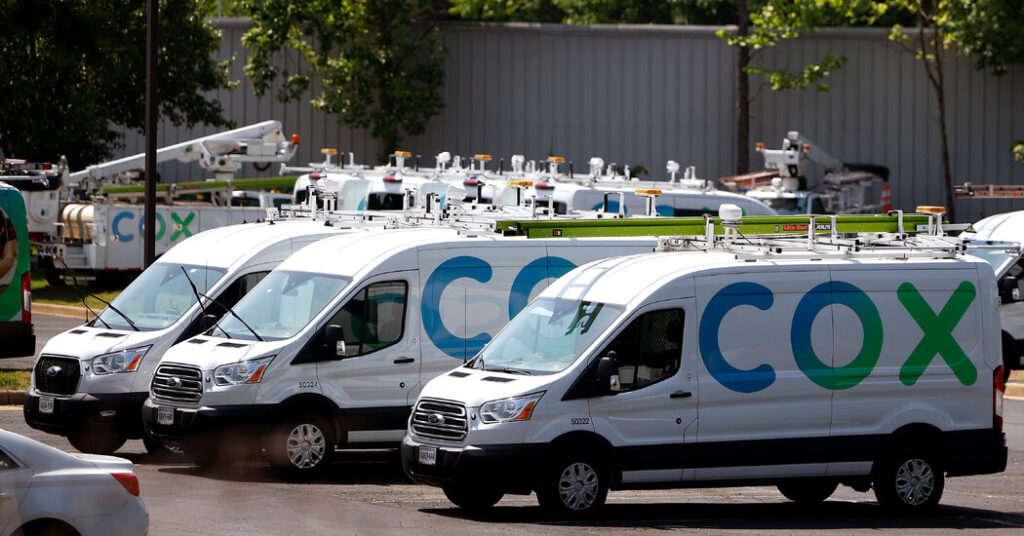
The Supreme Court unanimously said on Wednesday that a major internet provider could not be held liable for the piracy of thousands of songs online in a closely watched copyright clash.
Music labels and publishers sued Cox Communications in 2018, saying the company had failed to cut off the internet connections of subscribers who had been repeatedly flagged for illegally downloading and distributing copyrighted music.
At issue for the justices was whether providers like Cox could be held legally responsible and required to pay steep damages — a billion dollars or more in Cox’s case — if they knew that customers were pirating music but did not take sufficient steps to terminate their internet access.
In its opinion released on Wednesday, the court said a company was not liable for “merely providing a service to the general public with knowledge that it will be used by some to infringe copyrights.”
Writing for the court, Justice Clarence Thomas said a provider like Cox was liable “only if it intended that the provided service be used for infringement” and if it, for instance, “actively encourages infringement.”
Justice Sonia Sotomayor, joined by Justice Ketanji Brown Jackson, wrote separately to say that she agreed with the outcome but for different reasons.
Courts have long held that people can be liable for providing another person or entity with the tools to commit copyright infringement. Two decades ago, for instance, the Supreme Court unanimously ruled that the file-sharing company Grokster could be held responsible for the violations of its users.
But in a pair of more recent cases in 2023 unrelated to copyright law, the justices declined to hold technology platforms liable for problematic content posted by their users, but did not ultimately resolve the question of whether platforms are ever responsible for such content.
In the Cox case, free speech advocates urged the Supreme Court to side with the internet provider, warning of a chilling effect on free expression if internet companies could be on the hook for hefty penalties for the actions of their users. The advocates argued that such a ruling could result in speech-related lawsuits against other kinds of intermediaries, including bookstores and social media platforms.
Cox Communications provides internet service to more than six million homes and businesses in more than a dozen states. During oral arguments in December, justices from across the ideological spectrum raised concerns that siding with the music industry could result in internet providers like Cox being forced to cut off access to large account holders such as hospitals and universities because of the illegal acts of individual users.
While music piracy is not the existential threat to the business that it was when the internet was newer — before paid streaming services became popular — the industry’s lawyers told the court that illegal uploading and downloading of music had become faster than ever and continued to rob artists of their exclusive rights.
They said that Cox had ignored bad actors, helping 60,000 users distribute more than 10,000 copyrighted songs for free in order to keep subscriber payments flowing. In 2019, a jury found Cox liable for all 10,017 songs at issue and awarded Sony $1 billion in damages. The company appealed.
The U.S. Court of Appeals for the Fourth Circuit upheld the jury’s finding against Cox, saying there was sufficient evidence that the company was to blame for copyright infringement on its network.
But the court ordered a new trial on a separate issue and vacated the $1 billion judgment, saying Cox did not profit from subscribers downloading and distributing the copyrighted songs.
The Trump administration backed Cox’s position, citing the government’s interest in ensuring broad availability of communications services online.
Ann E. Marimow covers the Supreme Court for The Times from Washington.
The post Supreme Court Sides With Internet Provider in Copyright Fight Over Pirated Music appeared first on New York Times.