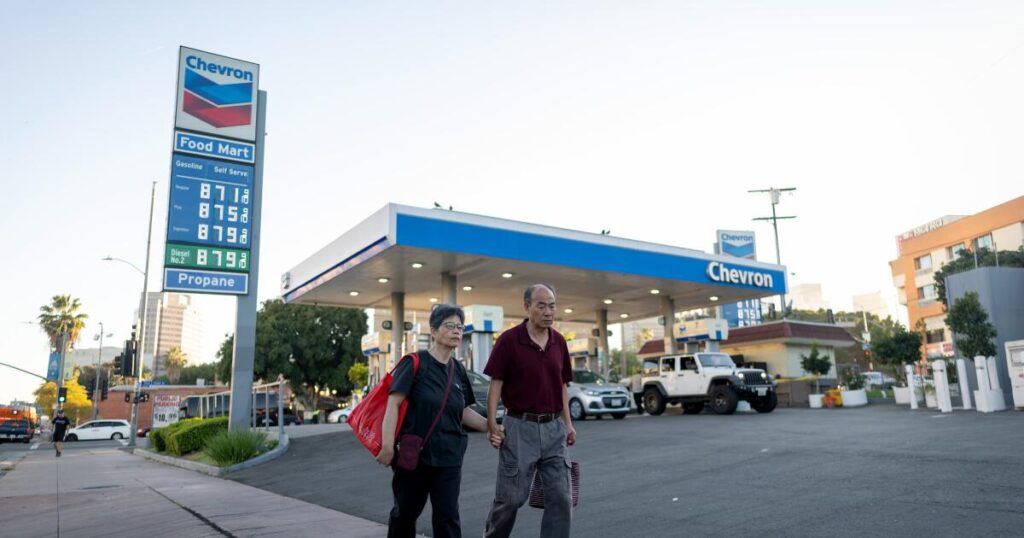
The drab Chevron at the edge of Chinatown always makes the news. It’s one of those Los Angeles gas stations that garners gasps, even shrieks, from Angelenos shocked by the cost per gallon, which is perpetually priced above other pumps across the city.
The price of gasoline has surgedsince the U.S. and Israel attacked Iran more than three weeks ago. Californians, who consistently face some of the highest prices in the nation for fuel due to taxes and clean air rules, are certainly feeling the ripple effects.
But the infamous gas station at the corner of Alameda Street and East Cesar Chavez Avenue across from Union Station on Thursday afternoon was busy nonetheless, with a a steady stream of customers.
For decades now, the station has been the place news photographers, camera crews and now social media influencers go when prices spike. It looks like any other gas station, until you check out the price-per-gallon on the digital sign.
The war in Iran, which has roiled the oil market, has made this Chevron arguably the world’s most famous.
One customer who would provide only his first and middle names, James Michael, was one of the former, having driven into town from Upland with his girlfriend for a concert at the Hollywood Palladium. He navigated to the nearest station expecting high prices he said. But $8.71 for regular?
“I assumed it would be really high prices given what’s going on in the world,” Michael said. “But it’s really expensive. That’s the most I’ve paid for as long as I can remember.”
In California overall, the price of a gallon of gas hit $5.37 last week, up 82 cents from a month ago, according to AAA. In the Los Angeles area, it was $5.72. But at this specific Chevron, prices are head and shoulders above surrounding pumps, hovering at $3 more.
As a result, the gas station’s pricing has for years served as the perfect backdrop for quick-hit TV news spots, with reporters from local and national news outlets regularly standing in front of the sign while discussing oil and gas prices or government polices that affect the cost of a gallon.
Apparently the gas station’s owners have had enough with all the attention from reporters, TikTok personalities and other gawkers. As customers were being interviewed pumping gas Thursday, an attendant approached a Times reporter and asked them to leave, noting it was private property. The attendant gestured toward the sky, saying that “the boss” was watching on camera and would not hesitate to call security.
The gas station is owned by Hawk II Environmental Corp., run by a Whittier man named Joe Bezerra Jr. Bezerra did not respond to a request for comment.
AAA spokesperson Kandace Redd said gas prices can vary widely from one neighborhood to the next, with higher rent, wages and operating costs often passed along to drivers. Thus, she said, gas stations in busy areas near highways, airports and busy tourist destinations such as downtown L.A. tend to charge higher prices.
Besides operating costs forcing up prices, stations “may even charge a little bit more for convenience,” Redd said. Corner locations that allow customers to easily enter, fill up and exit easily attract more drivers and allow businesses to then raise their prices without driving away customers.
“People tend to choose the most convenient gas station especially when they need to save time, and are not necessarily thinking about saving money,” Redd said. “Location is key.”
The Union Station Chevron is one of several in L.A. known for fuel sticker shock.
Charles Khalil, owner of the Mobil on La Cienega across from the Beverly Center — another L.A. gas station known for its high prices — said the plots of land gas stations occupy cost millions, with the value varying greatly depending on the desirability of the location. He said he and other independent owners make high payments on loans they took out to purchase properties, with the monthly payment for his La Cienaga station at around $28,000.
Meanwhile, even as major fixed costs remain, the volume of gas sold has trended down with the rising popularity of electric vehicles, Khalil said. About a decade ago, his station sold more than 150,000 gallons per month, sometimes hitting over 200,000 gallons. But that volume has dropped to about 40,000 gallons per month sold.
Khalil said that drop is typical for stations across California, Arizona and Nevada he has worked with through the marketing consulting firm he runs out of his Torrance office; it negotiates snack and drink prices with big companies such as Coca-Cola and Frito-Lay on behalf of the gas stations.
He doesn’t see prices inching up as taking advantage of customers, saying gas dealers simply react to crises, such as the Iran war, that are out of their control.
“Always when there’s a crisis like this, owners get nervous about making a living. They look at the price, and know people are going to buy less, that volume is going down. They get nervous, and go a couple cents higher, just trying to cover the loss that’s coming,” Khalil said.
Khalil has been in the gas station business for more than 50 years, having taken a job at a station soon after moving to the U.S. from Lebanon in the late 1960s. The La Cienega Boulevard gas station, which Khalil has operated since 1990, was charging $7 per gallon on Monday, according to the website GasBuddy.
Back on the other side of town back near Union Station, two cars stopped at the station with their blinkers on during a Thursday afternoon stop. One of the drivers, a woman with a small dog in her lap, spoke to the other driver through her window for a few minutes, catching up. Neither of them purchased gas.
Of the few drivers who did buy gas while a Times reporter was there, most didn’t appear to fill a whole tank, instead topping off a few gallons.
Among them was Keith Moore, 58, an employee at the nearby Twin Towers Correctional Facility who said he would fill about eight gallons to get him back to his residence in Hawthorne.
“I hate coming here. But sometimes I have no choice,” Moore said.
The post When gas prices spike, the world focuses on this L.A. gas station to vent its rage appeared first on Los Angeles Times.