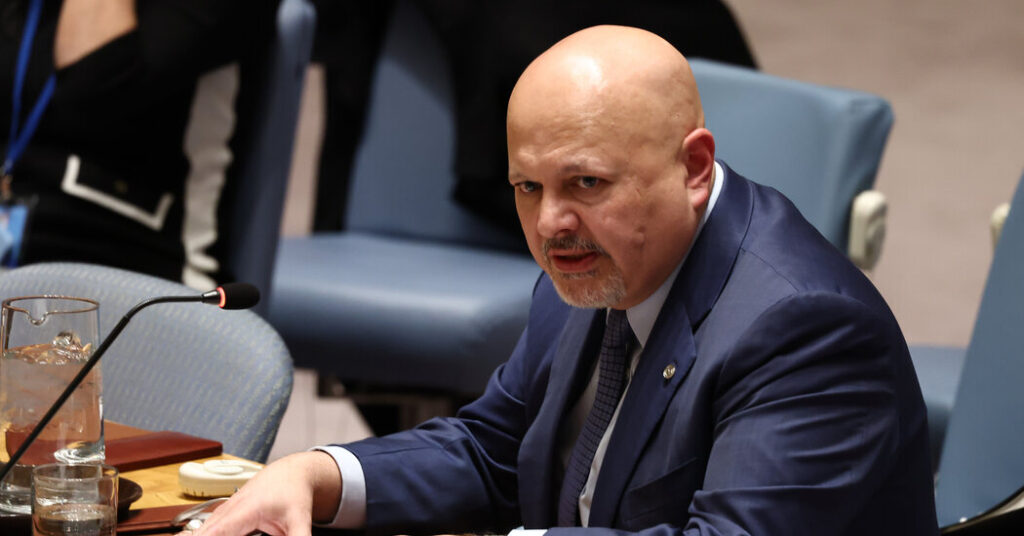
For more than a year, the operations of the International Criminal Court have been left in limbo amid global crises as the institution has investigated sexual harassment allegations against its chief prosecutor, Karim Khan.
That case has reached a critical juncture. A team from the United Nations has investigated the allegations at the court’s request. Their findings were then reviewed by a panel of judges who evaluated the evidence.
Though the U.N. investigators found evidence that Mr. Khan engaged in “non-consensual sexual contact” with a woman on his staff, the judges determined unanimously that the evidence did not meet the legal standard for misconduct. The New York Times obtained a copy of the judges’ report, which summarized the investigators’ findings but did not include the full document.
This week the executive body that runs the court began weighing the conflicting views of the evidence in a disciplinary process that is continuing. If the body decides that Mr. Khan engaged in serious misconduct, the court’s 125 member states will then vote on whether to remove him from office.
The drawn-out wrangling over the accusations against Mr. Khan comes at a perilous moment when multinational institutions and the basic structures of international law are under assault.
The Trump administration has imposed sanctions on multiple court officials, including Mr. Khan, in retaliation for investigations of the U.S. military and arrest warrants issued for Prime Minister Benjamin Netanyahu and other top Israeli officials for their conduct of the war in Gaza. Administration officials have threatened to impose sanctions on the court itself, threatening to undermine its ability to function.
Mr. Khan, who has consistently denied the accusations, stepped down temporarily last year pending the outcome of the investigation.
Adam Tudor, Mr. Khan’s lawyer, said in an email that “it would clearly be inappropriate for Mr. Khan to comment” on the judges’ report. But he said that the U.N. report’s underlying evidence ran to 5,000 pages and that it “cast very serious doubt on the (false) allegations” against his client.
Mr. Khan’s accuser told The Times that she could not comment on details of the ongoing investigation and that she had not seen either report, but she said she had provided evidence and had given full explanations and descriptions of events to investigators in hours of interviews. The Times is not identifying the woman by name to preserve her privacy because her accusations concern sexual misconduct.
Ezequiel Jimenez Martinez, the author of a recent book on International Criminal Court governance, said that relevant international labor laws required the judges to apply a standard of “beyond a reasonable doubt” when assessing the evidence.
That standard can be difficult to meet in sexual misconduct cases, because the allegations often have little evidence other than the testimony of those involved.
But, he said, he would be “very surprised” if the court’s executive body rejected the judges’ view that the evidence did not meet the threshold for misconduct — meaning that their advisory opinion could pave the way for Mr. Khan to remain in his job.
Little is clear cut.
The investigation and review process were put together specifically for this case, which resulted in an unusual procedure that had been “not transparent, made up and novel,” Mr. Jimenez Martinez said.
A ‘Fog’ of Uncertainty
The judges’ report is only one part of a lengthy disciplinary process and their view now indicates a schism in the investigation.
According to the summary included in the judges’ report, the U.N. investigation found evidence that Mr. Khan had “non-consensual sexual contact” with a junior employee, and that he retaliated against two other employees who reported her allegations to the court after she confided in them.
The panel was made up of Paul Lemmens, a former judge in the Belgian Council of State and the European Court of Human Rights; Seymour Panton, retired president of the Court of Appeal of Jamaica; and Leona Theron, a judge of the Constitutional Court of South Africa.
They expressed frustration with the quality of the U.N. investigators’ work, saying that their failure to make determinations about witnesses’ credibility had left “the panel in a fog of factual uncertainty.”
“They did not indicate which witnesses’ testimonies were found credible, and which ones were rejected,” the judges said. “They did not resolve narrative inconsistencies and discrepancies, did not weigh inculpatory against exculpatory materials, and did not thoroughly test witnesses’ motive or bias.”
The outstanding questions “do not disprove the allegations of misconduct,” the judges said, but they limited the facts they could use to reach a judgment.
Asked about the judges’ assessment, the U.N. Secretary-General’s spokesman, Stéphane Dujarric, said in an email that “the United Nations is not in a position to comment on ICC internal processes.”
The legal bar for finding misconduct when a disciplinary action is in question is “super specific and very strict,” Mr. Jimenez Martinez said. But it aligns with what has been used in disciplinary proceedings for other high-ranking officials at various United Nations agencies.
Other cases involving sexual harassment or misconduct, such as lawsuits filed by victims against their employers, typically use a much lower standard of proof that requires the plaintiff only to show it is more likely than not that the misconduct occurred.
Alex Vuillemin, the executive director of the Women’s Initiatives for Gender Justice, a women’s rights group, said that her organization was concerned by the high standard of proof used by the judicial panel, which she said amounted to a “trial-level burden.”
Conflicting Accounts
The judges’ report states that Mr. Khan “would not confirm” whether he had a sexual relationship with the woman on his staff during his interviews with U.N. investigators and that he denied allegations of sexual misconduct.
A description of the U.N. investigation in the judges’ report states that the woman who made the allegations was working under Mr. Khan as a special assistant at the time.
In her interviews with investigators, according to the judges’ description, she described escalating sexual overtures from her boss: First over-familiarity during a work trip to London, then touching in his office that turned into instances where “he would grab and paw at her breasts, try to access her pelvic area, and suck on her ear or neck.”
Eventually, according to her account, that progressed to sexual activity, both in his office and later on work trips. “The power dynamic between them meant that she could not say no to Mr. Khan,” the report says she told investigators.
But Mr. Khan pushed back on those claims in various ways. Among them, he “indicated that allegations of sexual harassment on missions are implausible given the security details surrounding him,” the report said.
In a statement, Mr. Khan’s attorney said that “Mr. Khan’s submissions during the process made clear his firm denials both of any non-consensual sexual conduct and of any consensual sexual relationship.”
The woman in the case eventually told colleagues, family and friends about the situation, though initially, her disclosures “tended to be piecemeal, indirect, and not explicitly accusing Mr. Khan of misconduct,” according to the judges’ report. That changed after April 2024, when she told her husband and a few colleagues.
Those colleagues decided to report the situation, but first alerted Mr. Khan that they were going to do so, according to the report.
During that conversation, in early May 2024, Mr. Khan fretted that the allegations would wreck his career, witnesses told the U.N. investigators. One witness said Mr. Khan initially did not offer a defense, but jumped at the “lifeline” of an alternative narrative when another colleague present said he “suspected whether Mossad played a role behind the scenes,” the report said.
At the time, Mr. Khan and his team were investigating Mr. Netanyahu, the Israeli prime minister, and other top Israeli and Hamas leaders. Several weeks later, Mr. Khan sought arrest warrants against them.
The report states that “multiple accounts discredit the suggestion” that his accuser was linked to Mossad, the Israeli intelligence service. The woman herself told The Times that she had undergone numerous security reviews as part of her work at the court and if there was any concern she would have been dismissed.
While the report notes that multiple witnesses agreed that the accuser “had not benefited” from complaining about Mr. Khan, the panel of judges pointed out that she had been offered opportunities to leave her position working for him and had not taken them.
The accuser told investigators that two colleagues had advised her to decline a transfer so that Mr. Khan would not “view her as a threat.” However, the investigators apparently did not ask those colleagues to corroborate those claims.
According to the judges’ summary, she also sent Mr. Khan messages, including an unsolicited: “Glad to be back on mission with you” about a work trip they took together.
The panel of judges noted that she offered explanations for the messages but “appeared keen to go on missions with Mr. Khan at a time when, according to her, he was subjecting her to severe sexual harassment and assault.”
The judges noted that there was conflicting evidence and that witness statements had raised questions about the credibility of the accuser, though multiple witnesses also said they found her credible.
The investigators, the judges wrote, failed to resolve those questions in their report.
Marlise Simons contributed reporting from Paris.
Amanda Taub writes the Interpreter, an explanatory column and newsletter about world events. She is based in London.
The post Sexual Misconduct Report Leaves I.C.C.’s Path Ahead Unclear appeared first on New York Times.