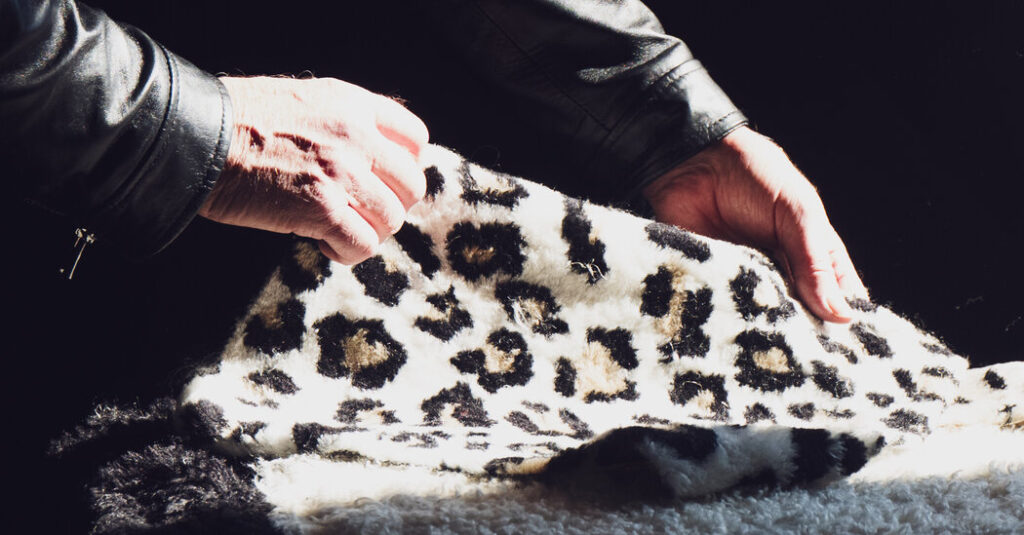
Around the age of 4, Roni Gamzon had a faux-fur coat that she wanted to wear “everywhere,” she said.
It was white with black, inkblot-like spots — as if Cruella de Vil had skinned some Dalmatian puppies — and she thought a lot about that look after a meeting with Martin Stübler, a bioengineer, and Steven Usdan, a textile recycler, in 2022.
Ms. Gamzon, now 26, grew up between Tel Aviv and Singapore, and studied computer science. At the time of the 2022 meeting, she was developing a fashion-tech start-up to help the luxury fashion world engage with Gen Z.
But she wanted to move into fashion sustainability, and thought that the area in which one could have the “biggest impact” was textile innovation.
Mr. Stübler, 35, who had worked for MycoWorks, famous for making mushroom leather, and Mr. Usdan, 64, a founder of Giotex, the textile waste recycler in Mexico, were developing an alternative to animal and synthetic fur.
Fur is, of course, a long-documented (and at times debated) animal welfare issue. But there is also the environmental aspect: Pelts are treated with a variety of chemicals, and faux fur, like that of Ms. Gamzon’s childhood coat, is almost always made from polyester and acrylic, which are plastics.
Ms. Gamzon had met Mr. Stübler that year at a sustainability conference for start-ups in Paris, where he showed her handmade swatches of prototype plant fur. “It stuck with me,” she said. “This needs to be in the world.”
In 2023, Ms. Gamzon helped Mr. Stübler and Mr. Usdan found BioFluff, a fashion-tech company based in New York and Paris that makes plastics-free fur, shearling and fleece from plants and silk. (Mr. Stübler exited this past summer.)
On a cold morning in February, at an office inside la Maison des Start-ups — an incubator run by LVMH to foster innovation, including BioFluff’s, in the luxury sector — Ms. Gamzon, now the company’s chief commercial officer, petted a swatch of spotty fur made from flax and inspired by Dalmatians.
“It was one of the first things I wanted to do,” she said with a laugh.
The Right Puff
Early on, Ms. Gamzon talked to designers about how the faux fur — which she named Savian, after the Hebrew word sometimes used to describe the fluffy white seed head of dandelions and groundsels — should look and feel. The things that always came up were the level of shine and the “softness and puffiness,” she said.
BioFluff worked up a material that was more voluminous than the prototype and then introduced Savian in late 2023 at COP28, the U.N. global climate summit, in collaboration with the designer Stella McCartney, who used it for a long black coat. In 2024, the Danish brand Ganni exhibited versions of its Bou bag made with Savian. (Neither product was produced for retail.)
BioFluff now has two fur lines, with products backed on viscose: Savian Naturals, made from plant fibers like hemp, flax and nettle that are sometimes blended with lyocell, a rayon fiber; and Savian Silks, made from silk fibers. (While making silk normally involves killing silkworms, the company’s look book notes the material’s “broad acceptance” even among animal-conscious brands.) A planned third line, a plush, will target the stuffed toys market.
And while BioFluff says that Savian Naturals is the world’s first 100 percent plant-based fur, the Shanghai-based faux furrier Ecopel has in recent years been working on similar options. Ecopel released Flur — a faux fur made from nettle fibers — in the spring of 2024. Ecopel’s sustainability manager, Arnaud Brunois-Gavard, said in an email that the material was still available but that its development was “on pause” while the company focused on options that allowed for a “greater variety of fur.”
In 2019, Stella McCartney developed a faux fur with Ecopel and the American chemical company DuPont that was 37 percent derived from corn-waste fibers. That material — which was retired last year — was replaced with Bio Fur, a wholly biopolymer-based offering, derived from certain plant waste that is turned into polylactic acid, a bioplastic. BioFluff says they do not use such bioplastics.
BioFluff makes Savian with retrofitted machinery at existing textile mills outside Florence, Italy.
Savian’s textures are inspired by animals — with names like Dalmatian, Cheetah, Bambi, Pony, Wolfy and Beaver, and with colorways ranging from cherry and coral to caramel and steel gray — but Ms. Gamzon said the goal was not for the faux furs always to look and feel like actual pelts (or plastics, for that matter); instead, the material can be “its own thing,” she said, “like a veggie burger.”
Mr. Usdan, BioFluff’s chief product officer, said he saw a lot of fatigue today around ecologically innovative textiles, owing not simply to green-washing, but also to fashion over-focusing on words like “recyclable” and “biodegradable” and banking on “magic-bullet solutions.”
What matters is the “practice around materials” at every stage, he said.
A preliminary third-party life-cycle assessment, commissioned by the company in 2023 with a grant, indicated that the carbon emissions associated with BioFluff’s plant fur were at least 75 percent below those of plastic fur, Mr. Usdan said. (Life-cycle assessments determine a product’s environmental impact over its life cycle.)
In a landfill, Savian can biodegrade within a few years, he added, whereas polyester and acrylic fur can take centuries to biodegrade. Savian can also be industrially composted within 12 weeks.
But real-world industrial composting of biodegradable fashion, which requires infrastructure ranging from waste collection and sorting operations to appropriate facilities, is “not going to exist any time soon,” said Annie Gullingsrud, the chief strategy officer at Trashie, a textile and electronics donation platform. This is owing in part to a dearth of the necessary infrastructure, she said.
Ms. Gullingsrud said she had reckoned with the work around developing sustainable materials that she and her colleagues were doing a decade ago: “We were dreaming. I had to learn to focus on the things with the most impact potential.”
There are two chief sustainability problems in fashion, as she sees it: “The CO2 problem” and the “waste problem” — or what to do with the dumped garments.
“The fur-coat category is minuscule,” she added, and unless BioFluff can produce Savian as cheaply as polyester, and unless it finds wider use for its products, the company is likely to have “very little impact” given the output of companies like Amazon, Shein, Temu and Quince, she said.
An Inflection Point
BioFluff is opening its first showroom in Paris this week, and Savian has appeared on several runways this season. This watershed moment comes at a time when animal fur has more or less fallen out of favor in the fashion world.
Kering, the group that owns Saint Laurent and Balenciaga, went fur-free in 2022. Oslo, Helsinki and Amsterdam had all banned animal fur at their fashion weeks by the time the British Fashion Council banned fur at London Fashion Week in 2023. A ban on fur at Copenhagen Fashion Week and a ban on sales of new fur in California went into effect that same year.
In October, Condé Nast decided against using fur in the editorial content and advertising of its brands, including Vogue. This month, the Television Academy banned fur from the Emmys red carpet, and a fur ban at New York Fashion Week — which the Council of Fashion Designers of America voted on in December — goes into effect in September.
While Ms. Gamzon said that BioFluff saw a “spike in interest” after the council’s ban, the designer Aurora James noted in February that vintage fur was also seeing a “crazy uptick.” She added: “I think the ban was really funny timing because every girl I know is trying to find, like, the best vintage fur coat right now. I don’t think people necessarily saw that coming.”
Ms. James — a co-vice chairwoman of the CFDA — did not support the group’s fur ban. In an essay on Substack, she described it as “antiquated” and discussed the nuances of vintage fur, factory-farmed fur and fur from artisan and Indigenous communities. (The CFDA approved her request for a cultural carve-out for Indigenous people.)
She also questioned the distinction between fur and leather. “The issue, for me, is the same as with meat,” she said. “How are you procuring this thing? What are its long-term impacts on the world?”
Alternative Fur in the Real World
Collina Strada is the first runway brand to sell pieces made with Savian, which was featured in its Fall/Winter 2026 runway show during New York Fashion Week in February. Hillary Taymour, the designer behind the New York-based vegan brand, described Savian as “such a good alternative.” She met Ms. Gamzon at a Climate Week round table in New York last fall. After receiving swatches of Savian Naturals at Christmastime, she placed an order in early January.
“We sewed it up roughly, gathered it, put it to a test — it sews up like normal material,” Ms. Taymour said. “It’s super soft. It hits all the check marks.” Her collection included a hood ($400), a muff/bag ($540), a wrap ($1,080) and a jacket ($1,350) made with brown Wolfy, as well as one of the brand’s Paw Paw coats in snow-leopard-patterned Pony that she overlayed with plaid organza ($2,700). The standard material costs $20 to $53 a meter and is “expensive compared to midrange polyester furs,” Ms. Taymour said.
Martine Rose, a men’s wear designer, used some Savian (which she said over email she loved “for its aesthetic”) across her Fall/Winter 2026 jersey, denim, sportswear and outerwear pieces. There were detachable fur collars and some “party sleeves” made in cherry-colored Mongolian, BioFluff’s answer to wavy East Asian sheepskin.
And Louis Vuitton used the Wolfy version of Savian for a vest in its Fall/Winter 2026 women’s wear collection at Paris Fashion Week. (The garment also uses polyester fur.)
Ms. Gamzon acknowledged that this wasn’t an easy field to get into, and that BioFluff had experienced a number of near misses. For example, she said, “all the creative director changes” at many of the major design houses “have made the process very difficult.” But she remains optimistic “that next Fall/Winter is going to be even stronger.”
Seeing more of their product on runways and in stores would be welcome, she said. “We’ve had our heart broken a lot.”
The post Your Next Fur Coat May Be Growing in a Field appeared first on New York Times.