The landmark housing package that passed the Senate with broad bipartisan support this month is loaded with measures to make it easier to build housing faster and cheaper — a critical step toward dragging the country out of a punishing housing crisis.
But there is one type of dwelling that the bill could create fewer of: single-family houses built as rentals.
One of the provisions among the 40 bills that make up the 21st Century ROAD to Housing Act would curb the role that institutional buyers play in the housing market, and that includes the build-for-rent industry. The bill would set new restrictions on investors who own 350 or more single-family rental homes, requiring them to sell newly built units to individual owners after seven years, or face stiff fines.
Now, with the legislation back in the House awaiting a vote, critics are urging lawmakers to drop that build-to-rent restriction, arguing it would counter the intent of the bill, making it harder, not easier, to build homes when the country desperately needs them.
That the bill treats one housing type as a special case shows how tethered lawmakers are to an ideal in which single-family houses are owned by the people who live inside them — an American Dream, requiring protection in federal law.
“It is as if the bill views renters as being not deserving of a single-family lifestyle,” said Ryan Smidt, chief executive of Clay Residential, a Houston builder of single-family rental communities in Texas.
Supporters of the provision point out that homeownership is a critical path to creating generational wealth. They argue that if builders turn their attention to creating tracts of rental homes, it will come at the expense of new starter homes, which have not been built at scale for years.
“Build to rent is essentially home builders switching their construction from building homes for people to building homes for large institutional investors,” said Jim Baker, the executive director of the Private Equity Stakeholder Project, a watchdog organization focused on the impact of institutional investors. “It puts homeownership further out of reach for individuals,” denying them an opportunity “for building wealth for themselves, their families and their children.”
The industry that builds single-family-home communities specifically for renters is relatively new and surprisingly robust — a reflection of high costs and changing demographics. Home prices have risen about 50 percent since the pandemic, pushing ownership beyond the reach of many households. The desire to live in a single-family house remains, however. Most apartments in the United States have two or fewer bedrooms, making them too small for many families. All this has created a gusher of demand for suburban homes for rent.
At an industry conference in Nashville last week called IMN’s Build-to-Rent trade show, attendees fumed at the plan to require builders to sell rental houses to individuals. “If this bill passes as is, I can’t really grow,” said Richard Ross, the chief executive of Quinn Residences, which owns about 5,300 single-family houses in rental communities across the Southeast.
Like many homebuilders, Mr. Ross finances his projects by bringing on investors who want the option to sell their stake down the line. Since large institutions like pension funds and private equity firms are the largest buyers of real estate assets, the seven-year clause essentially blocks the “exit” that developers need to convince early-stage investors who fund construction. Without a way to get out, those early investors might be unwilling to get in.
In a speech this month, Senator Brian Schatz, Democrat of Hawaii, assailed the seven-year clause as “bananas” and said it would “demonize people who want to build rental housing for folks.”
The provision, written by Senator Raphael Warnock, Democrat of Georgia, has the support of the legislation’s co-sponsors, Senators Tim Scott, Republican of South Carolina, and Elizabeth Warren, Democrat of Massachusetts.
The future of the entire housing package, however, is uncertain. House members have balked at several parts of the legislation, including the build-to-rent restrictions, and President Trump has expressed lukewarm support for it. In recent days, House and Senate leadership have suggested the package could go to a bicameral conference, a step that could delay passage indefinitely.
Homes for People, Not Corporations
Smaller investors have long rented out single-family houses. Until the Great Recession, however, institutional investors had generally stayed away from the market. That is because unlike apartments, which are geographically concentrated with common systems and maintenance schedules, single-family homes tend to be spread out, with a hodgepodge of designs and floor plans that make them hard for a large company to manage efficiently.
That changed after the late-2000s housing bust, when home prices fell so precipitously that investors could often buy foreclosures for less than they cost to build. Enticed by bargain prices, private equity firms including Blackstone Group began buying tens of thousands of single-family houses and renting them to tenants.
The purchases were encouraged by the Obama administration to stabilize a collapsing housing market. At the same time, a new industry of large single-family-house landlords was created. When prices recovered, investors kept buying — leading to charges that private equity was crowding out home buyers with cash offers.
America has a lot of houses, and on a national basis, large investors are only a tiny sliver of the market. Institutions with more than 350 units own less than 1 percent of the 92 million single-family houses in the country, according to John Burns Research and Consulting. But because investors have a tendency to crowd into the same markets, the share is higher in a number of metropolitan areas — as high as 5 percent in markets like Atlanta.
Several states, including Georgia, Tennessee and Californias, have passed or considered bills to prevent large investors from owning more than a few hundred single-family houses. In his State of the Union address, Mr. Trump called on Congress to permanently ban investment firms from buying up single-family homes.
“We want homes for people, not for corporations,” the president said.
This is a rare point of commonality between the president and Senator Warren. On CNBC, Ms. Warren said that investors could build “as many apartment houses, as many condo complexes, as many triplexes as they want” but that “homes should be for families, not giant corporations.”
The American Dream, for Rent
Even without legislation, the rental industry has started to change. Large investors have already throttled back their purchases of existing single-family houses, and in the past year were net sellers of them, according to John Burns Research.
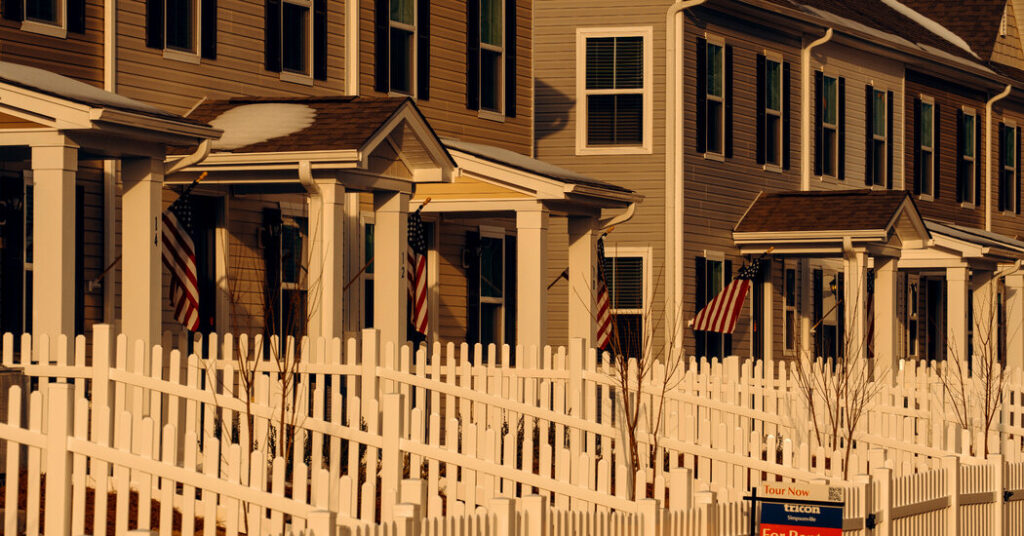
But single-family rental homes proved so popular that developers began building them from scratch — a much more efficient way to manage the rentals. Now they are raising subdivisions that look like the suburban dream in every way, except the occupants are tenants instead of owners. In 2014, builders completed fewer than 1,000 homes in built-to-rent communities, according to Zonda, a housing data and consulting firm. Last year, they completed about 50,000, or about 3 percent of the new housing stock.
Single-family rentals are subtly different from owner-occupied houses. The rental communities are built for ease of management and optimized for tenant living.
Mr. Ross, from Quinn Residences, said his company builds wider staircases because tenants move in and out more frequently than owners. They eschew carpet (too hard to maintain), use granite and quartz kitchen counters (more durable than the laminates used in many starter homes) and put leak detection technology on all appliances, since water damage is the company’s problem, not the tenants’ (whom he prefers to call “residents”). Communities often pay property taxes as a single parcel development instead of home by home, as in a for-sale project. The desire to live in a single-family home “is in the DNA of America,” Mr. Ross said.
The difference, however, is that rather than the occupant’s accruing equity while paying down a mortgage, the large investor profits, and the tenant’s protections against challenges like excessive fees, property neglect and eviction extend only as far as local rental laws permit.
As it happens, Mr. Ross was a speaker at IMN’s Build-to-Rent conference, held last week at the Grand Hyatt in Nashville. It is normally consumed by wonky subjects like interest rates or property management software.
This year, however, seemingly every panel featured a discussion on the bill and calls for the audience to write to their congressional representatives.
The provision mandating sales offers some outs for the industry. Investors would have the option to extend a lease for up to three years beyond the seven-year limit, and would be obligated only to list the home on the market for 60 days. But the mood at the conference was grim.
The build-for-rent provision was called catastrophic. The next stop after Nashville for a number of the participants: Washington, D.C., to lobby Congress.
Conor Dougherty covers housing and development, focusing on the rising costs of homeownership. He is based in Los Angeles.
The post The Single-Family Home Gets Caught in a Political Vise appeared first on New York Times.