The events of the past three months seem almost perfectly engineered to spark campus unrest. In January, mass-deportation operations led to the brazen killing of U.S. citizens at the hands of masked immigration agents. In February, the Environmental Protection Agency declared that it would no longer regulate greenhouse-gas emissions. A few weeks later, the Trump administration joined forces with Israel to launch an attack on Iran without congressional approval. One might expect left-leaning college students to have practically started a revolution.
But campuses across the country—places where, just two years ago, students occupied buildings and colonized the quad to protest Israel’s war against Hamas—are strangely silent. These days, those same students mostly head to class. The extent of the change is jarring. David Sengthay, a Stanford senior and the head of the undergraduate-student senate, told me that protests typified the university’s history, up to and including his first two years in Palo Alto. But by the time he returned as a junior, in fall 2024, something was different. “My class is the last class to really witness what happened at Stanford during its peak organizing,” he said. “People come to Stanford, these young students, and they don’t have access to what was promised to them. I know we’re not UC Berkeley, but, I mean, we still protested the Vietnam War.”
This might seem like an abrupt and mysterious reversal in campus culture. In fact, it’s a sign that student protest was never a fact of nature, but rather an administrative choice. Universities chose to let campus demonstrations get out of control; now they’re choosing to suppress them. This is why, even as legal challenges have blocked the Trump administration from enacting much of its higher-education agenda, the president has clearly achieved his aim of ending the protest movement. He has been able to do so largely because university leaders, tired of the chaos they had allowed to thrive, were quietly on board.
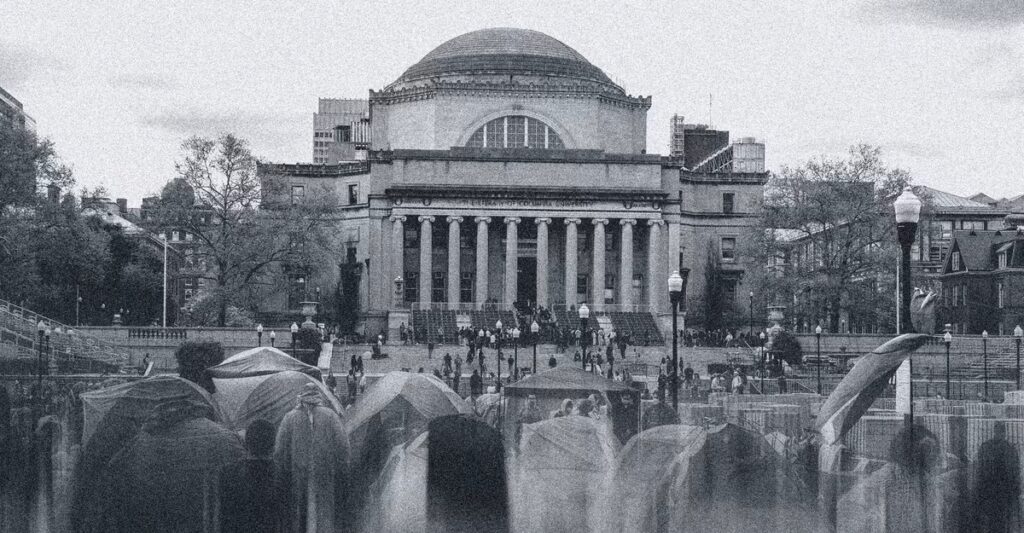
After the October 7, 2023, Hamas attack on Israel, university campuses were torn apart by protests over the war in Gaza. Students erected encampments at more than 100 schools. Many administrators were initially loath to stop the demonstrations, no matter how disruptive. Presidents and chancellors had spent years engaging with students who staged sit-ins in their offices; they saw protesting as a quintessential, if sometimes overwrought, part of attending college.
But the protests soon spun out of control. At Harvard, protesters at a Gaza “die-in” shoved a Jewish student who was filming them. Columbia students, along with outside agitators, broke into an academic building and temporarily detained the janitors inside. Students who camped out on the main quad at the University of Chicago disrupted classes in the surrounding buildings. That winter and spring, elite-university presidents were hauled in front of Congress to testify about protesters’ conduct and their response to instances of anti-Semitism at the demonstrations. The presidents of the University of Pennsylvania, Harvard, Columbia, and Northwestern subsequently resigned, unable to justify their decisions either to Congress or to their own outraged board members and donors.
[Rose Horowitch: Trump’s assault on higher education has hit a snag]
The hearings marked a turning point. Universities began taking more aggressive action against protesters. According to Ted Mitchell, the president of the American Council on Education, the sector’s largest trade group, the angry backlash from Congress gave some administrators political cover to do what they privately had already wanted to do. “I think it was the circumstance more than the threat of funding withdrawals,” Mitchell told me. “They were on the move well before the Trump administration began creating the financial penalties.” The day after then–Columbia President Minouche Shafik testified before Congress (but before her resignation), she authorized the New York Police Department to clear the protesters’ encampment. Officers arrested more than 100 protesters. The university has since suspended or expelled more than 70 students for engaging in protests that violated campus rules. Stanford similarly called the police to clear protesters who occupied the president’s office. The students faced suspensions or delayed graduation, and felony charges for causing hundreds of thousands of dollars’ worth of property damage. (Sengthay, the Stanford senior, agreed that the students had committed a crime, but said that he didn’t think the government should devote its resources to prosecuting them.)
Several universities tightened their official rules around student protest. Northwestern banned demonstrations before 3 p.m. at the “Rock,” the campus’s historic site of student free speech. The University of Virginia and University of California system outlawed encampments on school grounds. The University of Connecticut prohibited amplified sound during the school day. And Stanford forbade spontaneous demonstrations across much of campus. In the fall of 2024, campuses saw one-third as many protests as they had the prior spring.
Once Donald Trump assumed office, shutting down disruptive protests took on even more urgency. Almost immediately, the president signed executive orders promising to investigate and discipline protesters for anti-Semitism. Universities began taking action against their own students before Trump could do so. At Yale, about 200 students began forming an encampment to protest Israeli National Security Minister Itamar Ben-Gvir speaking at an event near campus. Administrators told students to disperse, disciplined repeat offenders, and ended Yale’s association with a chapter of Students for Justice in Palestine. At Columbia, when students occupied a library room ahead of finals week, the university immediately called in the police. “Colleges are doing what they can to try to stay out of the spotlight,” Robert Kelchen, a professor of education policy at the University of Tennessee at Knoxville, told me. At the same time, some academics think that the students themselves are different: Whether because of concerns about the worsening job market or a cultural shift rightward, they seem less interested in raising hell on campus.
What’s clear is that the cost of doing so has gone up. Last March, the Trump administration detained and attempted to deport Mahmoud Khalil, a Columbia graduate student who had led many of the anti-Israel protests. Later that month, federal agents detained Rumeysa Ozturk, a Tufts University graduate student who had written an opinion piece supporting Palestine. Other students had their active immigration status revoked for activism around Palestine. (Ozturk and Khalil have both since been released, although Khalil is still fighting a deportation order.) “Students don’t even know: Am I waiting to get in trouble by the dean, or am I waiting to get in trouble by, like, DHS?” Amanda Nordstrom, who leads the Campus Rights Advocacy department for the Foundation for Individual Rights and Expression, told me.
If the goal of these detentions was to chill dissent, it worked. Sengthay, at Stanford, told me that he and other students are still passionate about various causes, but they’re scared of the consequences of protesting and struggle to navigate the bureaucratic process to get permission to demonstrate. “People feel they can’t speak up in the ways they could three, four years ago,” he said. Laila Ali, a sophomore at Stanford and a member of the student government, told me that her friends who aren’t American citizens have stopped going to anti-Israel protests entirely.
Earlier this month, Stanford students held a town hall to talk about free speech on campus. According to Sengthay, things turned tense as students grilled Bernadette Meyler, the provost’s free-speech adviser. They used an app on their phones to show that she was speaking at a volume that Stanford would prohibit at a protest. (The university currently allows students to use amplified sound louder than 60 decibels only between 12 and 1 p.m., at only one location on campus, unless they get prior administrative approval.) When I reached out, Meyler referred me to a university spokesperson, who said in an emailed statement that “we have worked to ensure that students have real, accessible options to make their voices heard on issues they care about,” while adding that “we need to ensure that demonstrations don’t disrupt classes, events, or the freedoms of everyone else in our community.”
[Xochitl Gonzalez: Students yelled at me. I’m fine.]
Campuses haven’t been wholly devoid of protest activity. Students have organized occasional anti-ICE demonstrations this semester, Jeremy Pressman, a University of Connecticut professor who tracks protest activity across the country, told me. Students at the University of Georgia and Utah Valley University, for example, held protests when the agency came to recruit at a job fair. Carnegie Mellon University, Stanford, and the University of Pittsburgh have also seen demonstrations.
On the whole, however, the most striking thing about campus protest is how little of it is to be found. This is true even following the outbreak of war with Iran. Students on some campuses, including the University of Michigan’s, have started to protest the U.S. military’s actions. At NYU, 20 protesters met up in a snowy park. But the anti-war movement so far hasn’t picked up much momentum.
Sengthay said that he and other Stanford students had envisioned college as a “playground for free speech and democracy” before the greater responsibilities and pressures of adult life. They’ve since discovered that the rules of the game have changed.
The post Where Are All the Campus Protests? appeared first on The Atlantic.