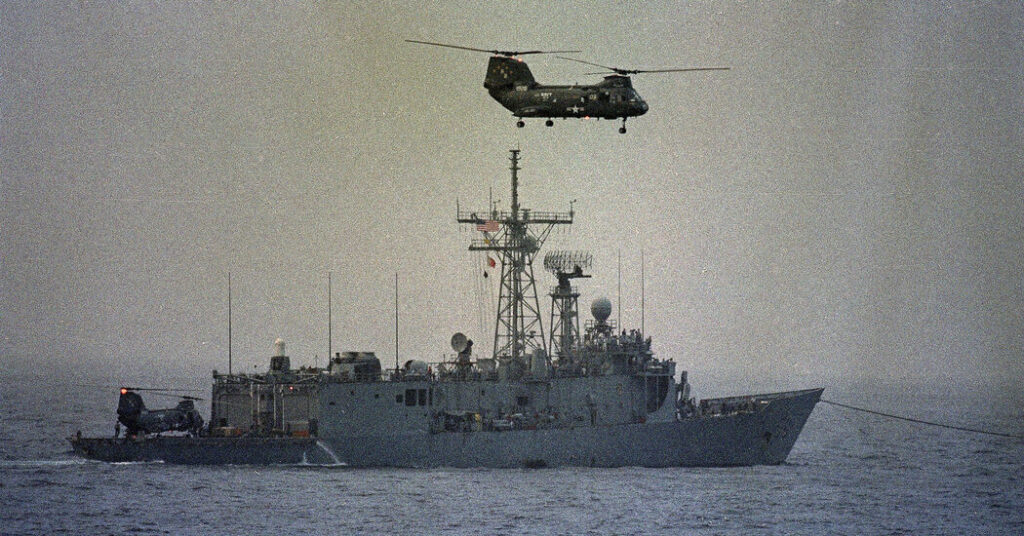
On a hazy afternoon in the Persian Gulf nearly 40 years ago, the captain of a U.S. Navy frigate summoned Lt. Gordan Van Hook to the bridge and handed him a pair of binoculars.
Through them, Lieutenant Van Hook, the ship’s chief engineer, saw the danger that lay ahead — three Iranian mines. The frigate, part of an American force sent to escort oil tankers, came to a stop well ahead of the mines. But some 10 minutes later, an undetected mine exploded under the ship.
“You could feel it lift,” he said in a recent interview. “It was a huge explosion.”
The mine tore a 21-foot-wide hole in the vessel, which nearly sank it, and seriously injured 10 members of its crew.
The hit on the frigate, the Samuel B. Roberts, on April 14, 1988, is a reminder of the dangers facing any attempt to provide a naval escort in the gulf today.
Iran has been attacking commercial ships in the Persian Gulf and the Strait of Hormuz as it retaliates against the United States and Israel. Ship operators have largely stopped sending vessels through the strait — through which a fifth of the world’s oil and gas passes — causing a sharp reduction in supplies to the world.
Tanker operators may not want to send their vessels through unless they have Navy warships escorting them for protection. Nearly three weeks ago, President Trump raised the possibility of providing naval escorts for the tankers to get oil and gas flowing out of the gulf again. He later called on other countries to provide protection in the Strait of Hormuz.
Iran told the United Nations’ maritime organization on Sunday that “nonhostile” ships may pass safely through the strait. In a letter to the International Maritime Organization, Iran’s Ministry of Foreign Affairs defined nonhostile vessels as those that “neither participate nor support acts of aggression against Iran” or belong to the United States or Israel.
Mr. Trump said on Tuesday that negotiations were underway with Iran to end the war and that Iran would like “to make a deal.” Iran’s public stance is that negotiations are not taking place, but Iranian officials say Tehran and Washington have been exchanging messages through intermediaries about de-escalating the conflict.
About 800 tankers are idling north and south of the strait awaiting safe passage, according to S&P Global Market Intelligence.
The commanders of any escort force would have to consider the threat from mines.
U.S. officials have said Iran has recently been laying mines in the strait, though it is not clear how many. Just one could do serious damage to a warship, as the crew of the Samuel B. Roberts found out.
The ship was part of a U.S. escort effort called Operation Earnest Will that began in 1987.
Iran and Iraq, at war since 1980, had been regularly attacking tankers. Despite those attacks, hundreds of vessels ventured out to the world through the Strait of Hormuz, and global oil prices had not risen to economically disruptive levels. Still, the strikes on tankers prompted Kuwait to seek the intervention of both the United States and the Soviet Union to protect its oil shipments.
To prevent the Soviet Union from gaining the upper hand in the Middle East, President Ronald Reagan agreed to put Kuwaiti tankers under the U.S. maritime flag and give them a naval escort fleet. One of the ships was the Samuel B. Roberts.
The operation got off to a bad start.
On the escort’s first sailing in July 1987, a Kuwaiti tanker escorted by two U.S. warships struck a mine. The tanker, called the Bridgeton, could still sail, and for the rest of the voyage, it traveled in front of the warships as their protection against mines. Despite the operation’s difficult beginning, there were no more hits on the Kuwaiti tankers protected by the U.S. escorts.
The Samuel B. Roberts was not so lucky.
It was not escorting a ship when it was struck, but heading north to refuel. The ship’s commanding officer, Capt. Paul X. Rinn, had not received reports of mines on the route he was taking, according to Bradley Peniston’s book on the mine strike, “No Higher Honor: Saving the U.S.S. Samuel B. Roberts in the Persian Gulf.”
The sailor who first saw the three mines that caused Captain Rinn to stop the frigate carried out his watch from a chair placed on the frigate’s bow.
“Imagine how bored you get up there,” Mr. Van Hook said in the interview. “But he spotted them — he was doing his job,”
The explosion of the undetected mine caused two compartments of the 445-foot ship to flood. Water was seeping into another compartment, and the fear was that, if it filled up, the frigate would sink. The crew crammed the cracks with pillows and mattresses held in place by plywood and wooden beams.
“It’s like if you had a wound — you just put something on it with pressure,” said Mr. Van Hook, who retired from the Navy as a captain in 2008 and now lives in Suffolk, Va. He was 31 years old when the incident happened.
Eventually, pumps sucked water out of the compartment at a rate greater than the flow coming through the stanched cracks. Afterward, the crew’s efforts to save the vessel became “a touchstone tale of courage and competence,” Mr. Peniston said in his book.
Four days later, the United States attacked Iranian Navy ships and oil rigs in retaliation for the mine strike.
Today, the United States has warships that send out underwater drones to detect mines. These could be used to try to protect an escort. But any ship involved in mine sweeping or escorting would itself be vulnerable to Iranian missiles, said Emma Salisbury, a nonresident senior fellow at the Foreign Policy Research Institute, a nonpartisan research group.
“It’s like running the gantlet,” she said.
Peter Eavis reports on the business of moving stuff around the world.
The post What Happened After a U.S. Warship Hit an Iranian Mine in 1988 appeared first on New York Times.