Brandon N. Owens is an energy infrastructure strategist and founder of AIxEnergy. Morgan Bazilian is the director of the Payne Institute for Public Policy at the Colorado School of Mines.
The race to build artificial intelligence infrastructure is no longer abstract. It is visible in land deals, the growing demand on the power grid and the expansion of data centers across the United States. Technology companies are committing billions of dollars to facilities designed to power the next generation of computing. Public debate primarily focuses on electricity affordability and grid capacity.
That focus is justified. Electricity is the dominant input to AI but not the only one. A second constraint is emerging, less visible and largely absent from the policy conversation. It is beginning to shape where these facilities can be built and how quickly.
Water — and increasingly, water security.
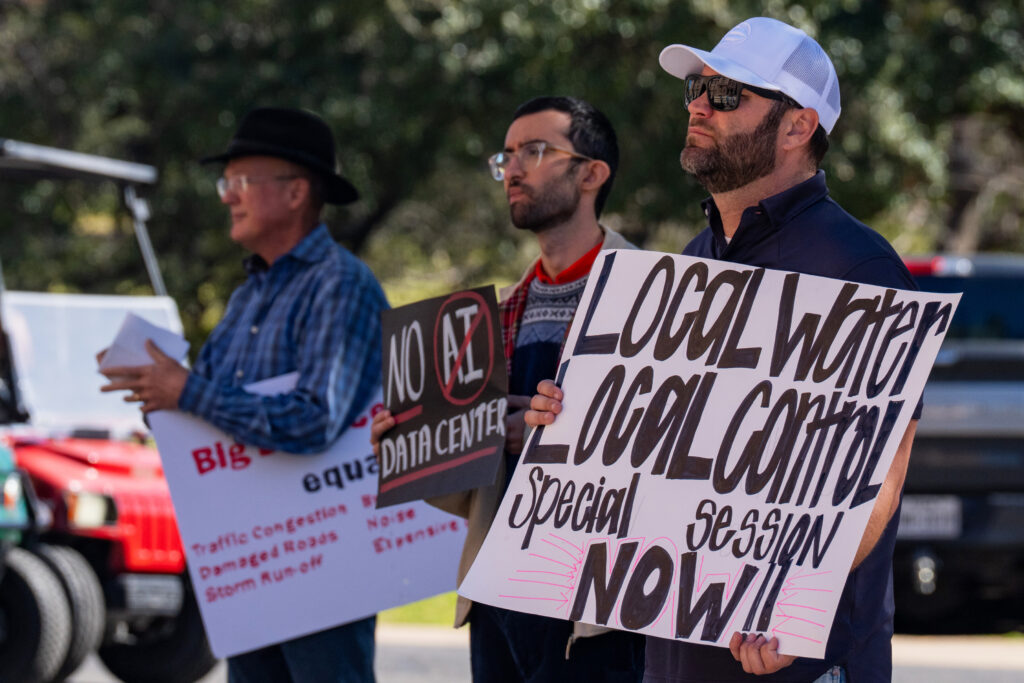
In the past two years, proposed “hyperscale” data centers — those industrial-scale facilities run by companies such as Amazon, Google or Microsoft — in the Southwest have encountered an unexpected obstacle: water permitting. A multibillion-dollar campus proposed outside Tucson drew opposition over projected water consumption and ultimately required a redesign of its cooling system. Nearby municipalities responded by introducing rules requiring conservation plans and public review for large industrial users. Similar scrutiny is appearing in other markets, including Northern Virginia, home to the world’s largest concentration of data centers.
These conflicts point to a reality overlooked in discussions of AI. Data centers may power a digital economy, but they operate within physical limits. Every watt of electricity consumed by computing equipment is ultimately released as heat, and that heat must be removed to keep servers within safe operating limits. In many of today’s most efficient facilities, this is achieved through evaporative cooling — systems in which water absorbs heat and then evaporates into the air, carrying that heat away.
For years, water remained a secondary consideration because it accounted for a small share of operating costs. But scale changes the equation. As facilities expand from tens of megawatts of use to campuses approaching hundreds of megawatts, water consumption grows from a marginal input into a factor that attracts regulatory attention and public scrutiny.
And the water used on-site is only part of the system. Electricity generation consumes water as well. Many power plants use it for cooling and evaporate a portion of it during operation. When a data center draws electricity from the grid, it also draws on that upstream water.
Different electricity generation technologies consume very different amounts of water. Wind and solar power require almost no operational water, while thermoelectric plants, including nuclear and many fossil fuel facilities, rely on water for cooling and can consume several liters for every kilowatt-hour they produce.
As a result, two identical data centers using the same cooling systems can have dramatically different water footprints depending on the regional electricity mix that powers them. In some parts of the country, the majority of water associated with computing is not used at the data center itself but is embedded in electricity generation.
For developers building hyperscale infrastructure, this variation is beginning to matter. These projects represent large, fixed capital investments. Hyperscale campuses often cost billions of dollars to build and can generate hundreds of millions in annual revenue.
Under those conditions, the greatest financial risk is not the price of water but the possibility that a project will be delayed. Water governance in the U.S. is highly decentralized. Federal regulations primarily govern surface-water withdrawals and wastewater discharge, while decisions about municipal water supply, groundwater management and conservation policies are largely made at the state or local level. In some regions, large industrial water users must undergo environmental review, submit conservation plans or demonstrate sustainable water supply before projects can proceed.
For developers planning computing campuses, these requirements introduce uncertainty into project timelines. Cooling technology, therefore, becomes part of financial risk management. Systems that reduce water consumption, such as dry cooling (using air instead of water to remove heat) or reclaimed water supplies (using treated wastewater rather than drinking water for cooling), might increase capital costs or electricity demand, but they can also shorten permitting timelines and expand the range of locations where projects can move forward.
Regions with lower water intensity in electricity generation, or with established reclaimed water infrastructure, may gain an advantage in attracting hyperscale facilities. Areas facing water stress might see slower development or require more capital-intensive cooling technologies.
As the physical footprint of computing expands, the geography of the AI economy may increasingly be shaped not only by where power is available, but by where water security can be assured.
The post Data centers are gobbling up a resource — but not the one you think appeared first on Washington Post.