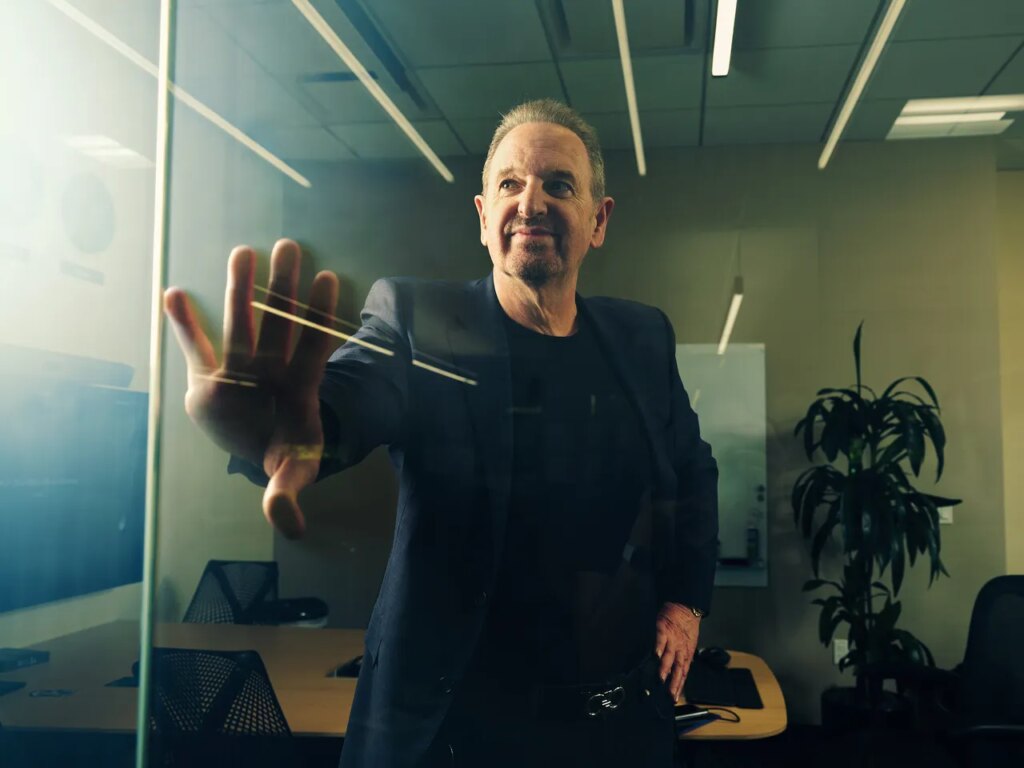
Rene Haas is half-prone on a couch in his office in San Jose, California. A basketball rests in his hand, partly obscuring his face. Haas had grimaced when WIRED’s photographer first asked him to assume this position. The headlines came to him immediately: “People are going to say ‘Arm’s CEO sleeps on the job,’” he says.
Still, Haas obliges. He gives us 46 minutes of his time, then shoos us out so he can hop on a call with Masayoshi Son, the Softbank CEO and chairman of Arm’s board.
I’m meeting with Haas just days before the chip firm’s momentous announcement that it’s launching its own silicon. For a company that’s made its fortunes licensing its architectures to other chip companies and never fabricating its own, the move is a huge bet. Apple, Tesla, Nvidia, Microsoft, Amazon, Samsung, and Qualcomm all make or sell chips based on Arm, either licensing the chip designs or paying royalties to the firm. It’s been estimated that there are three Arm chips for every human on Earth.
Seen another way, though, making a chip marks a return to Arm’s roots. The company goes back to the late 1970s, when two computer architects started a company, Acorn Computers, that produced a microprocessor built on an architecture known as RISC. By the early ’90s the company was flailing, and the then CEO pivoted to licensing its designs to other companies. Fast-forward to the mid-2010s, and Arm’s power-efficient mobile chip designs helped make it the most important chip IP company in the world.
The Big InterviewRead more deep, weird, smart conversations with the most important people in our world.
Arm’s trajectory hasn’t all been smooth. After Softbank acquired Arm in 2016 and took the publicly traded company private, the smartphone market’s growth slowed. Arm had to make an aggressive push into new lines of business. In 2020 Nvidia tried to scoop it up and regulators blocked the deal. As that deal collapsed, in 2022, Haas stepped into the CEO role. He took Arm public again, with Softbank still owning 90 percent of the company.
Haas had joined Arm in 2013 from Nvidia, where he’d led the computing product business unit, and eventually took over Arm’s cash cow, the IP products group. Similar to the way Nvidia CEO Jensen Huang leans on his decades-long perspective of the industry—gather ’round the campfire, kids, while I tell you about the early days of parallel computing—Haas is quick to reference 1980s geopolitical chaos when asked whether current events make him worry about his business. (No.) He’s met with President Donald Trump half a dozen times, he tells me, but he’s not particularly concerned about the US government interfering in his UK company’s affairs. He is tall, though not particularly foreboding, and often wears Saint Laurent boots with little heels, a blazer, and a Panerai watch.
Chip industry insiders say Haas, 63, is a masterful networker who pals around with the biggest names in tech. The Wall Street Journal once labeled him a “natural-born diplomat.” But with this chip project, one of the most loosely held secrets in the Valley, Arm—and Haas—risk rankling some of the company’s most loyal partners. Can you stay besties with people if, after years of polite dinner parties, you announce you’re buying their house? Haas seems convinced he can.
This interview has been condensed and lightly edited for clarity.
Lauren Goode: Since you became CEO, people say that there’s been a big culture change. Do you agree with that assessment?
Rene Haas: The thing that I’ve learned—I knew this intrinsically when I worked for Jensen, but I certainly internalized it when I took over here—is that the CEO sets the tone for the company.
My training, which ultimately develops who you are as a leader, was really accelerated by moving to Silicon Valley 30 years ago, working with a few startups and then working for Nvidia. And the common theme between all those companies is that I was working for founders. At the time I couldn’t tell you, “Oh, working with founders, that’s the kind of environment that I resonate with.” But looking back, that’s where I think my DNA was shaped and where I found the environment I thrive in.
What kind of environment is that exactly? Taking risks, bold growth, fast markets, making mistakes, but at the same time, being willing to take big bets. So when I took over here, I said, that’s the kind of culture I want.
Was this Arm silicon project already in the works when you became CEO?
No.
How much of this was your idea, and how much of it was Masa’s?
Was it his decision? No. I’m the CEO. Was he very aware and involved in the trade-offs and various things we looked at? Hundred percent. But this was more from a brainstorming perspective, as a partner of ideas, as opposed to your boss telling you, “Yes to this, no to this.” He’s not into that level of detail.
One of the benefits from SoftBank’s 90 percent ownership of ARM is that he’s our chairman, and he’s our biggest shareholder, and as a result of that he’s someone I talk to all the time. We’re pretty close.
One analyst told me you talk to Masa 10 to 12 times per day.
Some days. He does like to talk on the phone. I am up all hours. He knows my personal schedule very well. He knows when I get up, he knows my workout schedule. He knows when I go to sleep. He’s pretty good about all that.
What made you think this is the time for Arm to do this chip?
So somewhere along the way, we morphed from an IP company into a compute platform company. And by that, I mean, when you think about the role the CPU plays in any ecosystem, there’s such an interdependency between the hardware of the CPU and the software ecosystem, whether it’s running Windows or macOS or iOS or Android or Linux. I don’t think we acknowledged it or I don’t think we understood its importance, but when I took over, I definitely knew that this was who we were and it was something that we had to advance.
So why would we build a chip? When you’re a compute platform company, there are times when the ecosystem benefits from you physically building something. We’ve seen this in the past, whether it’s Microsoft building a Surface laptop that helps the Windows ecosystem, while HP and Dell and Lenovo are still building laptops; or whether it’s Google building a Pixel phone, but meanwhile, Samsung still builds Android phones.
Those products are still a sliver of their businesses.
But it benefits the ecosystem. If you think about Gemini on a Pixel platform, if Gemini is optimized on Android, it helps Samsung. If you think about Microsoft developing tools or applications for Surface that benefit Windows, it will benefit HP, Lenovo, and Dell.
That’s the thing that I think people haven’t always understood about us. They say, “Oh, it’s an IP company.” But the IP that we deliver is a compute platform, and ultimately platform companies need to do things to move the ecosystem forward.
What’s the new chip called?
It’s the Arm AGI CPU.
AGI as in, artificial general intelligence?
That’s right. You like it?
I don’t dislike it. I wonder if AGI is a term that’s going to go out of fashion at some point, as the industry collates around some other ideas of super intelligence.
I’m betting it won’t.
Who’s your target customer for this?
The first customer is going to be Meta. But we also have SK Hynix, Cisco, SAP, Cloudflare. We have multiple customers.
And this is a chip designed for data centers.
Data centers.
What makes this chip special?
There’s a number of things, but one is that it’s unbelievably power-efficient. This company was born from building chips to run off of batteries or in mobile phones. So we have this mindset around efficiency. And everything that you hear about the growth of AI is how much energy is needed. So anything you can do to deliver the world’s most power-efficient server CPU is all goodness. This is going to be the most power-efficient CPU.
The other thing that it’s going to be incredibly good at is running agentic AI. One of the myths out there has been that with the rise of AI, the GPU or the accelerator is everything. But when you look at how agents run inside the data center, that’s work that only the CPU can do. The GPU doesn’t go away, but it needs far more CPUs to run all the agents.
Meta just struck two pretty big deals with Nvidia and AMD, for both CPUs and GPUs. This includes Nvidia’s new Vera CPUs, which are part of the bigger Vera Rubin superchip.
That’s right. Which is Arm.
Pardon my French, but does launching your own CPU piss off a customer like Nvidia?
Yeah, so, back to the platform discussion … It raises all boats.
That is a very convenient answer.
But it’s not inaccurate. The more software that’s written for Arm, the more optimizations that are done for Arm—all of that helps anybody that builds on Arm. The opportunity is massive. When you look at the amount of dollars associated with the data center and AI growth, it’s just really large. To your question, does it piss off Nvidia? I’d imagine it will piss off Intel and AMD more than it pisses off Nvidia.
Why is that?
Because it takes market share from them.
You’re referring to the fact that it’s Intel’s x86 architecture versus Arm architecture. So you don’t think you’ll piss off your pal, Jensen, but that AMD and Intel may have some response to this.
I use “piss off” as tongue-in-cheek. It’s beneficial to the Arm ecosystem and it’s beneficial to Jensen that we build a chip. If you’ve got [Nvidia’s] Vera chip, which is a great product, and you’ve got Arm AGI CPU, which is a great product, it’s not great for Intel and AMD, that’s all I know.
Will Nvidia actually buy your CPU? Amazon execs appeared in a video at your event, vouching for your chip—will Amazon, which already has its own chips, buy yours?
I’d love it if Jensen bought some, but the Vera CPU is already very closely coupled to his own chip, and they have their own networking technology to connect all their chips. And Amazon will probably continue to use their own Graviton chip.
But we didn’t build this for Amazon, we built it because we think the market for Arm CPUs is really huge. It’s basically an underserved market. If you look at some of the early customers we have, like Meta, which is going to be using our chip in an air-cooled rack—they don’t need Nvidia’s NV Link. Or Cloudflare—they can’t buy Amazon’s Graviton chip, and they don’t have the wherewithal to build their own.
Who is fabricating your chip? Co-packaging? Networking?
TSMC. All TSMC. We’re also building a reference design of a server. Not “we,” but, we’re working with partners like Super Micro and Foxconn. In today’s day and age doing a chip by itself isn’t enough. So we worked with partners in the ecosystem to deliver a full solution in terms of a server rack.
You are now going to have to answer questions about volume and yield and gross margins.
Yes. When I joined Arm from Nvidia in 2013, I remember coming here and thinking, “Wow, there’s no scrap, there’s no yield, there’s no RMAs, there’s no forecast. You just hit Send and the royalty report comes in. What a wonderful business.”
So there’s a part of me that says, “Am I crazy for getting back into this?” But yes, all of that is stuff we’ll now have to manage, but I know how to do that. I know what’s required, and we’ve been building a team inside the company from an operations and go-to-market standpoint, everything that’s necessary to support that flow.
How many employees have you dedicated to this?
We’ve added about 2,000 engineers into a group that does backend design, implementation, and subsystem work. They’re not all on this chip, but we leverage a lot of the work that we do with our compute subsystems into this kind of work. I don’t know if I want to put a number and say it’s a 500-person or a 700-person project. It leverages a lot of work that we’ve already done.
A lot of folks in the industry say that when you first launch a chip, it can take two to three generations before it has the impact that you’re hoping it has. Do you agree with that?
Yeah. So, since I’ve become the CEO, we’ve been building what we call these compute subsystems. They essentially build all the building blocks of the compute engine that we can hand to customers for them to build their systems-on-chips. In some cases, it’s 85 percent of the work [already done for them]. It’s a huge amount of work.
The compute subsystem that the Arm AGI CPU is built on has already been shipped in silicon by other partners. So the confidence level that we have that this chip is going to work is extremely high. To your point, yes, it can take a certain number of iterations. That’s a bit more if you’re getting into a brand-new market and you’re trying to build something that’s never been built before. It’s never been tested. You don’t really know how the market’s going to accept it.
This one, our confidence level that the first one out of the chute is going to be very, very good and be a volume candidate is very, very high.
Lord, give me the confidence of a chip CEO. OK. I’m going to do a little rapid-fire with you. I’m going to say a few words to you and I just want your quick response. Intel.
Historic.
RISC-V.
Nascent.
Still nascent? Started in 2014.
Just giving you one word. Nascent.
I don’t know if you happened to read the WIRED article that my colleague wrote last year about the history of RISC and the founding of RISC-V?
Yes.
And how some people in that community—I won’t use the word, but they weren’t very nice about Arm.
What did they say?
They said you guys were assholes.
Him or me? [he gestures at his chief of staff, Saumil Shah.] We could say such things about them.
Back to rapid-fire: Sam Altman.
Brilliant.
What makes you think he’s brilliant?
I know him. He is a long, long-game type of guy. He really thinks quite big. He’s quite visionary in terms of how he thinks about problems, how he thinks about technology. Yeah, I think he’s brilliant.
When you look at politics, geopolitics, the macroeconomic climate, and also the memory shortage—it’s a crazy time to be launching a chip. How much has that changed your plans as you get ready to put this chip out into the world?
None. Because this is a long journey for us. The Arm AGI CPU is the first product. This is just the beginning.
My first job out of college was with Texas Instruments in 1984. It was a boom year for the semiconductor industry. But [the early 1980s] were one of the worst recessions ever. Then in 1985 Reagan took office for the second term, and he cut defense spending, which was a big part of TI’s business.
What was the lesson I learned about that? It’s never a good time to do anything. Seriously. There’s never a good time to do anything. There’s never a bad time to do anything. You’ve just got to do it.
I read that you’re a big fan of the famed basketball coach Phil Jackson. Why?
What I love about Phil Jackson is that he took two great teams that had a lot of talent and turned them into champions. Michael Jordan was not a champion before—
Michael Jordan was a stand-out at North Carolina.
He won the title when he was at North Carolina, but he wasn’t the best player on the team. And Kobe Bryant was not a champion before Phil Jackson. He turned them into champions.
Have you met Phil Jackson?
No, I have not.
How has this not happened?
[nodding toward his chief of staff] Someone doesn’t know how to do his job.
What irritates you as a leader? Please don’t say “stupid questions.”
People happy with the status quo.
What’s an example of that?
“We’ve always done it this way. Not sure we could do any better. Can’t see any other way to improve this.”
The antithesis of risk. What inspires you as a leader?
Making a big difference. Doing things that change the world.
Everyone says that in Silicon Valley. What does that actually mean?
Yeah, what does it actually mean? Well, if I distill it down to Arm, what inspires me is what we’re doing with this chip. It’s a big, big change for the company.
Is this a bet-the-farm moment?
No.
So even if this chip doesn’t work, you’re still confident in your IP business?
Absolutely. And the chip’s going to work. It works.
Let us know what you think about this article. Submit a letter to the editor at [email protected].
The post Arm’s CEO Insists the Market Needs His New CPU. It Could Piss Everyone Off appeared first on Wired.