DIMONA, Israel — When the air raid sirens blare and many residents of southern Israel seek shelter in basements, David Azran, 54, instead takes to his porch to watch Israel’s air defense system blast out a volley of interceptor missiles — dizzying ribbons of light streaking across the sky.
“I am not an ordinary guy,” he said, standing barefoot on the dirt with an assault rifle slung over his shoulder.
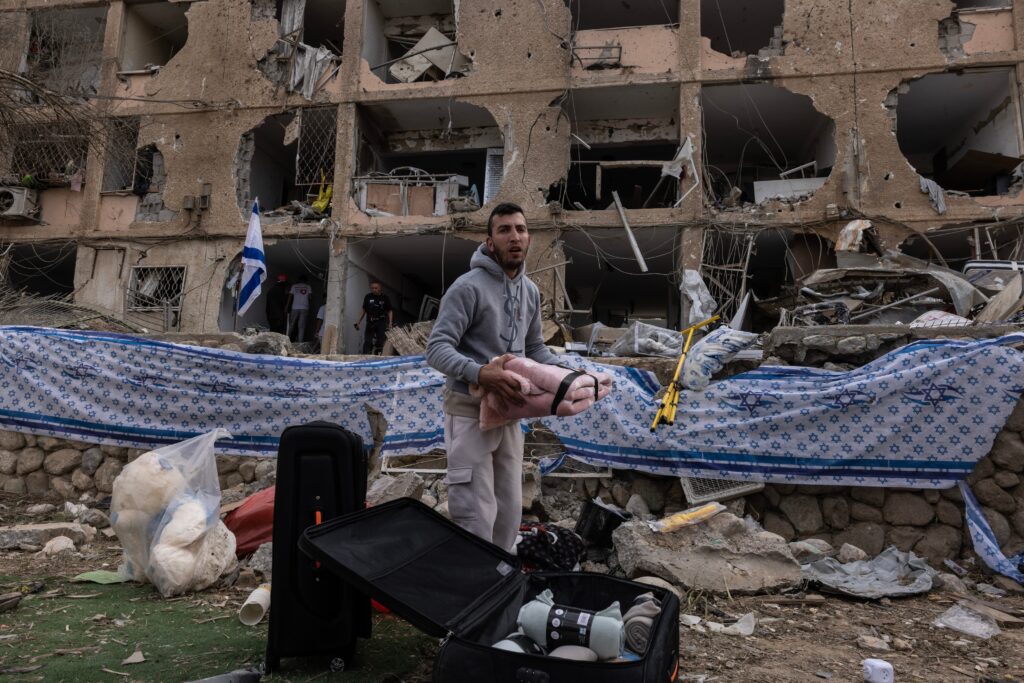
But faith in Israel’s state-of-the-art air defenses has been shaken. In incidents about three hours apart on Saturday night, Iranian missiles directly hit two civilian neighborhoods in Arad and Dimona, blowing out the windows of Azran’s home and many of his neighbors’. More than 115 people were injured, authorities said, including 11 seriously.
Israel’s military has not explained what went wrong. The strikes have raised questions about whether Israel may be running short of interceptors and revived concerns that the military may need to conserve expensive interceptors to defend vital targets over a sustained period. Dimona, which is home to a sensitive nuclear facility, presumably ranks among those vital targets.
The speaker of Iran’s parliament, employing a bit of hyperbole, said Israel’s failure to intercept missiles in highly protected Dimona represented a turning point. “Israel’s skies are defenseless,” the speaker, Mohammad Bagher Ghalibaf, said in a post on X.
Concern that Iran was amassing a missile stockpile capable of overwhelming Israeli defenses was a major factor in the push to renew strikes against Iran, senior Israeli security officials said.
Iran’s missile stockpile was significantly depleted during the 12-day war in June, officials said, reduced from an estimated 3,000 munitions to fewer than 1,500 as Iran bombarded Israeli targets and the Israel Defense Forces hit missile batteries and launchers.
But Iran quickly reconstituted its missile manufacturing lines, Israeli officials said, and had as many as 2,500 missiles ready again before the start of the ongoing war.
The pace alarmed Israeli security officials. Israeli defenses “cannot absorb 3,000 to 5,000 missiles,” a former senior Israeli security official said, describing concerns that Iran could have exceeded such numbers in a year. The official spoke on the condition of anonymity to discuss sensitive military issues.
Israeli officials insist their air defenses are performing as well as can be expected. But there isn’t any system that is 100 percent effective, Israeli military officials said.
In the first 23 days of the war, Israel has had a successful interception rate of about 92 percent, Lt. Col. Nadav Shoshani, an IDF spokesman, told reporters.
Shoshani said he would not detail what caused the interception failure on Sunday but noted that the strikes on Dimona and Arad were carried out with conventional ballistic missiles — “the types we’ve known, we’ve seen, we’ve intercepted.”
Israel’s multilayered air defense system is considered among world’s best, fending off attacks from multiple fronts. Each layer is designed for a specific type of interception: Iron Dome for short-range rockets and artillery shells; David’s Sling for ballistic missiles, cruise missiles and medium-to-long-range rockets; and Arrow 2 and Arrow 3 for long-range ballistics.
The expensive Terminal High Altitude Area Defense (THAAD) system, developed by the U.S. Army, is a backup.
Ran Kochav, former commander of the Israeli Air and Missile Defense Force, told The Washington Post that several reasons might explain the missed interception.
The first one has to do with a policy requiring Israeli commanders to decide in real time which interceptor matches a specific threat. This involves a strategic choice among systems such as Arrow, THAAD and Iron Dome, including a goal to “avoid ‘overkilling’ a simple rocket with an expensive missile or wasting an expensive interceptor on a threat that another could handle.”
“We have to calculate our interception inventory, and we have to decide in real time,” he said.
Secondly, technical or engineering malfunctions can occur within systems of radars and interceptors, or the connectivity between systems.
Third is a matter of “statistics,” he said: “It’s a very sophisticated system, but it’s not a hermetic system.”
Depletion could also be a factor. A single Arrow missile costs about $3 million. David’s Sling interceptors cost around $700,000 each, experts say, and Iron Dome interceptors cost around $50,000 to $70,000. A THAAD interceptor costs about $15 million.
The Pentagon burned through $5.6 billion worth of munitions in the first two days of the assault on Iran, according to three U.S. officials. An Israeli military official said that when planning the war, the IDF made sure it had “enough interceptors” to carry itself through a war it knew would “take time.”
Still, Kochav said the monetary cost of an interceptor is “not a factor” when a threat is identified heading toward “a populated area or a strategic site.” He said “the only ‘resource’ being managed is the availability of interceptors” to ensure the country can sustain its defense over a long period.
Yehoshua Kalisky, a senior researcher at Israel’s Institute for National Security Studies, explained that missiles are targeted across different layers of space. The top level of Israel’s air defense network, the Arrow 3, is designed to intercept missiles outside the atmosphere. If it misses, Arrow 2 is used.
“The systems back each other up to ensure we have maximum protection,” Kalisky said. Still, “there is no such thing as 100 percent hermetic defense.”
Shachar Shohat, a former commander of the IDF air defense array, said the better-than-90-percent success rate of Israel’s air defense efforts is very high, well beyond what was estimated or expected. Systems that achieve 60 to 70 percent are considered excellent, he said.
Once the military identifies an enemy launch, its calculation system must work in “split seconds,” given how some missiles are propelled into Earth’s atmosphere before turning back to descend at several times the speed of sound. “In fractions of a second, the system must correct its own flight path,” Kalisky said. “It is a genius system.”
He added, “It’s like someone firing a bullet at you, and you have to use your own pistol to shoot the incoming bullet.”
Misses happen. It’s possible, Kalisky said, that the hits in Arad and Dimona fell within that “statistical margin of error.”
In Dimona and Arad, residents received early warnings and air raid sirens, military officials said, and many residents headed for bomb shelters, following the guidance of authorities.
Dimona resident Eliav Lugasi, 36, was sleeping when the missile hit. He had slept through the alarms, was thrown out of his bed, passed out and woke up at a hospital. Two mornings later, he was alone amid the rubble at the strike site, stuffing an oversize suitcase with what he could salvage of his belongings. A red grocery bag was on the ground, his dead cat — one of eight he took care of — wrapped inside.
At the Dimona site Sunday, a group of teenage boys huddled in front of destroyed homes, playing drums and singing a boisterous tribute to the victims — and to Prime Minister Benjamin Netanyahu.
Shoshani, the IDF spokesman, said that at least 70 percent of Iran’s missile launchers and stockpile has been destroyed since the start of the U.S.-Israeli strikes on Feb. 28. He also said Iran’s fire rate was reduced by 90 percent. He said that in June, Israel saw 300 missiles per day launched toward it; today, it’s about 30 on average, he said.
Despite the reduced capacity, Tehran has sought to instill fear by brandishing its arsenal of multirange missiles.
On Friday, Iran launched missiles at Diego Garcia, the Indian Ocean island 2,500 miles away where the United States and Britain maintain an air base. Some analysts and officials said it was Iran’s first-ever use of intermediate-range ballistic missiles, raising alarm in Europe over suddenly finding itself within potential reach.
Shoshani said Iran fired a missile “to a distance of almost 4,000 kilometers,” or about 2,500 miles. It was an example, he said, of Iran’s government “lying to the world of their true intentions” and preparing the capability to carry out strikes “covering all the cities in Europe.”
A U.S. official, who spoke on the condition of anonymity because of the sensitivity of the issue, confirmed the launch of missiles toward Diego Garcia.
However, the official said the launch did not appear to come from a new weapon, meaning it was unlikely to have had the capacity to reach the island. It was unclear whether Iran had attempted the strike despite the range limitations of its existing missiles or whether something else had occurred.
“One fell short of its target, the other was brought down short of its target. Neither got close to Diego Garcia,” British Defense Secretary John Healey said, confirming that two Iranian missiles were launched in the early hours of Friday toward the island.
Jason H. Campbell, a senior fellow at the Washington-based Middle East Institute, said the Pentagon would need to quickly adjust if Iran indeed had missiles with far greater ranges than previously known.
“That would instantly change the decision calculus for a lot of U.S.-NATO allies and partners in terms of the nature of the current threat,” Campbell said, and what leaving the current Iranian regime in place “might mean for their safety.”
Iran may have “greater capabilities than what they’ve been advertising,” said Tom Karako, director of the Missile Defense Project at the Center for Strategic and International Studies, a Washington-based think tank.
He said the Iranians have been developing space launch vehicles, what he called a “cousin” of missiles.
“If you have the ability to put something, even something small, into orbit, you probably have the opportunity to throw something, you know, further than 2,000 miles,” Karako said.
Soroka reported from Tel Aviv. Greg Miller in Tel Aviv and Dan Lamothe in Washington contributed to this report.
The post Iran’s missiles pierce Israel’s defenses, raising doubts about interceptors appeared first on Washington Post.