When the retired U.S. Army colonel Joe Buccino first saw White House posts mixing Iran war footage with clips from cartoons and video games, he felt something he had rarely experienced from American military messaging: disgust.
The veteran, who served multiple tours in Iraq and Afghanistan, and was formerly a spokesman for U.S. Central Command, had seen firsthand the sacrifices the nation’s service members made in combat. He had closely followed the reports of the 13 Americans killed and more than 200 injured in the U.S. and Israeli campaign in Iran.
But President Donald Trump’s top communications team, he said, had decided to treat the international conflict like a big joke. Veterans who were already questioning the war’s strategy and endgame, he added, were unnerved to find the nation’s highest office posting pop-music-scored clips of missile strikes, mixed with footage from Call of Duty and “SpongeBob SquarePants.”
“They’re completely diminishing what they’re asking the nation to do in Iran,” Buccino said in an interview. “It seems almost obscene relative to the actual violence and suffering that’s involved with this.”
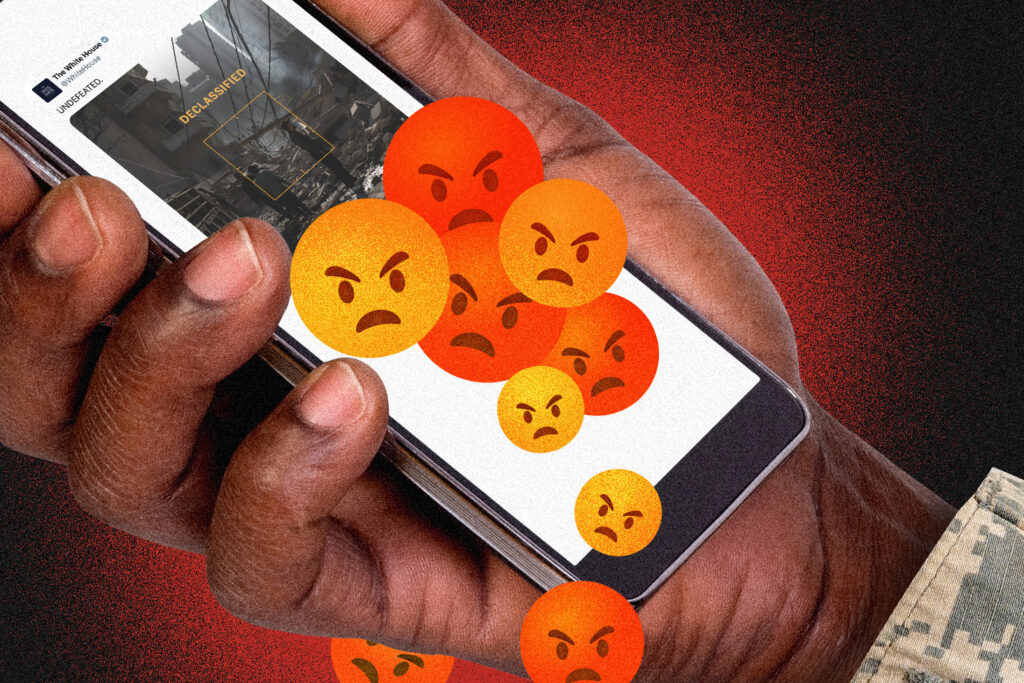
The White House’s relentless stream of meme videos has won millions of online views in a campaign that officials argue is inspiring patriotism and military pride. Yet as the war enters its fourth week, the Trump administration is facing increasing pushback from veterans’ groups that argue that the meme strategy makes a mockery of a serious conflict and obscures questions about its human costs.
The videos have also fueled fierce backlash as they clash with real-world grief: On the same day earlier this month that an Air Force refueling plane crash killed six American service members, the White House posted a meme video interspersing explosions in Iran with celebrations from a sports game on the Nintendo Wii.
John Vick, the executive director of Concerned Veterans for America, a conservative advocacy group, told The Washington Post in a statement that the military’s success deserves to be celebrated, but that “gamifying or making light of war also undermines the sacrifice of the Americans who have died, and obfuscates the cost of open-ended conflict.”
“Most Americans, and especially American veterans, are ready to hear how and when we achieve victory and bring this war to a close,” Vick added. “That is what the Pentagon needs to communicate, and soon.”
UNDEFEATED. pic.twitter.com/Jt69bcag5y
— The White House (@WhiteHouse) March 12, 2026
The White House videos, posted to its official Instagram, TikTok and X accounts, have featured jokes from popular movie, TV and gaming franchises such as “Top Gun,” “Grand Theft Auto: San Andreas” and “Dragon Ball Z,” and many feature comedic visual effects and rap music soundtracks. On March 9, a day after The Post and other media organizations reported on a video showing a U.S. Tomahawk missile killing dozens of children in an Iranian elementary school, the White House posted a missile strike video backed by the rapper Nelly’s “Here Comes the Boom.”
The White House has said its meme strategy reflects its pride in Operation Epic Fury’s “overwhelming success” and “the strength of the most lethal fighting force in the world.” In a statement, White House spokeswoman Olivia Wales said that Trump “grieves for our fallen heroes” and “will never forget their sacrifice in support of this noble mission.”
However, officials there have also said that public outrage is key to driving up views. When the singer Kesha complained that her song had been used in a war meme TikTok, White House communications director Steven Cheung said on X: “All these ‘singers’ keep falling for this. This just gives us more attention and more view counts to our videos because people want to see what they’re bitching about.”
Some Trump supporters argue that the strategy has worked by getting the attention of younger Americans through a form of short-video expression they understand. Malcolm Davis, a 21-year-old student at Kennesaw State University in Georgia who helped get out the vote for Trump’s 2024 campaign, said the memes have been effective because they show “how strong and powerful America is on the world stage.” He added that he understood “why some people think these videos and memes are in poor taste, but it is what it is.”
Most polls since the conflict began find that more Americans oppose the strikes than support them, with a majority saying the administration has not clearly explained their purpose. But separate polls by The Post and Fox News shortly after the strikes found that veteran households expressed more support, in line with their more Republican leanings.
Rosa Brooks, a law professor at Georgetown University and a former senior Pentagon official, said that could quickly change if the war intensifies and fuels public questioning over whether troops are being treated “like pawns in a game.” The Iraq War, she noted, launched with high veteran support, which eroded over time as American deaths mounted and the political objectives became more obscure.
“Veterans and military families tend to be supportive of war efforts because they recognize thousands of military personnel are doing the best they can to carry out these orders in a responsible and competent way,” she said. But “as the civilian harm grows and as U.S. service members come back killed or injured, people will be questioning the justification for the conflict. … They sure don’t want to feel like people’s lives are being thrown away just for fun.”
OPERATION EPIC FURY • Destroy Iran’s missile arsenal. • Destroy their navy. • Ensure they NEVER get a nuclear weapon. Locked in. pic.twitter.com/ika3MMJmZT
— The White House (@WhiteHouse) March 6, 2026
Some veterans suspect the strategy could undermine support for the war effort among the Americans commanded to fight it. Connor Crehan, an Iraq War veteran who co-hosts the Barstool Sports military podcast “Bold American,” said some fellow veterans who were closely supportive of the military thought the meme campaign was in poor taste.
“Serving in Iraq, seeing my friends pay the ultimate sacrifice … knowing the toll it took on our country, I don’t love the idea we’re turning around and making hype videos,” Crehan said in an interview. “I can’t imagine how it feels like for those family members of people who signed up to serve the country and did so proudly … to then see the White House making videos like, ‘Look at all these cool explosions.’”
Criticism of the war memes has been wide-ranging. Steve Downes, whose grizzled voice, from the video game series Halo, was featured in a White House meme video, derided it as “disgusting and juvenile war porn.” And Cardinal Blase J. Cupich, the archbishop of Chicago, said in a statement that the “sickening” meme campaign had “dishonored” dead soldiers and threatened a “profound moral failure” for society at large.
“Our government is treating the suffering of the Iranian people as a backdrop for our own entertainment, as if it’s just another piece of content to be swiped through while we’re waiting in line at the grocery store,” Cupich wrote.
Many conservatives have also expressed their frustration online. Nathan Hughes, an Arkansas man pardoned by Trump after participating in the Jan. 6, 2021, assault on the U.S. Capitol, said in a post on X earlier this month, “Why is the @WhiteHouse posting cringe memes of us dropping bombs on Iran after they just blew up an elementary school full of children?” He added, “I didn’t vote for this.”
The White House’s videos have proved especially gut-wrenching for “Gold Star” families who have lost loved ones in the line of duty, said Karen Meredith, an anti-war activist whose son died in Iraq in 2004.
Meredith said she was at a Gold Star parents’ event on the day the war started, and “there was a pall among all of us, because we just had immediate flashbacks.” In the days afterward, she was horrified to see how the White House was treating the combat, and she said she worries how it could affect the “1 percent of the population who carries 100 percent of the burden” of military losses.
“It’s so painful for us, because we know the war is not a game,” she said. “And yet every day, it’s like a thousand cuts. You can’t get away from it.”
Will not stop until the objectives are met. Unrelenting. Unapologetic.
pic.twitter.com/iM9fqjn1zc
— The White House (@WhiteHouse) March 5, 2026
Bonnie Carroll, founder of the Tragedy Assistance Program for Survivors, a nonprofit organization known as TAPS that helps provide grief camps for children and other support for military families, said the war is difficult for many of those they work with and has rekindled memories of the “catastrophic impact” of a loved one’s death.
“The war brings back their own loss experience. They know what these newly bereaved families are facing,” said Carroll, who lost her husband in an Army plane crash in 1992. “Our families, because they honor life and service, kind of rise above all that chatter. For them, this is real, this is life or death.”
Even beyond the personal impact, some veterans said they worried the memes would trivialize the consequences of deadly conflict. Joey Coon, an Army National Guard member who deployed to Iraq in 2005, said he feared the digital campaign would help give the public an “emotional distance between reality and actual suffering” that could lower the threshold for what Americans will tolerate.
“I’m still losing friends over that war, including another just last month, and that’s a consequence of a quick, decisive — as we were told — war initiated 20 years ago,” he said. “If war is a game, then it’s pretty easy to press start.”
Scott Clement and Razzan Nakhlawi contributed to this report.
The post White House’s Iran memes horrify many veterans of U.S. wars appeared first on Washington Post.