Residents of central Queens have two problems: few green spaces, and even fewer ways to get around.
The sprawling New York City subway network does not reach much of the borough, the city’s largest. In many neighborhoods, residents either rely on some of the slowest buses in the nation or drive their own cars.
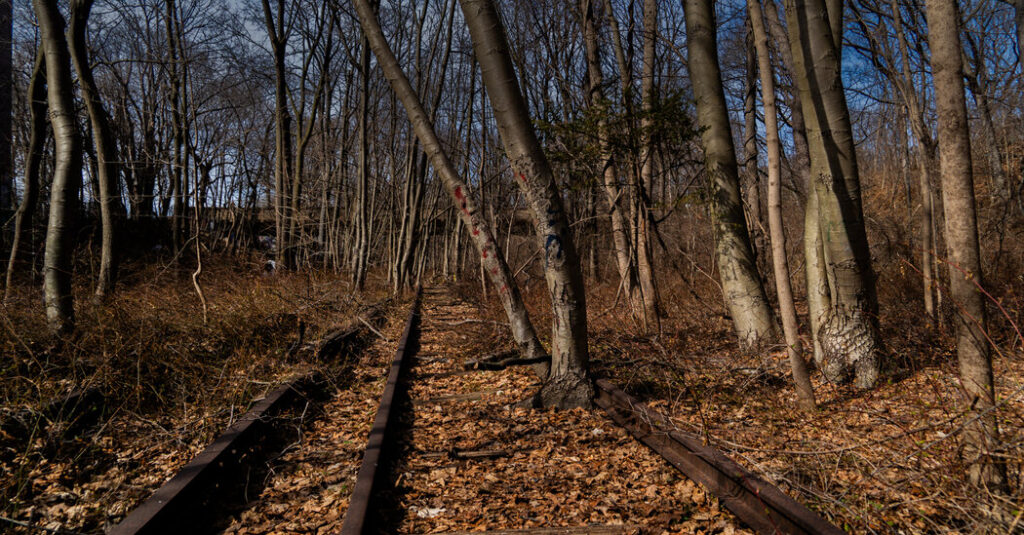
That is why a long-abandoned stretch of aboveground train tracks connecting Rego Park and Ozone Park — two neighborhoods that, somewhat ironically, lack greenery — has been eyed for decades for redevelopment.
But locals are split over the best way to repurpose the 3.5 miles of tracks, which had been used by the Long Island Rail Road’s Rockaway Beach Branch before it closed in 1962, a casualty of declining ridership.
Should the tracks become a park? A subway line? What about both?
The Metropolitan Transportation Authority, the state agency that runs the subway, has said that adding service to the route, a multibillion-dollar investment, would not be cost effective.
And a plan to create an urban park on the tracks, similar to Manhattan’s High Line — without restoring train service — is currently in the early stages of development.
But supporters of a competing proposal to build both new subway stations and acres of green space along the city-owned tracks — a plan known as QueensLink — have been hoping that Mayor Zohran Mamdani will tip the scales in their favor.
Mr. Mamdani expressed support for the idea last year, as a mayoral candidate and an assemblyman representing parts of Queens. A spokesman for City Hall, Jeremy Edwards, declined to comment on whether the mayor still supports the transit expansion.
“The city remains committed to expanding green and open space across the boroughs and is actively exploring all available funding options to make that a reality,” Mr. Edwards said.
The plan would create four new subway stations for the M line, from Metropolitan Avenue to Liberty Avenue. It would require building a tunnel and would extend the M, which currently ends in Forest Hills, to the beaches of the Rockaways.
A report released Wednesday projected that the subway extension would draw 75,000 riders daily and eliminate 4.7 million car trips a year, at a cost of $4.8 billion. But it faces long odds, with the city planning to proceed this year with the rival park plan, known as QueensWay, and key state officials reluctant to express support.
The report, by the infrastructure consulting firm Steer, found that the M.T.A.’s past assessments of the project overstated the costs and underestimated the potential benefits for Queens residents, who cannot currently travel by subway between some of the borough’s wealthier northern neighborhoods and lower-income southern areas.
“We can stitch the city together better,” said Eric Goldwyn, a program director at New York University’s Marron Institute of Urban Management, which consulted on the report.
The stretch of tracks, which wends past backyards in some segments and soars overhead in others, is one of the last undeveloped parts of the rapidly growing borough. Some parts are overrun with lush flora; others are strewed with garbage.
Adding subway service could relieve congestion on a number of crowded train lines in Queens and significantly improve the commutes of people who currently rely on buses or cars, advocates say. For instance, a trip from Elmhurst to the Rockaways that now takes 68 minutes by bus could take 42 minutes on the subway, the report says.
But there are several obstacles. The M.T.A., which would have to agree to the project, estimated in a recent assessment that restoring train service to the tracks could cost nearly $6 billion and would benefit about 40,000 daily riders, just over half as many as the Steer report estimates. (The Steer report assumes more frequent train service to the area.)
The authority has already committed $68 billion to capital projects through 2029, and has a long list of other priorities, including a Second Avenue Subway extension, at a time when the federal government is withholding funds for major infrastructure projects.
One of those capital projects is the Interborough Express, a $5.5 billion light-rail line connecting Brooklyn and Queens that would serve far more riders than QueensLink and that Gov. Kathy Hochul already supports.
“There are just a lot of other transit projects that are in front of it in line,” said Kate Slevin, the executive vice president of the Regional Plan Association, an urban policy research group. “You have to prioritize.”
At the same time, the QueensWay project, which calls for building up to 47 acres of green space along the tracks, is set to begin construction this year, according to a spokesman for the city’s Economic Development Corporation.
The proposal was backed by Mr. Mamdani’s predecessor, Eric Adams, and has already raised $49 million of its $350 million price tag from the city. (The project was expecting to receive another $117 million in federal funding, which had been authorized by the Biden administration, but it was rescinded under President Trump.)
QueensWay’s first phase — which would add bike paths, walkways and other amenities along less than a mile of track — could be completed by 2028, said Mike Lieberman, a program director with the Trust for Public Land, a nonprofit that has worked on the proposal for years.
“This is about delivering real benefits to residents,” Mr. Lieberman said, adding that he believed further delays to reconsider the transit plan would hurt everyone. “We continually end up in this cycle of kicking the can down the road.”
The governor’s office declined to comment on the feasibility of the QueensLink project. An M.T.A. spokesman referred back to its assessment that the project is a low priority.
Supporters of the proposal worry that it will become even more difficult to get the city and state to agree to build new subway stations if the park plan moves forward first.
“It’s like doing your landscaping before doing your house,” said Noelle Hunter, a spokeswoman for QueensLink.
But they are hopeful that with a new mayor who once backed the transit plan, and a number of other elected officials showing their support, the project will gain momentum.
“It’s definitely worth us waiting, to see if we can move this project forward,” said Claire Valdez, a Queens assemblywoman who is running for Congress and who supports adding train service to the tracks. “The governor and the M.T.A. are wrong — they’re not seeing the vision here.”
James Sanders Jr., a state senator who represents a swath of Queens near the abandoned line, said adding new subway service would generate jobs and cut back on pollution in car-dependent neighborhoods.
For residents who have waited years for something to be done with the train tracks, a decision can’t come soon enough.
Travis Terry, 51, a longtime supporter of the park plan, said he did not oppose adding train service as well. But he thinks there’s no time like the present to get started.
“People would say to me, ‘Your daughter’s first bike ride will be on the QueensWay,’” he said. “Well, now she’s in college.”
Stefanos Chen is a Times reporter covering New York City’s transit system.
The post Should These Abandoned Tracks Become a Park or a Train Line? Or Both? appeared first on New York Times.