When Mayor Zohran Mamdani threatened last month to raise property taxes on New Yorkers, it was seen as a tactic to pressure Gov. Kathy Hochul into increasing income taxes on the wealthy.
Instead, it provoked immediate backlash.
Numerous elected officials — from Mr. Mamdani’s left-leaning allies to centrist Democrats representing Black homeowners — said in no uncertain terms that raising property taxes was a nonstarter.
The mayor began to quietly retreat. He convened city and state lawmakers in a series of private meetings to hear their concerns and let them know he was highly unlikely to pursue the tax increase as he was pushing for more state revenue, according to interviews with nine lawmakers.
Now, five weeks after he proposed increasing property taxes by 9.5 percent, the mayor seems to have all but given up on the idea, even as Ms. Hochul shows no interest in raising income taxes on the rich — a priority for Mr. Mamdani’s democratic socialist base.
By trying to use the proposed property tax increase as leverage with the governor, Mr. Mamdani appeared to have overestimated his power and underestimated the severe antipathy New Yorkers have toward a property tax system that often disproportionately affects middle-class homeowners.
His strategy also illustrated the risks of trying to pressure a governor whom he’d already endorsed for re-election without building public support for his tax plan.
Mr. Mamdani portrayed his announcement last month as a binary: Either Albany would raise taxes on those making $1 million or more a year and funnel more state revenue to the city, or property taxes would go up and the city would have to raid its budget reserves.
The mayor’s framing of the choice greatly angered Ms. Hochul, who thought Mr. Mamdani’s presentation amounted to grandstanding, according to three people familiar with her thinking. The mayor, who has refrained from appearing at rallies with allies to push higher taxes, had agreed not to escalate his rhetoric on demanding tax increases, two of the people familiar with the matter said.
The episode was a rare sign of tension between Ms. Hochul and Mr. Mamdani, who have forged a close partnership since he took office. Their multibillion-dollar announcement on child care exemplified some of their shared priorities, and Ms. Hochul said earlier this month that she is “working very hard to have a constructive relationship with the mayor.”
But she added that city officials needed to be doing more to rein in spending, especially after the governor had just agreed to give the city $1.5 billion in aid for a host of municipal services.
“One and a half billion is not something that is handed out every day,” she said. “I did that because I wanted to help them get a foundation to build from as they look for savings, which I think are necessary. So this is for them to work out now.”
From the outset, Mr. Mamdani had presented the property tax hike as a last resort, should he be left with a deficit after state leaders conclude their budget process. The state budget is due on April 1 but frequently is resolved after that deadline. Should that deficit persist, he would most likely still have time to try to build support for hiking property taxes — the only tax unilaterally under a mayor’s control — before his next budget presentation is due on May 1.
“I don’t think he wants to raise property taxes,” said Leroy Comrie, a state senator from Queens who attended a task force meeting where Black politicians voiced their frustration over the proposal. “He knows that it will hurt minority communities the most.”
James Sanders Jr., a state senator from Queens, said the mayor’s proposal “caused an earthquake in the Black population, which was just starting to get to know him” and raised the “question of whether the administration is fully getting it.”
Now, as state budget negotiations enter their final, frenzied stretch, Mr. Mamdani and his team are instead pushing other increases to corporate and unincorporated business taxes and to the personal income tax rate in New York City, as first reported by the news site New York Focus.
Increasing property taxes is so unpopular that a New York mayor has not done it substantially since Michael R. Bloomberg raised them by 18.5 percent to account for economic fallout from the Sept. 11, 2001, terrorist attacks.
Liz Krueger, the longtime Senate Finance Committee chair representing the Upper East Side, said that New York City was truly in “crisis” then, suggesting that the city under Mr. Mamdani was in nowhere near as dire shape.
“People in executive positions frequently float test balloons,” she said. “I think that this test balloon showed that it wasn’t a very feasible proposal.”
Carl Heastie, the Assembly speaker who represents a homeowner-heavy section of the Bronx, agreed.
“Property, a lot of the time, is the biggest asset that people will have in their lives,” he said. “I just think you don’t want to mess with that.”
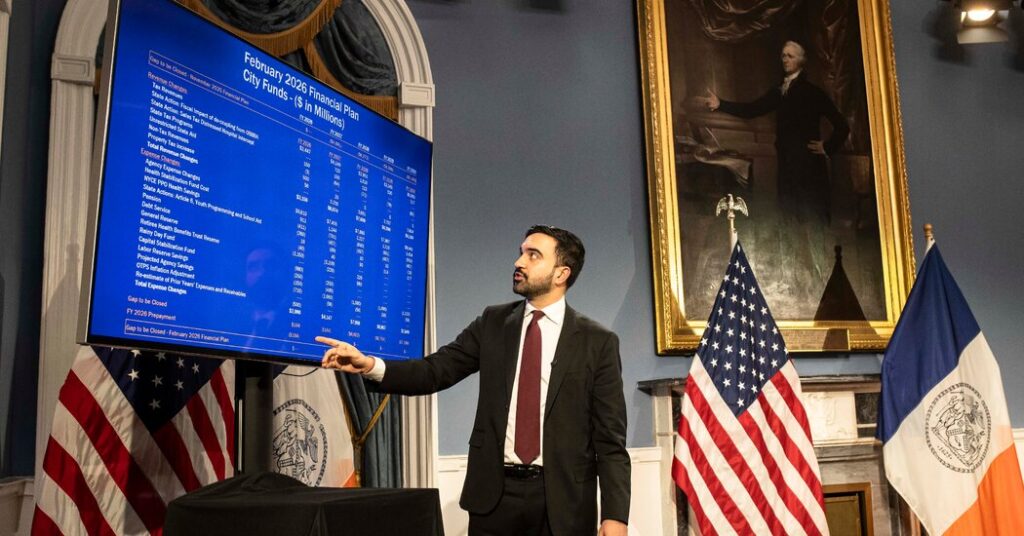
When Mr. Mamdani unveiled his $127 billion budget proposal last month, he blamed the budget crunch on his predecessor, Eric Adams, and said it made it harder for him to try to fund his sweeping campaign agenda that included faster bus service and greatly expanded child care services.
He said the proposed property tax increase would raise $14.8 billion in revenue over four years, even as he insisted he didn’t want to have to enact the measure.
Several people involved in the city’s budget negotiations who were granted anonymity said City Hall officials were taken aback by the level of opposition to the proposal. One of Mr. Mamdani’s former colleagues in the State Legislature told the mayor that if he went through with the property tax proposal, he would be a one-term mayor.
In one of two meetings late last month with City Council members, Mr. Mamdani and a few of his aides gathered in a private room in City Hall with the Council’s Progressive Caucus, a group of lawmakers ideologically aligned with the mayor.
According to someone who attended, the legislators made clear their opposition to his property tax proposal, which the entire City Council would need to approve in order for it to take effect. The mayor indicated he was confident about getting more state aid to close a projected budget deficit of $5.4 billion over two years, the person said.
“I can confirm the administration has never asked us to support this,” Councilwoman Sandy Nurse, a co-chair of the Progressive Caucus, said of the proposed property tax increase.
After the mayor addressed members of the state’s Black Legislative Task Force a few weeks ago, some attendees came away convinced that he was using the warning of a tax increase purely as a bargaining chip.
Chantel Jackson, an assemblywoman from the Bronx who chairs the Black Legislative Task Force, said his property tax move “definitely caused a ruckus that I don’t think he was prepared for or that his team was prepared for.”
For now, the mayor is considering other options to close his budget gap, including drawing down the city’s cash reserves, which the city comptroller, Mark Levine, and other financial ratings agencies have warned against.
At the same time, he has proposed championing a reform to the state’s property tax system, which has long been the subject of scorn and legal action from critics who have derided it as being wildly inequitable and placing an unfair burden on lower-income New Yorkers.
In the complex system, which breaks real estate into four tax classes, some properties pay much less than their market value would dictate while others pay too much.
When asked about the proposed property tax hike, the mayor’s spokeswoman, Olivia Lapeyrolerie, said it is too early to draw conclusions, noting that the city budget typically comes together in June. The deadline for enacting a budget is June 30.
“March comes before June, and the mayor is focused on working with our partners in Albany to close the city’s inherited budget gap,” Ms. Lapeyrolerie said. “As happens annually, the mayor will then negotiate a budget with the City Council, based on what emerges from the state budget.”
If the mayor does intend to push a property tax increase, getting City Council support will not be easy.
Among the early, vocal detractors of the idea was City Council Speaker Julie Menin, whose support Mr. Mamdani needs to pass his budget. Ms. Menin also declined to join the call for an income tax hike or lay out agency cuts.
“Speaker Menin was clear from the outset that raising property taxes isn’t an option,” Council spokesman Yoav Gonen said. “Doing so would exacerbate the affordability crisis for renters, small businesses, homeowners and communities across the city.”
Sally Goldenberg is a Times reporter covering New York City politics and government.
The post Mamdani Is Quietly Backing Away From a Threat to Raise Property Taxes appeared first on New York Times.