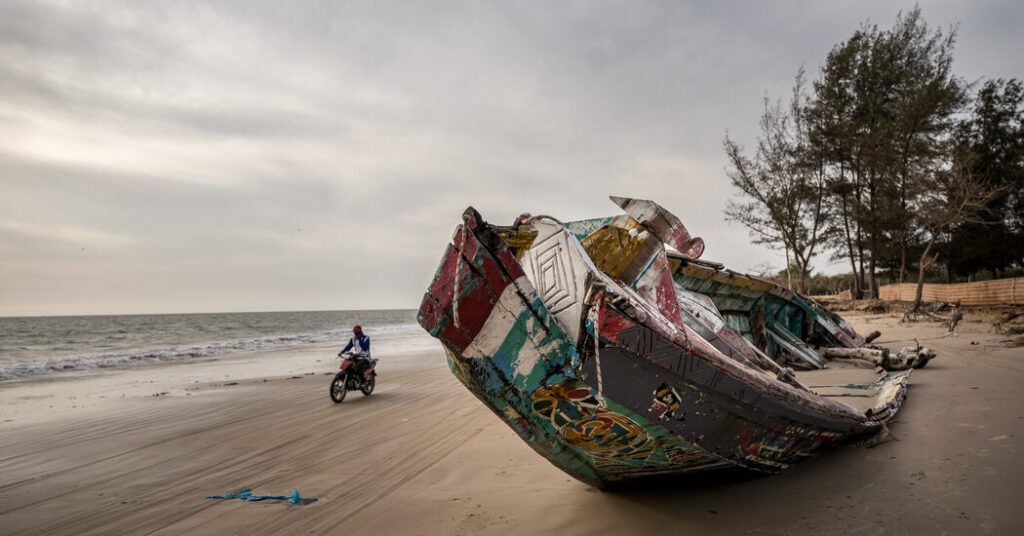
The brightly painted wooden boats that line Gambia’s shores are built for local fishing in the calm, slow-moving tides. Overnight, however, some of them disappear to embark on one of the world’s most dangerous sea journeys.
Packed with hundreds of people, migrant boats typically depart from bustling coastal towns in Morocco, Mauritania and Senegal on their way to Europe. But as the immigration authorities have cracked down on those well-known hubs, migrants and smugglers have sought alternative departure points.
Now, many African migrants are turning to Gambia, with the remote fishing island of Jinack becoming a hot spot.
The island has a special appeal: Local villagers say it is haunted by their ancestors, who are said to bring misfortune on outside authorities who try to interfere. Belief in this curse is so widespread that even some local officials hesitate to go to Jinack. When migrants and smugglers in West Africa learned of this, they began to flock to the island.
“At the peak of it, late last year, migrants outnumbered us by 10 to 1,” said Yusupha Manneh, a community leader in Jinack Kajata, one of the four villages scattered on the narrow island.
Late last year, three boats crowded with hundreds of migrants departed from Jinack. One boat capsized, and the authorities fear the other two were lost at sea. Dozens of migrants have been found dead, mostly brought to shore by the tide, said Momodou Ceesay, director of operations at the country’s disaster response agency.
Hundreds remain missing.
One of the them is Landing Manneh, who left his wife, Suwadou, 27, and baby. “We have not given up hope,” she said. “We leave it to Allah.”
The number of migrants trying to cross from West Africa to the Spanish Canary Islands surged in recent years before plummeting last year, according to the International Organization for Migration, a United Nations agency.
Analysts said the drop was partly the result of brutal crackdowns by North African governments that received hundreds of millions of dollars from the European Union to block migration.
About 21,877 migrants arrived on the Canary Islands last year, according to the I.O.M. “While many of these arrivals originated from the coasts of Morocco or Mauritania, the coast of Gambia has also emerged as a location of departure,” the agency said.
Ebrima Drammeh, a migration activist from Gambia, said that of the 73 boats that set out for Europe from Gambia last year, about 21 departed from Jinack. Part of the island’s appeal is its location; Jinack sits exactly where the River Gambia meets the Atlantic Ocean. Boats can easily slip away under cover of night and thick mangroves. Then there is the supposed curse.
“Officers don’t come here in uniform,” said Ousman Manneh, the son of the village chief on Jinack. “This is a tradition. Our spirits don’t want officers because our forefathers came here to seek refuge from unending wars.”
As the authorities seldom visit the island, cannabis has been grown and sold openly for decades, despite being illegal in Gambia. A rare drug raid was carried out in 1999 by Capt. Amadou Suwareh, a regional commissioner. According to villagers, a swarm of bees surrounded him when he tried to escort suspects off the island, forcing him to flee in terror. He was fired just days later.
Villagers took this to be proof of the ancestral curse.
“If it doesn’t make sense to other people, it makes sense to us because it is our belief system,” said Yusupha Manneh, the community leader.
In the months before the three boats left the island late last year, migrants had crammed onto Jinack. Some locals vacated their rooms and rented them out for about $10 per night. Migrants waited weeks before departing on one of the overcrowded fishing boats.
Residents said that the police and immigration officers visited the island only after the boats left. The officers did not wear uniforms, they said.
“Our approach in Jinack is more of community engagement initiative than interceptions,” said Siman Lowe, a spokesman from the Immigration Department.
Last year’s boat accidents were a turning point for Jinack. Residents were outraged that the authorities had failed to intervene and potentially save hundreds of lives.
In January, villagers who felt the migrant departures had brought negative attention to the island took it upon themselves to seize two boats that were fitted for a journey to Europe.
They rounded up the migrants and handed them to the police, according to Mr. Lowe. Earlier this month, narcotics authorities conducted raids on the island, burning down dozens of illegal cannabis farms.
But such moves are unlikely to stop the migrant boats, said Mr. Drammeh, the migrant activist. He left Gambia in 2013, traveled to Libya and eventually made his way to Italy. He returned to Gambia for the first time this year.
“Nothing has changed,” he said. “The conditions that forced me to leave still exist.”
Tabora Bojang contributed reporting.
Saikou Jammeh is a reporter and researcher for The Times based in Dakar, Senegal.
The post Villagers Say This Island Is Cursed. Migrants Saw an Opportunity. appeared first on New York Times.