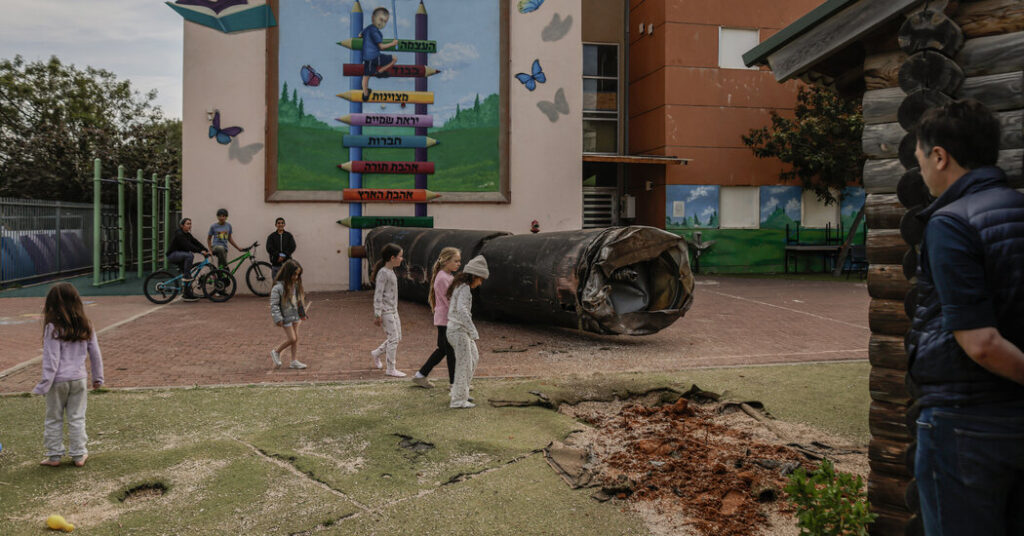
Maayan’s mother, Meitar Cohen, 32, works as a teaching assistant at the school, which is in the Peduel settlement, about 15 miles east of Tel Aviv. She has four other children, all boys; Maayan, a third grader, is the only one who attends this school, called Shilat.
The family lives in a caravan near the school. But the caravan has no safe room, so they have spent several nights in the school’s shelter alongside other families, Ms. Cohen said. The school, like others across Israel, had been closed since Saturday night, when a strike hit the city of Arad.
Her children are deep sleepers, Ms. Cohen said, and she prefers the difficulties of the shelter to the risk that an air-raid siren might not wake them.
Phone warnings woke the families in the shelter around midnight, Ms. Cohen said. Then a siren sounded. One of Maayan’s brothers ran to close the shelter door, and they heard a loud explosion soon afterward.
Later, when Ms. Cohen was texted an image of the missile fragment, she thought it was A.I.-generated. But Maayan recognized the site immediately and became very frightened, Ms. Cohen said.
After making sure it was safe outside, Ms. Cohen said, she let Maayan and some friends go and look at the fragment. She wanted them to understand what had happened, rather than let their imaginations inflate their fears. That is when this photograph was taken.
According to Jeffrey Lewis, a nuclear nonproliferation expert at the Middlebury Institute for International Studies, the photo shows the remnants of an Iranian Ghadr or Emad ballistic missile. Those are variants of the Shahab-3, an Iranian weapon based on a North Korean medium-range missile.
John Ismay and Peter Robins contributed reporting.
The post A Missile Fragment in a Schoolyard appeared first on New York Times.