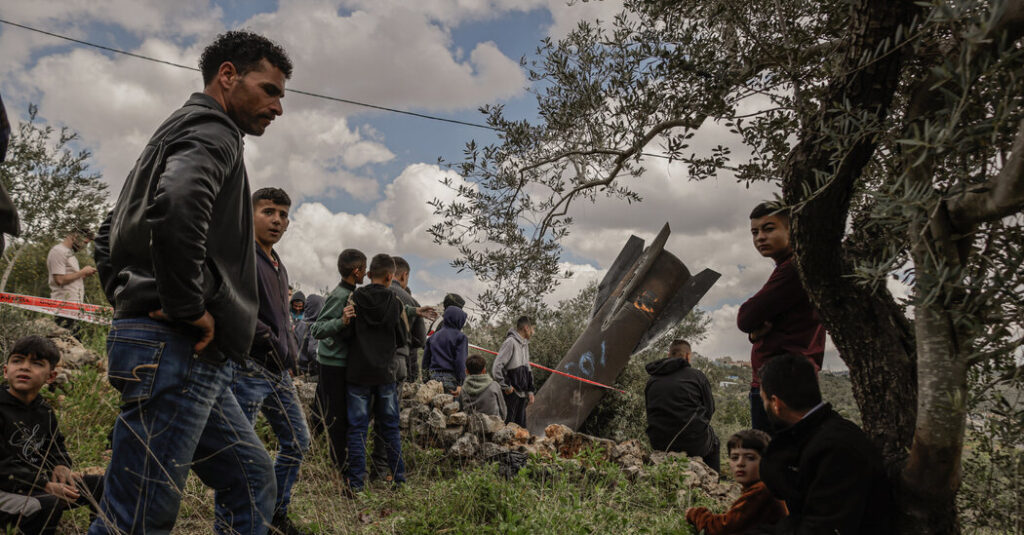
Iran fired waves of missiles and drones across the Middle East on Tuesday, displaying a sustained ability to retaliate as President Trump said for a second day that talks with Iran were underway to end the war.
Mr. Trump told reporters during an appearance in the Oval Office on Tuesday that negotiations with Iran were continuing and that Vice President JD Vance and Secretary of State Marco Rubio were joining Jared Kushner, Mr. Trump’s son-in-law, and Steve Witkoff, one of his most senior advisers, in the discussions. The president said that Iran would like “to make a deal.”
“We’re actually talking to the right people, and they want to make a deal so badly, you have no idea how badly they want to make a deal,” Mr. Trump said.
Although multiple Iranian officials have publicly denied that Washington and Tehran are talking directly, two officials with knowledge of diplomatic efforts said the United States had sent Iran a 15-point plan to end the war. Transmitted through Pakistani intermediaries, the plan deals with Iran’s ballistic missiles, nuclear programs and maritime shipping routes, according to the officials, who spoke on condition of anonymity to discuss sensitive details.
Pakistan’s prime minister said in a social media post on Tuesday that his country could host talks but only if both sides agreed to them.
The American outreach comes as Bahrain, Israel, Iraq and Lebanon all reported attacks from Iran on Tuesday, and the governments of Kuwait and Saudi Arabia said they had also intercepted attacks.
At the same time, the United States is sending more than 4,000 Marines to the region, and senior military officials are weighing a possible deployment of a combat brigade from the U.S. Army’s 82nd Airborne Division.
For weeks, military leaders in the United States and Israel have reported that their daily barrage of strikes amounting to thousands of targets have decimated both Tehran’s leadership and its military capabilities.
But Iran appeared to display a degree of governing capabilities on Tuesday with the selection of Mohammad Bagher Zolghadr, a hard-line former deputy commander in the Islamic Revolutionary Guards Corps, as the country’s top national security adviser. He replaced Ali Larijani, who was killed in an Israeli strike last week.
Iran’s attacks across the region also appeared to indicate, at the very least, that it retains residual military capabilities. The Israeli authorities said on Tuesday that missiles launched from Iran had struck multiple areas in Israel, including a direct hit to Tel Aviv that caused extensive damage to at least three residential buildings and injured at least six people. Israeli air defenses failed to intercept the missile, an Israeli military spokesperson said.
In the semiautonomous Kurdish region of Iraq, a volley of six Iranian ballistic missiles killed six Kurdish fighters and wounded 30 others, the regional government said.
And in Bahrain, an Iranian missile killed a Moroccan contractor working for the United Arab Emirates armed forces and injured five Emirati service members, the Emirati defense ministry said on Tuesday. The ministry did not clarify why Emirati armed forces members were deployed in Bahrain.
An Iranian military officer, Commodore Alireza Tangsiri, sought to underline Iran’s stranglehold over the Strait of Hormuz, the key oil shipping lane, by writing on social media Tuesday that a container ship in the Gulf, the Selen, was “turned back” because it lacked permission.
“The passage of any vessel through this waterway requires full coordination with Iran’s maritime authority,” said Commodore Tangsiri, who serves as commander of the Navy of the Revolutionary Guards.
The maritime news website, gCaptain, cited tracking data showing that the Selen, which was bound for Pakistan, turned around before reaching the strait.
The growing severity of the oil shock caused by the closure of the strait continued to reverberate across the globe.
President Ferdinand R. Marcos Jr. of the Philippines declared a national energy emergency on Tuesday as the country’s supplies of gasoline dwindled. The country has enough gasoline in reserve to last 53 days, enough diesel for 46 days and enough jet fuel for about 39 days, the Philippines’ Department of Energy said.
Like many Asian countries, the Philippines is heavily dependent on oil from the Middle East. Diesel prices have doubled there since the war began, surpassing 120 pesos, or $2, per liter, and government offices in the country have switched to a four-day workweek to save fuel.
In the United States, where the airline industry is dealing with long lines at airports caused by the partial shutdown of the Department of Homeland Security and the absence of many security screeners the department employs, the chief executive of United Airlines warned of the prospect of significantly higher ticket prices.
“If oil prices stay where they are today, that’s 11 billion of expense for us, and that would require prices to be up 20 percent to break even, to cover that cost,” Scott Kirby, the chief executive, said on Bloomberg TV.
Mr. Kirby also described as “reasonable” a forecast of oil prices reaching $175 a barrel and staying above $100 until the end of next year.
The European Union, which like Asia is highly dependent on Middle Eastern oil, could help secure the Strait of Hormuz but only “when hostilities end,” Ursula von der Leyen, the president of the European Commission, the executive arm of the European Union, said on Tuesday.
“We think that it is time to go to the negotiation table and to end the hostilities,” she said.
Frank-Walter Steinmeier, who has the largely ceremonial post of president of Germany, offered some of the bluntest European comments on the war since it started Feb. 28. Speaking at an event in Berlin, he called the war a “politically disastrous mistake” and said there seemed little doubt that “the justification based on an imminent attack on the U.S. does not hold water.”
On the Lebanese front, Israel said on Tuesday it would intensify its ground operation there. Israel’s defense minister, Israel Katz, said Israel intended to expand the area under its control in southern Lebanon as part of an operation against Hezbollah, the Iran-backed militant group.
The Lebanese government said it had withdrawn its approval of Iran’s ambassador, Mohammad Reza Sheibani, and had given him until March 29 to leave the country, the Lebanese foreign ministry said on Tuesday.
The government cited “Iran’s violation of diplomatic norms and established protocols between the two countries” but did not specify what those violations were. The government typically uses that language to refer to interference in Lebanese internal affairs, especially Iran’s support for Hezbollah.
Reporting was contributed by Adam Rasgon, Julian E. Barnes, Farnaz Fassihi, Natan Odenheimer, Anushka Patil, Johnatan Reiss, Euan Ward, Ismaeel Naar, Emmett Lindner, Vivian Nereim, Elian Peltier, Sui-Lee Wee, Isabel Kershner, Christopher F. Schuetze, Dayana Iwaza, Erika Solomon and Ephrat Livni.
Yeganeh Torbati is the Iran correspondent for The Times.
The post Iran Signals Resilience With Volley of Missiles Across Middle East appeared first on New York Times.