A majority of Supreme Court justices seemed sympathetic on Tuesday to the idea that the Trump administration should be able to turn away asylum seekers along the U.S.-Mexico border.
If the court backs the administration, it would allow President Trump to revive a policy first used in 2016, in which the government stopped asylum seekers from setting foot on U.S. soil, where federal law would entitle them to try to claim asylum and receive protection from persecution.
Under federal law, any noncitizen who is “physically present in the United States” or “arrives in the United States” can apply for asylum. Migrants who announce their intention to do so are then referred for an interview to determine whether they have a credible fear of persecution.
At issue in the case is whether noncitizens must fully cross the border to gain the right to apply for asylum or if they must be allowed to apply if they merely appear at the border and seek entry.
The Supreme Court’s conservative majority has generally been receptive to the Trump administration’s assertions of presidential power, in a series of temporary orders that have allowed President Trump to implement his policies while litigation plays out in the lower courts. But last month the justices, including two of Mr. Trump’s nominees, invalidated his sweeping tariffs on imports from nearly every U.S. trading partner, in a rebuke of his signature economic policy.
A key question for the justices in Tuesday’s asylum case, which will likely be decided in late June or early July, is what exactly it means to “arrive” in the country. The justices spent more than an hour on the case, much of it spent struggling to parse the difference between a person who “arrives in” the United States and one who is “arriving at” the border.
Chief Justice John G. Roberts Jr. and Justice Amy Coney Barrett, who are often in the majority, suggested that “arrives in” the U.S. means a person who has fully crossed the border — as the Trump administration has argued.
President Barack Obama first began turning back some asylum seekers in 2016. The policy was dramatically expanded by President Trump during his first term before it was rescinded by the Biden administration in 2021.
Lower courts have repeatedly invalidated the policy after immigrant rights advocates and several asylum seekers from Honduras, Nicaragua and Mexico sued in 2017. Kelsi Corkran, an attorney for the migrants, told the justices on Tuesday that the policy was illegal and at odds with the nation’s long history of providing refuge to immigrants escaping persecution.
The Trump administration, which has taken steps to dismantle the asylum process for migrants globally, urged the justices to allow it to be reinstituted.
Vivek Suri, an assistant to the solicitor general, called the policy a critical tool that the administration intends to revive if it determines it is needed to address a surge of migrants at the border.
Justice Neil M. Gorsuch, another member of the conservative majority, asked about the rights of an asylum seeker at the back of the line, or a person standing at the water’s edge waiting to cross the Rio Grande, which separates Mexico and the United States. He was illustrating concerns about the limits of the asylum seekers’ claims and asking how far their rights would extend.
Justice Brett M. Kavanaugh suggested the discussion about the exact location of the border was “very artificial.” No matter where the court sets the line for asylum seekers’ rights to kick in, he said, the government would likely just stop migrants there, pushing them farther into Mexico.
Justices Sonia Sotomayor and Ketanji Brown Jackson, both liberals, had the toughest questions for the administration. They were the only two justices who seemed to fully embrace the claims of the asylum seekers.
Turning away asylum seekers, Justice Sotomayor suggested, violates Congress’s intent in enacting a statute that entitles arrivals to claim protection against persecution, as well as international agreements involving refugees dating back to World War II.
“They’ve arrived. They are knocking at the door,” Justice Sotomayor said.
Justice Jackson suggested that because the policy was defunct, there was no longer a live controversy for the justices to decide, and the issue should be dropped in the lower courts. Mr. Suri, the government’s lawyer, said in response that the administration wanted the authority to reimpose the policy as needed.
For decades, the government has interpreted the law as providing migrants a right to seek asylum at border crossings if they fear persecution because of their race, religion, nationality or political views. With fewer legal pathways to enter the United States, such claims have proliferated in recent years, with backlogs now totaling almost four million cases and lengthy wait times for hearings.
A 2016 surge of Haitians at the southern border near San Diego first prompted the Obama administration to limit asylum seekers by “metering” the flow of migrants allowed to cross into the country. President Trump expanded and formalized that temporary practice to all southern entry points starting in 2018 — a policy the administration said was necessary to deal with overcrowding and that advocates said was illegal and inhumane.
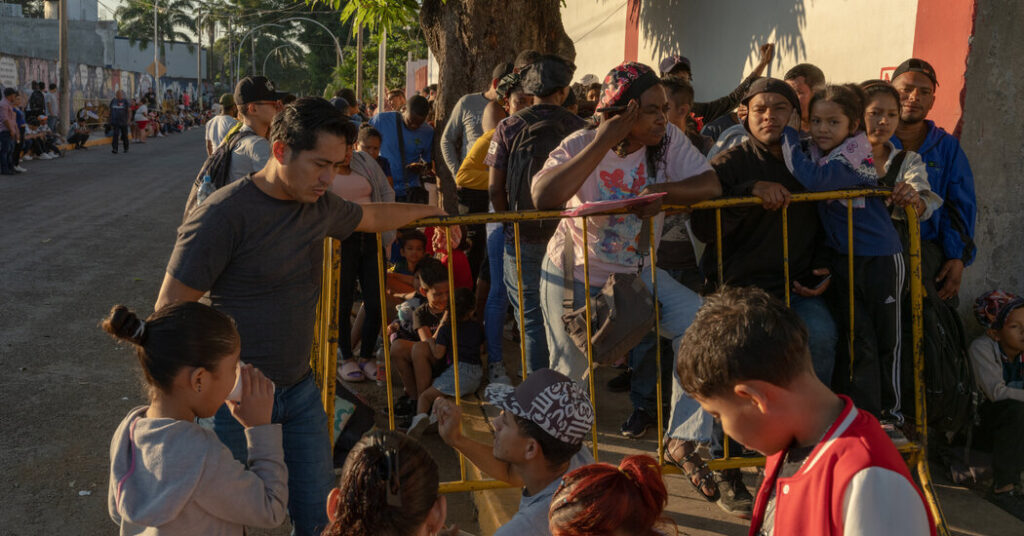
In some cases, Customs and Border Protection officials stood on international bridges and prevented migrants from reaching ports of entry on the U.S. side of the border. Asylum seekers who were turned away began to mass on the Mexico side of the border. Some were stranded in encampments for weeks or months, facing food shortages and dangerous conditions.
“You cannot ask someone fleeing rape, torture, or death threats to wait in danger indefinitely because a government has decided their lives are inconvenient,” Nicole Elizabeth Ramos of Al Otro Lado, one of the groups challenging the policy, said in a statement. “The question before the court is whether those laws can be set aside by executive action, or whether they remain binding at the border, as written.”
In addition to its policy concerns, the administration said the government’s obligations in the asylum statute only apply domestically and not across the border in Mexico.
Justice Department officials cited the court’s decision in the 1990s involving tens of thousands of Haitians fleeing a military coup by boat. In that case, the Supreme Court said the government was permitted to stop the migrants at sea, and to prevent them from reaching U.S. territory without determining whether they qualified as refugees.
Lower court judges sided with the migrants on the asylum issue. A District Court judge said asylum seekers must be processed if they have arrived at the border, even if they are stopped before stepping onto U.S. territory. A divided panel of the U.S. Court of Appeals for the Ninth Circuit agreed, saying that a person who “presents herself to an official at the border has arrived, no matter which side of the border she is standing on.”
“To arrive” means to reach a destination, said Judge Michelle T. Friedland, joined by Judge John B. Owens.
A larger set of appeals court judges declined to rehear the case, but a dozen of 29 judges dissented, with Judge Daniel Bress writing that the panel was “gravely wrong” and that its ruling “will seriously harm our country’s ability to manage its borders.”
A group of former government officials who worked for presidents of both parties urged the court to uphold what they said was Congress’s intent for a fair process to evaluate asylum claims and protect vulnerable people fleeing persecution. No prior administration, the group said, has ever claimed the authority to categorically block access to asylum based on a few inches of territory.
These “safeguards,” the group said in a court filing in support of the migrants, are “not just bureaucratic red tape that the government may disregard or alter at will.”
Ann E. Marimow covers the Supreme Court for The Times from Washington.
The post Supreme Court Seems Open to Trump Request to Block Asylum Seekers at Border appeared first on New York Times.