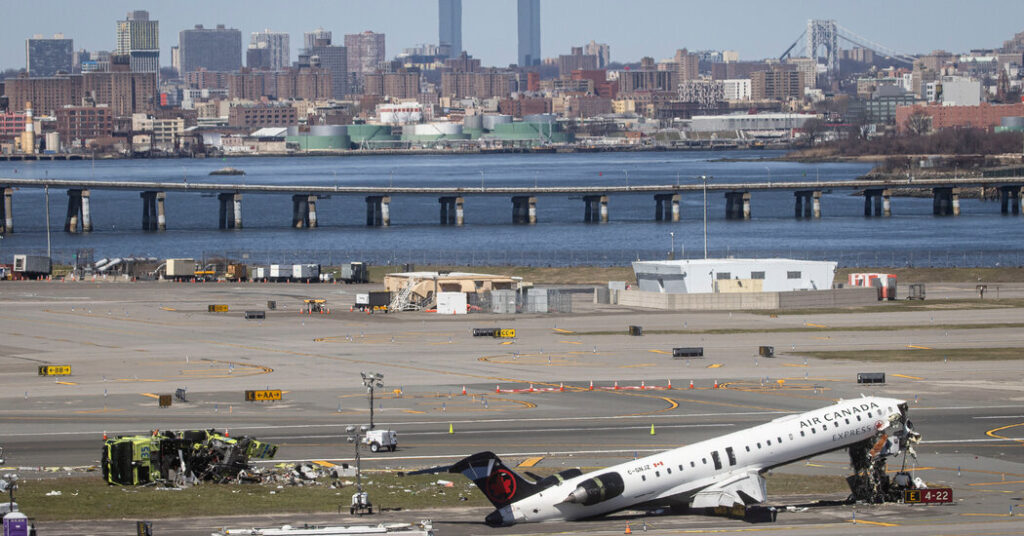
It took 20 seconds for a routine landing at LaGuardia Airport on Sunday night to devolve into a fatal disaster.
Air Canada Express Flight 8646 was about 100 feet above the ground when an air traffic controller gave permission for a fire truck to cross LaGuardia’s Runway No. 4.
Eleven seconds later, a controller in the LaGuardia tower started yelling over the radio at the fire truck’s driver to stop immediately, Doug Brazy, a senior aviation accident investigator with the National Transportation Safety Board, said at a news conference on Tuesday afternoon.
One second after that, the plane touched down on the runway, Mr. Brazy said. Three seconds later, the captain assumed control of the plane from the first officer. The jet rolled on the tarmac for another seven seconds, braking hard. Then the two vehicles collided, the nose of the plane imploding, the fire truck flipping on its side, debris spraying across the tarmac. Both pilots died; both firefighters were injured but survived.
The first investigators arrived before sunrise on Monday morning. The rest of the team assembled slowly, as air safety experts faced the same delays as other Americans attempting to travel during a partial federal government shutdown.
Forty hours after the disaster, many facts remained unknown, Jennifer Homendy, chairwoman of the National Transportation Safety Board, said, including what exactly caused the cascade of failures that ended in two deaths and injured dozens of people who thought they were about to safely arrive at their destination.
Officials are investigating whether the crash stemmed from problems with staffing, vehicle tracking technology, communication systems, human judgment or a combination of them all.
“When something goes wrong, that means many, many things went wrong,” Ms. Homendy said.
In her comments on Tuesday, she focused on several areas of concern for safety investigators. The jet struck a fire truck that was not equipped with a transponder, she said. Emergency vehicles at other airports around the country tend to have transponders, which allow air traffic controllers to monitor the vehicles’ positions, Ms. Homendy said.
LaGuardia is equipped with a surveillance system that allows controllers to track the movement of planes and vehicles on the ground and gives audible and visual warnings of possible incursions on runways. Those alarms did not trigger before the crash, Ms. Homendy said.
Without transponders, investigators working to recreate Sunday’s crash have been forced to rely on older radar technology, which presents vehicle tracking information with far less precision.
Investigators do not know whether the firefighters in the truck heard the tower’s command to stop driving forward, Ms. Homendy said. Audio and video footage reviewed by The New York Times suggests that there was a communication breakdown, though it remained unclear why. Shortly before the collision, an air traffic controller is heard saying, “Stop, stop, stop, stop, Truck 1, stop, stop, stop.” Six seconds later, the controller again said, “Stop, Truck 1, stop!”
The firefighters are the only people who could say for certain whether they heard the command from the tower, but investigators so far have not formally interviewed them, Ms. Homendy said. One of the two men remained in the hospital on Tuesday, and the other had been discharged.
There were two air traffic controllers in the LaGuardia tower at the time of the crash, Ms. Homendy said. There is confusion about which controller was in charge of monitoring the movements of planes and vehicles on the ground, she said. Standard procedure at LaGuardia calls for two controllers to work the overnight shift, when plane traffic at the airport is light.
During busy daytime hours, more controllers handle tasks, including monitoring ground movements and clearing pilots for departure, Ms. Homendy said.
Safety officials have worried about this staffing arrangement for years, she said. This practice was an issue in the January 2025 midair collision between a commercial jet and an Army helicopter above Ronald Reagan National Airport outside Washington, D.C., which happened at 8:47 p.m.
Despite this longtime concern, Ms. Homendy stressed that it was too early in the investigation to know whether the controllers were distracted, or if staffing may have played a role in communications failures. The details of the crash that were released on Tuesday were described as preliminary. Investigators plan to interview everyone who was in the tower at the time, she said.
The pilots of the plane were identified on Tuesday as Antoine Forest and Mackenzie Gunther, both from Canada. It was unclear whether the pilots saw the fire truck driving onto the runway ahead of them, Ms. Homendy said.
Recordings of air traffic control audio communications reviewed by The Times suggest that the air traffic controllers were focused on another emergency, which involved a United Airlines flight that had twice aborted takeoff, according to Kathryn Garcia, the head of the Port Authority of New York and New Jersey, the airport’s operator. After the crash, the recordings captured a controller telling another pilot, “I messed up.” It was not immediately clear what he was referring to.
Of the 76 passengers and crew on the aircraft, 39 were hospitalized. Six people from the plane remained hospitalized on Tuesday, Air Canada said in a statement.
Even before the crash, long lines had been forming at LaGuardia because of the partial government shutdown’s impact on understaffed security checkpoints. Two days after the accident, the terminals remained scenes of chaos and frustration. Even though debris remains scattered across the runway, forcing controllers to limit the number of arriving and departing flights, airlines have not canceled enough flights to compensate for the airport’s diminished capacity, Ms. Garcia said. The agency’s leaders had tried to persuade the airlines to cancel more flights, Ms. Garcia said.
Those efforts appeared to have little immediate effect. Departures were delayed by an average of nearly three hours on Tuesday. Wanda Richmond arrived at LaGuardia at 9 a.m. on Tuesday, five hours before her flight to Wilmington, N.C., was scheduled to leave, because she had been warned by American Airlines to leave plenty of time to navigate security lines, she said. After an hour standing in a line that stretched from one end of the terminal to another, she received a message from the airline that her flight was canceled.
“I’ve never seen anything like that before, ever, ever,” said Ms. Richmond, 52.
Reporting was contributed by Nate Schweber, Pranav Baskar, Vjosa Isai, Hurubie Meko, Norimitsu Onishi, Gabe Castro-Root and Patrick McGeehan.
Christopher Maag is a reporter covering the New York City region for The Times.
The post Flight 8646 to LaGuardia: From Routine Landing to Disaster in 20 Seconds appeared first on New York Times.