Senate Republicans sent Democrats a new proposal Tuesday to end the partial shutdown of the Department of Homeland Security, which has led to long lines at airport security in recent days and has forced many of the agency’s employees to go without pay for more than a month.
The proposal would fund DHS except for the part of Immigration and Customs Enforcement charged with arresting and deporting undocumented immigrants, according to three people familiar the plan, who spoke on the condition of anonymity to discuss private conversations.
But President Donald Trump did not commit to the potential compromise even though several Republican senators pitched him on it Monday evening at the White House.
“I don’t want to comment until I see the deal, but as you know, they’re negotiating a deal,” Trump told reporters Tuesday in the Oval Office. “I guess they’re getting fairly close. But I think any deal they make, I’m pretty much not happy with it.”
On Sunday, Trump wrote on social media that Republicans should not “make any deal” with Democrats until they support the voting bill known as the Save America Act, which Senate Democrats unanimously oppose.
Senate Minority Leader Charles E. Schumer (D-New York) said Democrats could not accept any deal that does not include new restrictions that the party demanded after federal immigration agents killed two U.S. citizens in Minnesota. Democrats will send Republicans a counteroffer, Schumer said.
“Every Democrat in my caucus has been consistent all along: We have to rein in ICE and stop the violence,” Schumer told reporters. “We need reform.”
Republicans, who control the Senate 53-47, would need the support of at least seven senators in the Democratic caucus — which includes two independents — for any deal to overcome a filibuster.
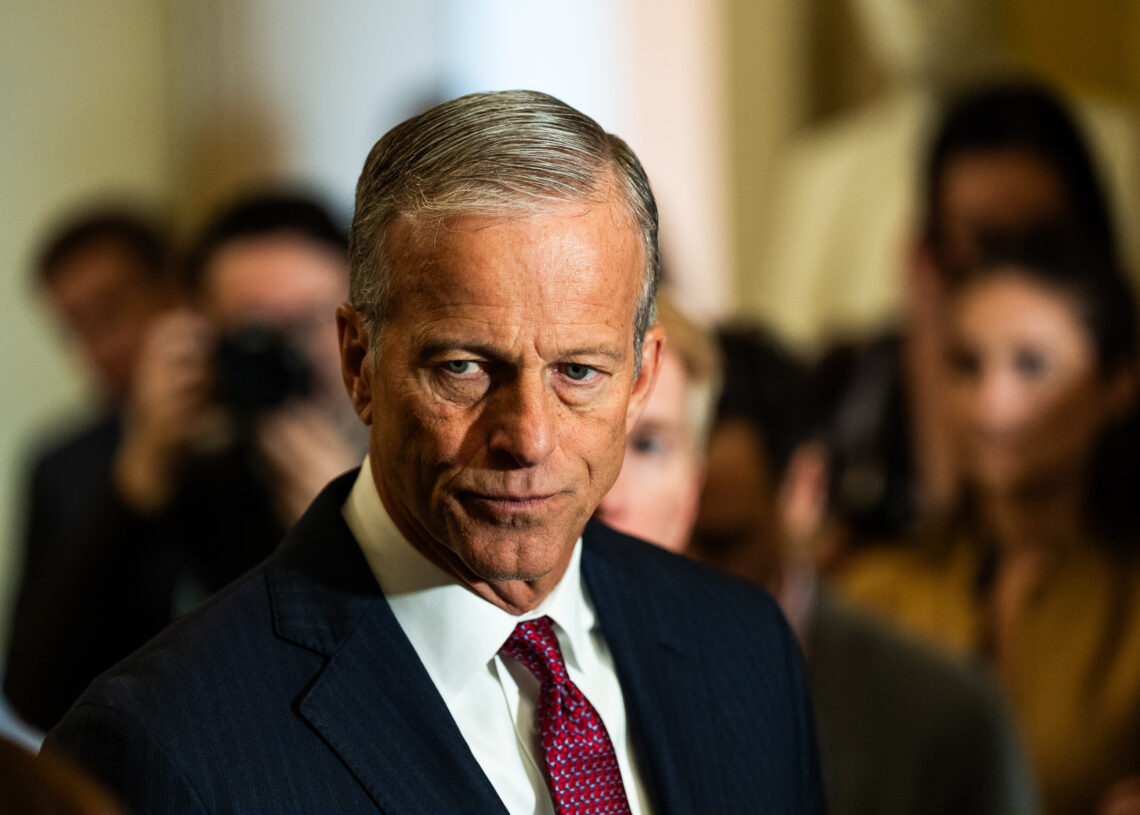
Senate Majority Leader John Thune (R-South Dakota) balked at the idea of agreeing to any of Democrats’ demands if Democrats refused to fund ICE.
“If they want to have a conversation about some of the reform ideas that they had put in front of us, then that would be contingent upon actually providing funding for ICE,” Thune told reporters.
DHS has been shut down since Feb. 14. Democrats have refused to fund the agency unless Republicans agree to their demands, which include tighter rules governing the use of warrants, barring agents from wearing masks and requiring them to wear body cameras and identification.
The White House has been negotiating with Democrats for more than a month, but the two sides have not reached an agreement despite increasingly long waits to get through security in many airports. Trump deployed ICE officers to airports on Monday to help relieve Transportation Security Administration officers.
The Republican proposal would allow Democrats to avoid voting to fund ICE’s deportation efforts, but it would not impede those efforts. Republicans passed legislation last year that included tens of billions of dollars in extra funding for ICE, allowing the agency to keep operating even while much of the rest of DHS is shut down.
Republicans have discussed sending more funding to the part of ICE responsible for arresting and deporting undocumented immigrants — known as Enforcement and Removal Operations — without Democratic support through the reconciliation process. Reconciliation allows the Senate to pass legislation with a simply majority instead of the 60 votes needed to overcome a filibuster, as long as it complies with obscure budget rules.
Sen. Eric Schmitt (R-Missouri) said he supported the Republican proposal because it would allow the party to send more money to ICE through reconciliation. Democrats, he suggested, had overplayed their hand.
“The Democrats have royally screwed this up because of their blind hatred for President Trump and ICE agents,” Schmitt told reporters.
Republicans could also try to use reconciliation to pass the Save America Act, the voting bill that the Senate has spent the past week debating even though Democrats have vowed to filibuster it. Trump has demanded repeatedly that Republicans find a way to pass it.
The Save America Act would require voters to prove they are U.S. citizens when registering to vote and to show photo identification when voting. It’s unclear whether Republicans could find a way to draft those provisions so they comply with the budget rules that govern reconciliation. Sen. Mike Lee (R-Utah), the bill’s most passionate advocate, said Tuesday that he didn’t see how Republicans could manage it.
“It’s hard to imagine how the SAVE America Act could be passed through reconciliation,” Lee wrote on X. “And by ‘hard’ I mean ‘essentially impossible.’”
DHS includes Customs and Border Protection, TSA, the Federal Emergency Management Agency and other agencies, in addition to ICE. The proposed agreement would fund CBP, which includes Border Patrol. A Border Patrol agent and CBP officer shot Alex Pretti, a U.S. citizen whose killing in Minnesota in January triggered widespread outrage and led Democrats to demand new restrictions on agents.
“This offer doesn’t have reforms and funds most of their immigration enforcement operations,” Sen. Chris Murphy (D-Connecticut) told reporters on Tuesday, explaining his opposition to the Republican proposal.
The proposal would also fund part of ICE known as Homeland Security Investigations, which is responsible for investigating drug smuggling and other crimes.
Sen. Susan Collins (R-Maine), chair of the Senate Appropriations Committee, had raised concerns about the prospect of a deal that did not include funding for Homeland Security Investigations.
“That’s child trafficking, it’s drug smuggling, it’s counterfeit goods,” Collins told reporters Sunday. “I don’t think we want to cut off Homeland Security Investigations.”
The House would also need to pass any deal that Senate Republicans strike with Democrats.
Speaker Mike Johnson (R-Louisiana) may need Democrats to pass any DHS funding legislation because House Republicans have a perilously narrow majority. Johnson can afford to lose only one Republican, and Rep. Thomas Massie (R-Kentucky) consistently votes against government funding bills.
House Minority Leader Hakeem Jeffries (D-New York) would not say Tuesday whether House Democrats support the Republican proposal, telling reporters that he plans to speak with Schumer.
Some House members have proposed their own plans for reopening DHS. Rep. Rosa DeLauro (Connecticut), the top Democrat on the House Appropriations Committee, introduced a discharge petition last week in a longshot attempt to force a vote on the House floor on funding DHS except for ICE and CBP.
Reps. Brian Fitzpatrick (R-Pennsylvania) and Tom Suozzi (D-New York) said they would introduce bipartisan legislation this week to fund the agency. The bill includes new accountability measures such as a mandate that agents do not wear masks coupled with new penalties for doxing, the practice of revealing someone’s identity and potentially exposing them to threats, Fitzpatrick said. It also impose new warrant rules and a requirement for ICE to prioritize undocumented immigrants who pose a public safety threat.
“People are looking at what’s going on at the airports, we’re all concerned about the possibility of something very bad happening, and we don’t want to see Homeland Security not in the game,” Suozzi said. “At the same time, we want to see reform of some of the really inappropriate — I say immoral and illegal — behavior of ICE.”
Lawmakers are under pressure because Congress is scheduled to leave at the end of the week for a two-week recess. Thune has said that he does not see how the Senate can leave town if DHS has not reopened.
Sen. Lindsey Graham (South Carolina), one of the Republicans who met with Trump at the White House on Monday, said he thought Trump would ultimately support Senate Republicans’ proposal.
“There’s some people who don’t like it on our side,” Graham told reporters. “I’m sure there are some people who don’t like it on their side. But if you’re waiting in line four hours in Atlanta, this madness needs to come to an end.”
Marianna Sotomayor contributed to this report.
The post Senate Republicans pitch deal to end DHS shutdown, but Trump isn’t sold appeared first on Washington Post.