There are two obvious reasons to have a nuclear weapon. The first is to dominate or overawe your nonnuclear-armed neighbors, to make them submit to you because they fear incineration at your hands. The second is defensive — to deter a more powerful enemy from attacking you, to persuade them that the price of their victory will be too awful to be borne.
The American and Israeli war against Iran is motivated by a fear of the first scenario — a Middle East remade by Iranian nuclear blackmail. But the conflict to date has made the second scenario more relevant, by demonstrating that Iran already possesses a kind of nuclear-esque deterrent, a credible threat of mass destruction that may place limits on what its opponents can reasonably risk.
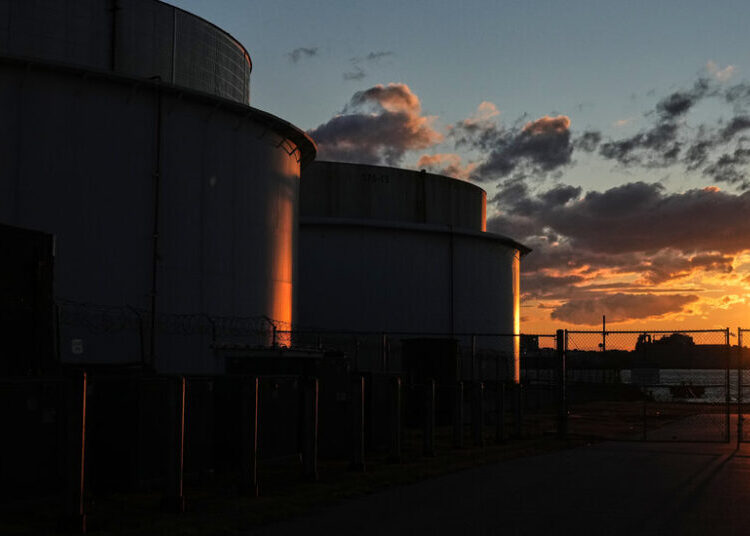
Unlike North Korea, the Iranian regime does not have a brace of nuclear warheads with which to keep America at bay. But it has an escalatory power that was unavailable to Saddam Hussein and Muammar Qaddafi in their fateful conflicts with the United States. The closure of the Strait of Hormuz, and the resulting damage to global energy markets, is the first great escalatory move. The threat to go all out to destroy the larger infrastructure of the Persian Gulf, from refineries to desalinization plants, is the second — usable only in extremis, as an act of murder-suicide, but still a potent threat from a regime facing existential defeat.
The central problem with our strategy is that it has placed the Iranian government in exactly that kind of existentially threatened position, through a decapitation campaign designed to create regime change, without yet delivering the desired political revolution. So long as the regime survives and the war continues, the Iranian government can make unusually credible apocalyptic threats, because we ourselves have put them in a position in which apocalyptic moves are rational.
This was not the case with earlier U.S. strikes against Iran’s nuclear program. It wouldn’t be the case if we were merely striking its military infrastructure. But it is an inevitable consequence of leading with decapitation efforts, which leaves the targeted regime with every incentive to make extreme, even nuclear-scale moves that would be irrational in other contexts.
There are limits, of course, to the nuclear analogy. Iran’s ability to wreak havoc does not depend upon a single weapon used for instantaneous destruction but on a set of distributed capacities with compounding effects, from the missile launchers required to target its gulf neighbors to the physical control of territory around the Strait of Hormuz.
The Hormuz weapon takes time to make itself felt, the missile launchers are vulnerable to air power, and so the potency of the Iranian deterrent can be reduced by attrition. Weaponry can be destroyed and territory can be captured, and at some point a combination of nonexistential military moves could theoretically make the existential threat more manageable, mitigate the potential economic damage and reduce Iran’s escalatory power. (All while leaving open the hope that regime change could come to fruition along the way.)
This is the kind of war some hawks want the Trump administration to fight, with ground troops and expeditionary forces achieving by degrees what can’t be achieved immediately. And, interestingly, there’s a convergence between these hawks and some of the war’s critics, who argue that if the United States doesn’t choose to fight this way — if we don’t have U.S. Marines capturing territory around the strait, if we don’t permanently eliminate the Iranian threat to set the Persian Gulf ablaze — then we will have to accept an epochal defeat, in which Iran emerges as a new regional hegemon, like Paul Atreides in “Dune” becoming emperor after he threatened to destroy the spice of Arrakis and wreck galactic civilization.
I am somewhat skeptical that Iran is about to have its Paul Atreides moment. No Iranian leader is a psychic messiah figure (to my knowledge), Iran’s conventional forces are hardly an all-conquering army, and geopolitics doesn’t usually work like a science fiction plot device. Everyone knows that Kim Jong Un has the power to set his region ablaze, but that hasn’t made Kim a potential god-emperor of Asia; it just makes the North Korean regime unusually hard to attack.
Similarly, if the United States backs off from the decapitation campaign and returns to diplomacy, Iran’s threats against the region and the global economy will become less credible than they are when it has its back against the wall. America’s conventional military advantage will endure, meaning that we will be able to inflict renewed pain on Iran if it tries to make economic blackmail permanent. And Tehran’s willingness to threaten doomsday against its neighbors is more likely to increase its own long-term isolation than it is to encourage those neighbors to bandwagon with the Islamic republic.
Which is not to say the de-escalation will be costless for the United States, or that an armistice short of regime change won’t represent a limited defeat for American power. But contrary to some doomsayers, America is strong enough and insulated enough to absorb a strategic disappointment. And letting President Trump spin that kind of disappointment as a grand success might be acceptable if the alternative isn’t the coup de main he plainly hoped for, but a land war in Asia conducted in the shadow of a global economic rout.
Breviary
My debate with Steven Pinker on the God question.
Alan Jacobs on atheism and belief.
Richard Hanania on Paul Ehrlich’s anti-humanism.
Helen Lewis on millennial feminism.
Chris Walker on A.I. and scientific decadence.
Sheila Fitzpatrick on late-Soviet spiritualism.
The post Iran’s ‘Nuclear’ Option appeared first on New York Times.