As President Trump prepared to welcome conservative Latin American leaders to a summit in Florida in early March, U.S. officials released a video of a massive explosion — capturing the destruction of what they said was a drug trafficker’s training camp in rural Ecuador.
The video was meant to show that the U.S. military, which for months has bombed boats it says are carrying drugs from South America, was “now bombing Narco Terrorists on land,” Defense Secretary Pete Hegseth wrote on social media.
But a New York Times investigation raises questions about the operation that both the United States and Ecuador spotlighted as part of a new military alliance targeting drug traffickers.
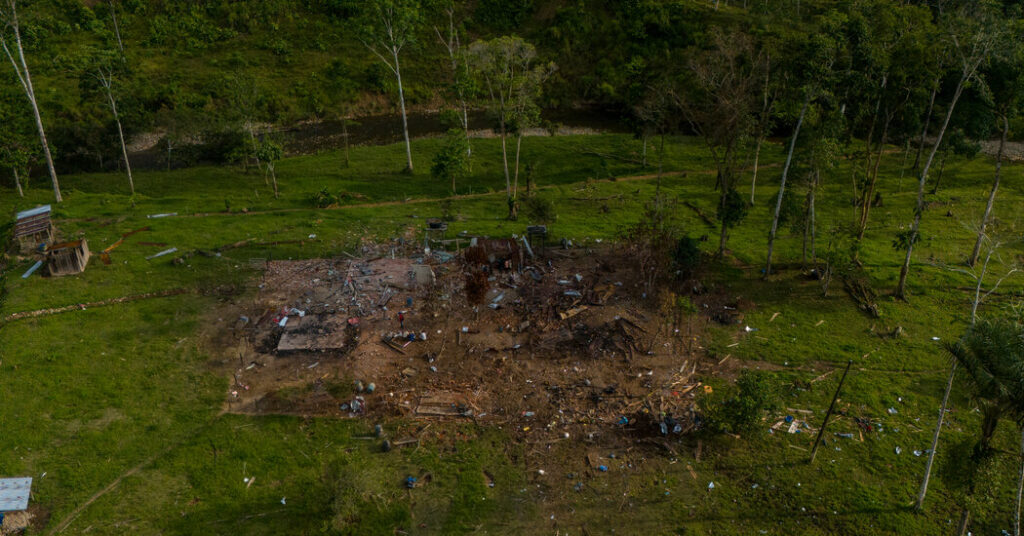
The military strike appears to have destroyed a cattle and dairy farm, not a drug trafficking compound, according to interviews with the farm’s owner, four of its workers, human rights lawyers and residents and leaders in San Martín, the remote farming village in northern Ecuador where the strike took place.
And though the Pentagon said at the time that it had “executed targeted action” against the site at Ecuador’s request, U.S. troops had no direct involvement in the strike shown in the video, according to four people with knowledge of the operation, three of whom spoke on the condition of anonymity to discuss a sensitive matter.
In San Martín, which The Times visited over two days this month, residents told a different story about the bombardment and the actions by Ecuador’s military in the days leading up to the strike.
Workers on the farm told The Times that Ecuadorean soldiers arrived by helicopter on March 3, doused several shelters and sheds with gasoline and ignited them after interrogating workers and beating four of them with the butts of their guns. Three of the workers, who requested anonymity for fear of retaliation by the government, said the soldiers later choked and subjected them to electrical shocks before letting them go.
Village residents said Ecuadorean helicopters returned to the farm three days later, on March 6, and appeared to drop explosives on the farm’s smoldering remains. It was at that point, they said, that Ecuadorean soldiers recorded the footage that U.S. and Ecuadorean officials said captured the bombing of a traffickers’ compound.
The Ecuadorean military said in a news release that the property was used by an armed group to hide weapons and as a place for drug traffickers to sleep and train. The farm’s owner and local residents denied the claims.
Residents said the strike was part of a broader, multiday operation by Ecuadorean soldiers, who burned two nearby abandoned homes earlier in the week, then bombed one of them by plane.
The Times visited San Martín a few days later in March and sought to corroborate residents’ accounts with photos and videos of the military operation and its aftermath.
Ecuador does not produce cocaine but is a top exporter of cocaine smuggled from Colombia and Peru to the rest of the world. Ecuadorean drug gangs partnered with foreign cartels have recently turned the once-peaceful country into one of the Latin America’s most violent.
Colombian armed groups are also known to operate along Ecuador’s border, where illegal mining and the cocaine trade have flourished. But residents said the dairy farm and other homes the military blew up were not linked to illicit activity.
The Ecuadorean government said in the news release that it had relied on U.S. “intelligence and support” to target the farm, which it said was a camp used to train “about 50 drug traffickers.”
Ecuadorean officials also said it was a “resting place” used by the leader of Comandos de la Frontera, a Colombian armed group that moves cocaine along the Ecuador-Colombia border, according to the authorities.
Ecuadorean officials said soldiers had recovered guns and other “evidence of illicit activity” on the property. The Ecuadorean military did not offer evidence for its claims even though it tends to publicize photos of drugs, weapons and contraband it seizes during operations.
The Ecuadorean military responded by referring questions to President Daniel Noboa, who did not respond to a detailed set of questions.
Kingsley Wilson, the Pentagon’s press secretary, said the strike on March 6 was conducted “jointly” with Ecuador, adding, “Due to operations security, we will not discuss specific tactics or targeting details.”
She said the Pentagon was committed to working with Latin American partners because “cartel networks threaten the stability of our hemisphere.”
Two U.S. officials who requested anonymity to speak about the operation said U.S. Special Forces had provided guidance to the Ecuadoreans in the raid on the two abandoned homes upriver, which the two militaries believed were tied to a trafficking group. One of the officials added that the U.S. military deployed a helicopter to assist Ecuador’s strike on the farm, but that the U.S. military had no direct involvement in the bombing.
Mario Pazmiño, a retired colonel and former director of intelligence for Ecuador’s Army, said it was “protocol” to destroy any place used by Colombian traffickers in Ecuadorean territory.
Mr. Pazmiño said he had been told by high-ranking Ecuadorean military and security officials that the military had concluded the property had been used by the Comandos leader and members of his group as a place to sleep.
Mr. Pazmiño independently provided information that aligns with accounts from residents. Ecuadorean forces questioned four people on the property, he said, and used helicopters to launch rockets on the farm.
He, too, said that while the U.S. and Ecuador had been cooperating elsewhere in Ecuador, the U.S. military had not been involved in the bombing of the farm.
“What the army did was attack that house, or farm, and destroy it in its totality,” said Mr. Pazmiño, referring to Ecuadorean forces.
A representative for the Comandos told The Times in a phone interview that the group had not used the property as a camp or hide-out.
The dairy farm’s owner, Miguel, said he bought the 350-acre farm about six years ago for $9,000, growing it to more than 50 cows used for milk and meat.
Miguel, a 32-year-old carpenter and father of two, asked to be identified by only his first name for fear of retaliation by the government. He showed The Times the land’s property title that listed him as its owner, as well as photos of the farm before it was demolished.
As Miguel stood in the rubble, he denied that his farm was used as a training camp, and said he was baffled by the military’s decision to bomb the property.
He fought back tears as he explained what was there before: two wooden shelters, an outpost to make cheese, sheds for his equipment. The horse paddock was spared, but the chicken coop was gone.
“It’s an outrage,” Miguel said, stepping over his dead chickens. “It’s a lie that 50 people trained here. Where are they going to train? Out here in the open? There’s no logic.”
He added, “Everywhere you look there are animals: the cows I milk, the calves, the horses.”
The Alliance for Human Rights, a coalition of groups in Ecuador, filed a 13-page complaint with the Ecuadorean authorities and the United Nations, claiming that the military’s actions were attacks on a civilian population.
“There isn’t a single public official who has come to verify what happened,” said María Espinosa, a human rights lawyer.
Some San Martín residents wondered whether the government had used the strike on the farm to drum up support for its crackdown on the country’s violent drug gangs.
This month, a swath of the Pacific coast has been placed under a nighttime curfew as Ecuador’s security forces, with intelligence support from U.S. forces, combat gangs.
“All we want is for the truth to come out,” said Vicente Garrido, the vice president of the San Martín village board. “They say it was some training camp, but it’s becoming clear that they were just homes.”
The Strike on the Farm
San Martín, a village of two dozen families in the Amazon jungle, sits on the pebbled banks of the San Miguel River, which separates Ecuador from Colombia.
Residents live in wooden homes and harvest coffee and plantains. They move freely between Ecuador and Colombia, traveling to school and work by canoe.
Fear shapes daily life: Residents said they have long balanced a fragile coexistence with armed groups they fear even naming, as well as military patrols they say act with impunity. Farmers said they faced constant suspicion from soldiers who believe they are complicit with armed groups.
“Here, we survive,” said José Fernández, 62, a San Martín resident.
Comandos de la Frontera, the dominant group in the region, is one of the most powerful in southern Colombia and has spilled over into Ecuador, where that country’s military has been targeting it since last year.
On March 3, more than a dozen Ecuadorean troops arrived by helicopter near Miguel’s farm.
They stormed the property, guns drawn, according to four of the five farm workers there that day. The four workers described a similar sequence of events in separate interviews.
The workers, all Colombian, said the soldiers separated them, tied their wrists and accused them of hiding drugs and weapons, and of collaborating with armed groups because they were Colombian.
The farm manager, a 32-year-old man, said soldiers demanded to see the “hidden stashes” on the farm, even as he insisted the farm was simply a farming operation.
The workers said the soldiers asked them about specific people they had never heard of. The soldiers let a 66-year-old worker go, then started beating the younger workers, all in their 20s and 30s, they said. One worker said he fainted twice after soldiers dunked him headfirst into a barrel of water and threatened to drown him.
The soldiers then loaded four of the workers into a helicopter, poured gasoline on two homes, tool sheds and the cheese-making building, and lit a fire, burning down most of the farm’s structures, according to the workers and a group of residents who arrived after noticing the commotion.
Ecuadorean soldiers appeared to fire five shots in the group’s direction as Mr. Garrido, the village board’s vice president, tried to approach to seek answers, according to video recorded by another resident.
The farm workers said they were flown to what they believe was a military base about 20 minutes away. There, they said, the soldiers choked them with their own shirts and shocked them with stun guns.
The men said they were eventually released at dawn and told to go back to Colombia.
“They basically said that if I set foot in Ecuador, they’ll kill me,” one worker said.
Three days later, on March 6, the Ecuadorean military reappeared in helicopters, residents said. They dropped at least two explosives on the farm’s smoldering remains, according to the videos the Ecuadorean and U.S. militaries uploaded to social media.
Later that day, Ecuador proclaimed it had “destroyed” Comandos de la Frontera.
Federico Rios contributed reporting.
Luis Ferré-Sadurní is a reporter for The Times based in Bogotá, Colombia
The post The U.S. Said It Helped Bomb a Drug Camp. It Was a Dairy Farm. appeared first on New York Times.