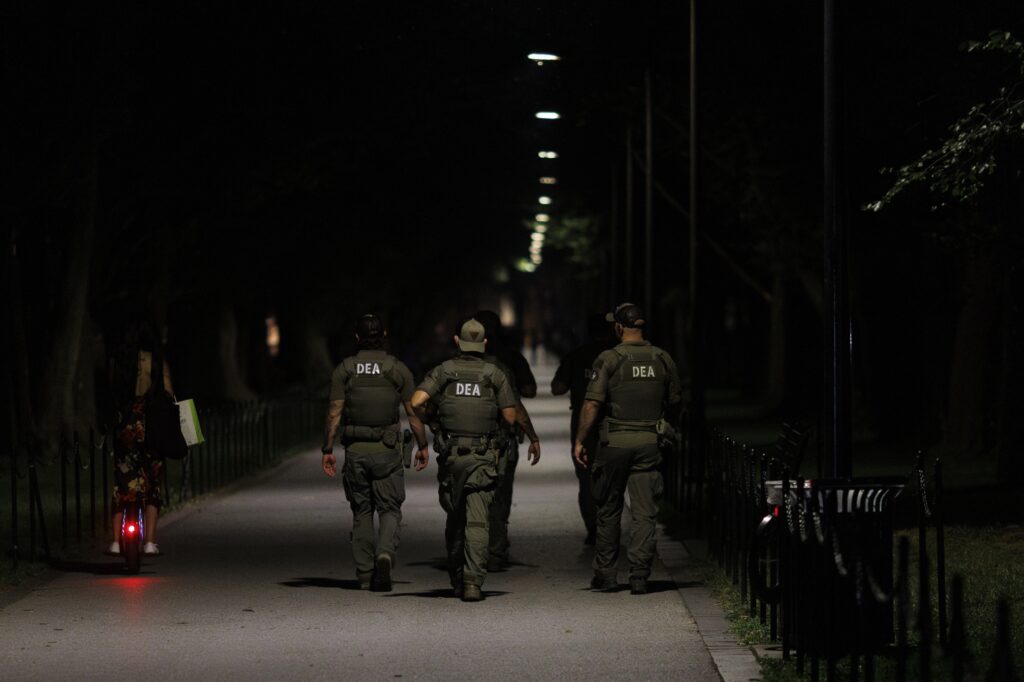
Mayor Muriel E. Bowser signed into law emergency legislation that will trigger the release of police body-camera footage in recent cases in which federal officers shot at people on D.C. streets, incidents that caused broad concern among civil rights watchdogs and lawmakers about how those officers were operating in joint patrols with local police.
At the same time, Bowser (D) vetoed a companion emergency bill from council member Robert C. White Jr. (D-At Large) that sought to require D.C. police to document the presence of federal law enforcement officers at the scenes of arrests or in the event they used force.
Both bills were part of an effort by the D.C. Councilto enhance transparency around federal officers who are policing city residents, part of an operation President Donald Trump ordered last year to “make D.C. safe and beautiful” that has transformed policing in the nation’s capital.
Bowser’s split actions underscore the disagreement between the mayor and lawmakers about the extent to which the city should be demanding accountability for the actions of federal law enforcement officers. Bowser previously urged the council to leave that to Congress, through its oversight of federal agencies, arguing it was not the city’s role. But lawmakers disregarded that request, arguing the city needed to be doing more to shed light on the joint operation at a time when distrust of law enforcement has soared.
Asked why she vetoed White’s bill, spokespeople for Bowser referred to a March 3 letter to the D.C. Council in which she expressed opposition. “This is a federal issue that should be handled by the Congress,” she said then.
“That’s sad,” White said Monday evening, reacting to Bowser’s veto after a candidate forum that also featured council member Brooke Pinto (D-Ward 2). “I don’t know how you say to residents, ‘We don’t want to know more when federal officers fire their weapons at people in D.C.’ We have an obligation to report that. I just don’t understand the circumstance in which that would not be true.” White and Pinto are running to replace Del. Eleanor Holmes Norton (D).
In a letter to D.C. Council Chairman Phil Mendelson (D) on Monday, Bowser said she decided to sign Pinto’s bill into law because it was not a significant change from existing laws on body-camera footage.
“While we still believe that changes related to federal law enforcement are most appropriately handled by Congress, this emergency legislation closely aligns with District laws and policies related to the serious use of force and automatic release of body worn camera footage and identification of involved officers that the D.C. police officers currently operate within,” her brief letter said.
Pinto applauded the mayor’s signature on the bill Monday. Her bill requires the release of D.C. police officers’ body-camera footage in cases, from August onward, of fatal officer-involved shootings or other serious uses of force by federal officers. The footage of at least two previous shootings — at people in cars that were being chased — must be released within 10 days.
“I introduced this important bill because DC residents deserve to know what’s going on in our own communities,” she wrote in a statement on X.
With both Pinto and White running for Congress, they appeared in competition over the legislation, since each had introduced similar bills around the same time. Pinto was expecting to take the lead on the issue as chair of the public safety committee with oversight of D.C. police; White called her “territorial.” They ultimately reached a compromise allowing both bills to move forward with tweaks.
Bowser’s actions also have some political implications. Lawmakers were acutely aware that their debate on the bills was being watched by Republicans in Congress, who have not hesitated to try to block bills they see as out of line with Trump’s agenda.
Republican lawmakers tend to give Bowser’s vetoes significant weight, meaning White’s bill could be in more jeopardy of being targeted in Congress in the event lawmakers challenge Bowser’s veto. Congress does not review emergency bills, which are in effect for 90 days, but longer-term temporary and permanent versions do require review.
Still, he, Pinto and other lawmakers have said the issue is too important to allow concerns about Congress’s potential reaction to dictate how they legislated. White said the mother of Phillip Brown, who narrowly escaped injuryafter being shot at by a Homeland Security Investigations officer in October, cried in his office, urging action. “I can’t tell a woman like [her] that that’s a federal role, not a local role,” he said.
Pinto said before the council vote March 3 that she had received assurances from some in Congress that her bill would not be a target but wasn’t sure about White’s — although she said that she agreed it was good policy and that lawmakers were taking a “calculated risk” in pushing the bills.
White’s bill sought to require D.C. police to identify all federal law enforcement officers present at the scene of arrest, or in cases when force was used, in their reports and make a note if the officers could not be identified. In a hearing earlier this month, interim police chief Jeffery Carroll pushed back on the idea, arguing it would add a burden to D.C. officers and was not their role.
Like Pinto’s bill, White’s passed the D.C. Council unanimously, meaning lawmakers probably have the votes to override a veto.
Jenny Gathright contributed to this report.
The post Body-cam footage of federal officers shooting at people in D.C. to be released appeared first on Washington Post.