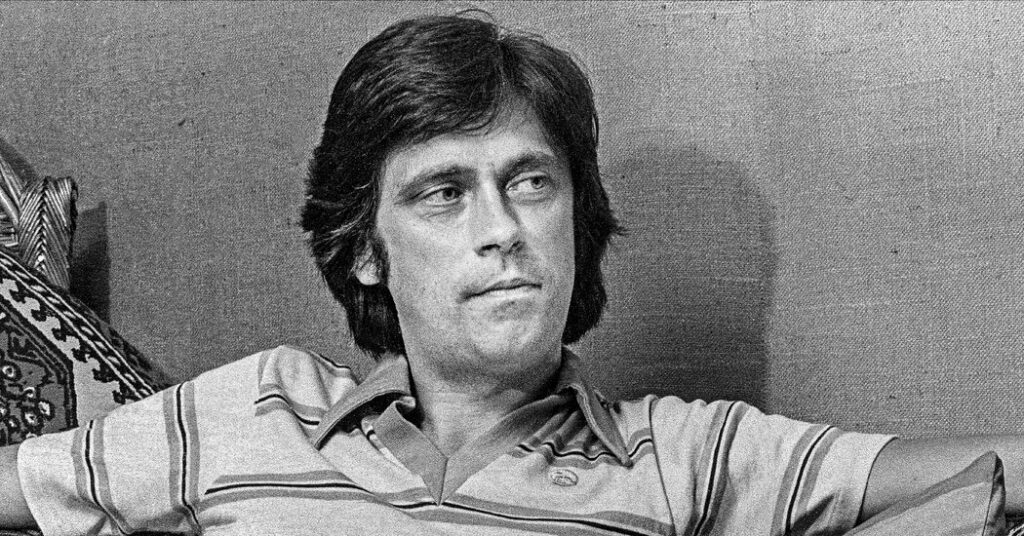
Mike Vernon, a record producer and label owner who helped shape the sound of the British blues boom of the 1960s through his raw productions of landmark albums by John Mayall & the Bluesbreakers and the early Fleetwood Mac, propelling the guitar virtuosos Eric Clapton and Peter Green to fame, died on March 2 at his home in the Andalucía region of Spain. He was 81.
His death was confirmed by his daughter Alexis Vernon, who did not specify the cause or say where in Andalucía he lived.
During his late-1960s heyday, Mr. Vernon produced for Britain’s powerhouse Decca label as well as for his own, Blue Horizon, recording blues rock acts like Ten Years After — starring Alvin Lee, who was called “the fastest guitarist in the West” — and Chicken Shack, a springboard for Christine McVie, the future singer and keyboardist for Fleetwood Mac.
For Blue Horizon, Mr. Vernon also recorded notable American bluesmen like Otis Spann, Champion Jack Dupree and Elmore James.
While he made forays outside the blues, including producing David Bowie’s quirky, English-dance-hall-influenced 1967 debut album, Mr. Vernon was best known for helping to reinterpret a Black American genre born of the Mississippi Delta — and electrified in Chicago — into a high-volume, hard-rocking Anglo variant that reshaped rock.
He made his name producing for John Mayall and his band, the Bluesbreakers. Mr. Mayall was known as the “godfather of British blues,” less for his accomplishments as a vocalist and multi-instrumentalist than as a shepherd for guitar talent. Mr. Vernon worked with the band on its album “A Hard Road” (1967), which featured Mr. Green, later of Fleetwood Mac, and a follow-up album from the same year, “Crusade,” which showcased the future Rolling Stones lead guitar wizard Mick Taylor.
Most significant, Mr. Vernon produced the band’s seminal 1966 debut album, “Blues Breakers,” with Eric Clapton. Guitar Player magazine once described Mr. Clapton’s playing on that disc — a meaty howl wrung from a Gibson Les Paul and channeled through a growling Marshall amplifier — as “the electric guitar equivalent of the Wright Brothers’ first flight at Kitty Hawk.”
The album — also known as the Beano Album because of the comic book that Mr. Clapton is pictured reading on the cover — cemented Mr. Clapton’s reputation as Britain’s reigning guitar god, as demonstrated by his blistering licks on Freddie King’s “Hideaway” and Otis Rush’s “All Your Love.”
“Clapton had said, ‘This is going to be your biggest challenge, recording my sound,’” Mr. Vernon recalled in an interview. “We didn’t realize how big a challenge it was going to be.”
Instead of relying on studio effects, Mr. Vernon captured the unvarnished power of the band’s searing live performances.
“There was no one there saying, ‘We need a single,’ or, ‘We need a fast one,’ or, ‘It needs variety,’ or any of that,” Mr. Clapton recalled in a 2016 interview with the music site Louder. “We just went into the studio and played our set.”
Michael William Hugh Vernon was born on Nov. 20, 1944, in Harrow, northwest of central London, the elder of two sons of William and Eileen (Edmund) Vernon. His father was a shop manager, his mother a seamstress.
Like so many youths in weary postwar Britain, Mike fell in love with the exuberance of American rock ’n’ roll and R&B, which stoked an interest in blues artists like Memphis Slim and Big Bill Broonzy.
After graduating from the Purley County Grammar School in Croydon, he studied for a time at the Croydon College of Art but detoured toward a career in music when, at 18, he wangled a job as an assistant at Decca. Little more than a gofer at first, he began hanging around the label’s studios to learn the recording process; he wound up, in 1963, helping to produce the Yardbirds’ “Baby What’s Wrong” and “Honey in Your Hips.”
In 1964, with his younger brother, Richard, and his friend Neil Slaven, Mr. Vernon founded the influential fanzine R&B Monthly, which raised his stature in London’s music scene.
The next year, he and Mr. Slaven started Blue Horizon, a blues label distributed by CBS Records. Its biggest act was Fleetwood Mac, then an all-male, guitar-centric blues outfit — a far cry from the sleek California pop juggernaut that it would evolve into in the mid-1970s, showcasing Stevie Nicks, the guitarist Lindsey Buckingham and Ms. McVie.
The star in the band’s early years was its founder, Mr. Green. His melodic, emotive guitar stylings inspired B.B. King to say: “He has the sweetest tone I ever heard. He was the only one who gave me cold sweats.”
Mr. Vernon worked on the group’s debut, titled simply “Fleetwood Mac,” as well as its follow-up, “Mr. Wonderful,” both from 1968. He also produced hit singles by the band, like “Albatross” (1968), a pensive yet soothing instrumental that reached No. 1 on the British charts; the moody ballad “Man of the World” (1969), which reached No. 2; and “Black Magic Woman,” a Top 40 hit for the group before Santana adapted it as a signature.
After the British blues wave crashed in the early 1970s, Mr. Vernon and his brother started a recording studio in Chipping Norton, a town northwest of Oxford. Bands he produced over the years included the 1980s hitmakers Level 42 and Dexys Midnight Runners, and he served as a vocalist with a number of groups, including his own, Mike Vernon and the Mighty Combo.
Mr. Vernon largely stepped away from music after moving to Andalucía in 2000, although he returned to produce next-generation British blues acts like Oli Brown and Dani Wilde.
In addition to his daughter Alexis, he is survived by his brother; another daughter, Briony Vernon — like Alexis, a child from his marriage to Kathryn Hayes, which ended in divorce in 1997;; and four grandchildren.
In a 1994 interview with Sound On Sound, a British trade magazine, Mr. Vernon was asked about that decade’s blues boom.
“I’ve been in this business long enough to remember the last blues ‘boom,’” he said, “and I know perfectly well that blues music will never go away, because everything that we now call pop music has its roots in blues.”
Alex Williams is a Times reporter on the Obituaries desk.
The post Mike Vernon, Who Helped Spark the British Blues Boom, Dies at 81 appeared first on New York Times.