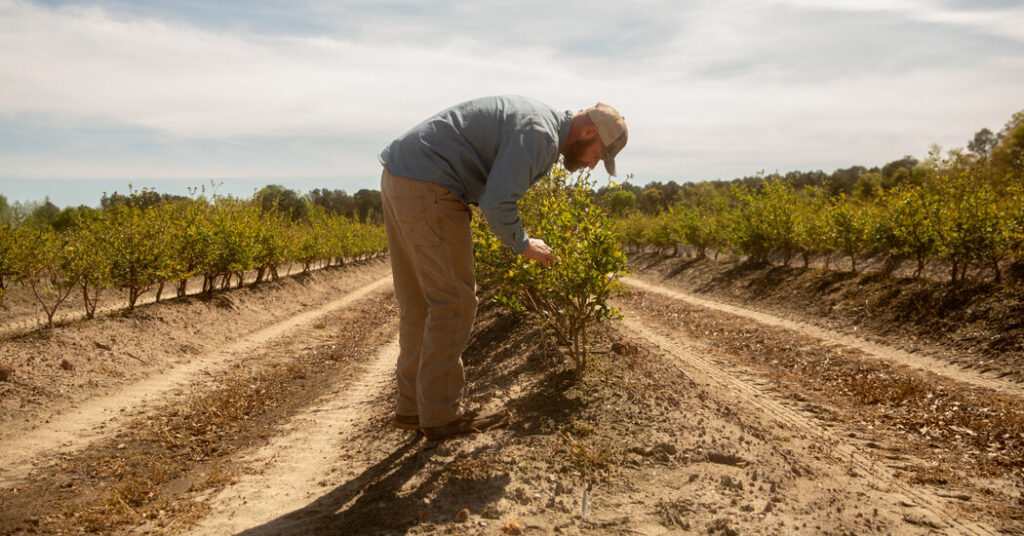
When Covid-19 came to Alma, the blueberry capital of Georgia, Chris Towns was staring down a paltry return on his berry crop as shoppers stayed at home and stuck to buying essentials.
The federal government offered relief, in the form of 30-year, low-interest loans. Desperate to stay afloat, he borrowed $125,000. When another round was offered the next year, he bumped up the amount to $495,000.
“We were looking in the future, if it did turn around, we could have some capital to expand with,” Mr. Towns said. “I saw the purpose of the money as trying to inject money back into the system.”
Then Mr. Towns ran into one of the toughest farming economies in generations. Costs of labor and fertilizer kept rising, and berries weren’t selling for enough to make up the difference. Repeated freezes shrank yields. Hurricane Helene took out half his blueberry plants in 2024.
He’s worried about what might come next: If he gets more than 90 days behind, his loan could be referred to the Treasury Department for collections. The government could intercept any payment from federal agencies, including subsidies from the Agriculture Department. He has been doing everything he can just to cover interest payments, including taking out another loan from a Georgia state agency.
“I’m not making any progress on it,” Mr. Towns said. “I’m never going to get it paid off.”
His troubles are part of a bigger problem plaguing a pandemic relief program that could end up costing taxpayers more than policymakers anticipated. Congress appropriated trillions of dollars to support businesses and workers as the pandemic rampaged through the economy. Most of it came in the form of grants, unemployment payments and forgivable loans.
But $378 billion was supposed to be paid back. The Economic Injury Disaster Loan program expanded a longstanding offering from the Small Business Administration meant for more localized catastrophes, quietly dispensing about four million low-interest, 30-year loans for up to $2 million each with little documentation.
At first, it lifted borrowers. Recipients had about 5.2 percent more employees on their payrolls a year later than otherwise similar businesses, according to an analysis by Gusto, a bookkeeping platform. But the advantage faded within a year, to 2 percent. By 2023, small businesses with outstanding loans from the program were less likely to be profitable than those without them, a Federal Reserve survey found.
Now, the iceberg of loans is growing more delinquent. As of June, the latest data available, the S.B.A. had referred more than $75 billion to the Treasury Department for collection. The portfolio had an unpaid principal balance of $279 billion.
Lawyers for small businesses report a deluge of calls from borrowers who have gotten letters from debt collectors operating as contractors for the Treasury Department demanding immediate payment in full of the outstanding debt, plus hefty fees.
“You just kind of saw it coming like a tsunami,” said David Swan, a bankruptcy lawyer with the Hirschler firm. “I didn’t have to be Nostradamus or anything.”
Mr. Towns, who also teaches at a high school and counsels young farmers, said most people had gotten by with reduced payments on hardship programs. Those are running out, the defaults are only beginning, and even people like him who are doing everything they can to stay current are starving their businesses.
“They should have never allowed me to take that much money,” Mr. Towns said. “We’re not blaming the government, but it was almost predatory lending.”
The Hounding Begins
The federal government has plenty of experience collecting debts. The Treasury Department’s Bureau of the Fiscal Service is in charge of collecting money owed to the government. It allocated about $24 million per fiscal year on debt collection services between 2013 and 2024.
The work has picked up. The Bureau of the Fiscal Service’s payments to debt collectors rose to $51 million in 2025 and $65 million in 2026. An S.B.A. inspector general report last August criticized the agency for failing to pursue delinquent loans by visiting sites to identify collateral to seize or referring cases to the Department of Justice.
Part of the problem: By late 2025, Kelly Loeffler, the program’s administrator, had delivered on her promise of slashing the S.B.A.’s work force, which shrank 31 percent over the year ending last November. Although the agency judged last May that it was capable of servicing the remaining loans, borrowers reported long hold times on calls and weekslong waits to get an email returned.
Like any letter from a debt collector, demands to repay delinquent loans can be alarming. “Due to your failure to honor this obligation, the entire balance of your account is due,” reads one letter from a collection agency called CBE Group that was viewed by The New York Times.
Ruby Brister took out a $318,000 loan when she had one elder care home in Honolulu. She had leased space for another in the fall of 2020, but the pandemic led to a long delay getting it licensed, leaving her paying rent for three years before it opened.
Things got worse. When two of her clients died, Ms. Brister faced a cash crunch, and missed payments on her loan. She got a notice that her loan had been referred to the Treasury, and when she called the number provided, a debt collector, HS Financial, answered. The collector said her new balance was $448,000 with new fees and interest applied, and imposed a three-year payment plan. Ms. Brister said the monthly payment of more than $12,000 would be a strain for her business, so she’s hiring a lawyer to try to negotiate a longer term.
“It’s not like I’m trying to run away from it,” she said. “I know these governments gave us chances. But we’re just trying to stay afloat.”
The Treasury Department has some stiff remedies. It can refer delinquent loans to credit reporting services and garnish money that comes from the federal government, such as Social Security payments and tax refunds. For those who borrowed more than $200,000 and secured the money with a personal guarantee, the government can place liens on homes and businesses or refer cases to the Justice Department.
For borrowers without a personal guarantee, the government’s recourse is limited, but it is still applying pressure. Cooper Macco, a lawyer with Macco and Corey in New York, said an S.B.A. call center representative had told his client to take out a home equity line of credit to pay off the loan, which would have left the client worse off.
“Now they’re encumbering personal assets to pay back the government,” Mr. Macco said. “You hate to say it, but in this situation, the S.B.A. is trying to collect the debt from individuals, so the advice they give you might not be the best advice.”
No Good Options
People who deal with the S.B.A. say the agency is in a pickle. It had never opened such a large direct loan program for businesses; its flagship offerings are guarantees of loans from banks and have strict underwriting requirements. It has nowhere near the infrastructure required to maximize repayment.
A spokeswoman for the S.B.A. said the agency accepted “offers in compromise,” which are deals for the debtor to make a partial lump payment and the creditor to forgive some of the rest. Lawyers say they have had little success negotiating them on behalf of their clients.
Many people accepted the loans during a crisis without fully understanding the rules, and may have done things with the money that would disqualify them for forbearance or forgiveness anyway. Leslie Tayne, a debt relief lawyer on Long Island, said she was hesitant to accept clients with pandemic-era loans, especially if the debtor has violated the terms.
“We have seen people contact us and say they’re at the wage garnishment stage. At that point there’s very little that can be done,” Ms. Tayne said.
Borrowers often expected Congress would forgive the loans. There is a Change.org petition with more than 1,000 signatures pleading for relief, and many borrowers have asked their congressional representatives for help.
Repayments of student loans also slowed while the Biden administration looked for a way to forgive large amounts, but courts rejected those efforts and those borrowers are also falling further behind. The Trump administration has shown no interest in writing down the loans, and there is little appetite on Capitol Hill to do so, either. With no action, those debts will linger.
At the same time, pursuing small-business owners to recover the money is expensive, time consuming and politically risky.
“From just the amount of defaults that I’m seeing, the deluge of these cases now, I can’t imagine that the Treasury or Congress is not going to have to act to do something,” said Benjamin Goldburd, a tax and corporate lawyer with the firm Goldburd McCone. “The government doesn’t want to start having to make hundreds of thousands of lawsuits against small businesses.”
Brett Theodos, who studies small-business lending at the Urban Institute, said the program had made the loans seem “really warm, fuzzy and accommodating,” with little warning of the penalties for nonpayment. Now, there’s no easy way out, and trust in government is at risk.
“If this is ever going to be used again, it’s important to not be seen as a boondoggle,” Mr. Theodos said. “Conversely, we don’t want to harm a bunch of people to add next to nothing to our national debt repayment.”
Small-business owners holding unsustainable debts say the government should at least drop high fees and set reasonable repayment terms, rather than ruining their credit and stripping their assets without much return.
Jim Mellon, a franchisee in the wellness industry, borrowed $2.2 million across three locations while they were closed during the pandemic. After the hardship program ended last summer, he didn’t have the cash flow to increase his payments. Now two of the loans have been taken over by the Treasury, and new fees and interest have brought the total to more than $3 million.
“There’s no way. I can’t pay that,” Mr. Mellon said. “The odds of me living to 90 are not great. If the businesses last that long, great — but what’s going to happen to these loans?”
Lydia DePillis reports on the American economy for The Times. She has been a journalist since 2009, and can be reached at [email protected].
The post Covid Relief Loans Are Haunting Small Businesses appeared first on New York Times.