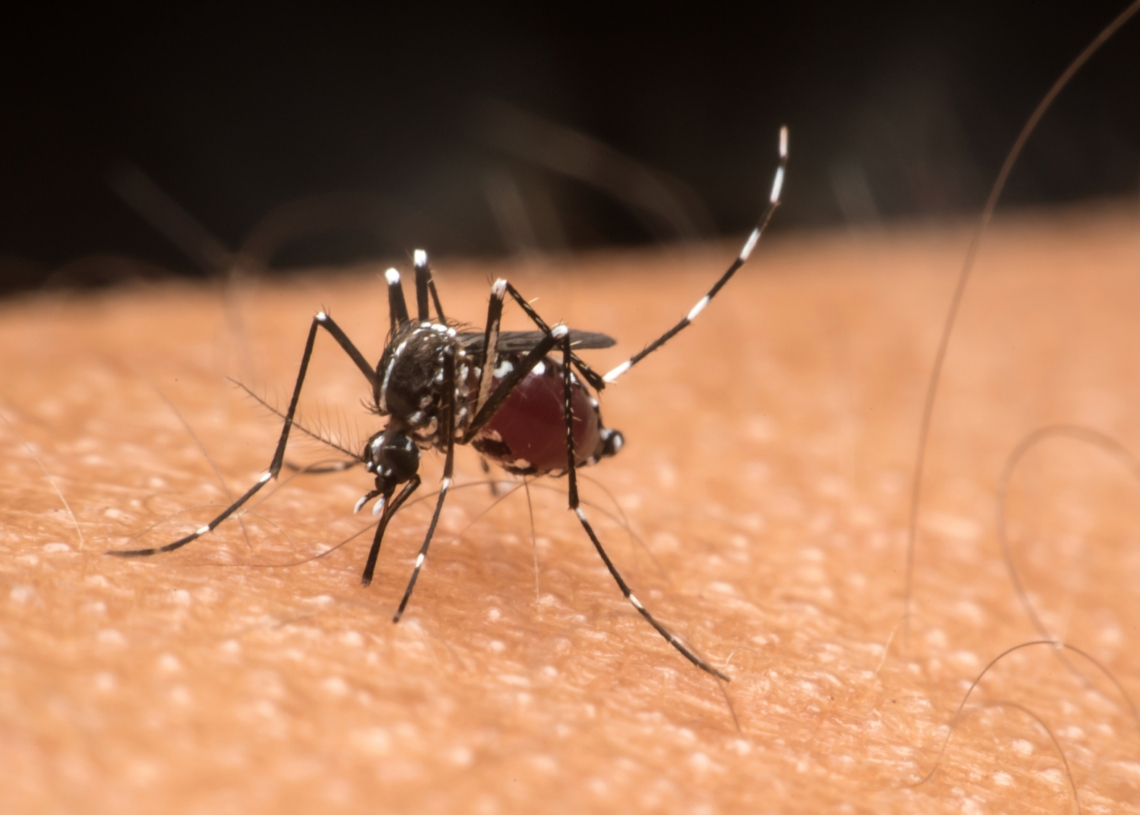
Sometimes science requires you to put yourself in the line of fire. You know, to put your body on the line in the name of science. Or, you can get an undergrad to stand in a room and allow 100 mosquitoes to drain you of your blood like they’re a bunch of tiny 18th-century bloodletters.
Writing in The Conversation, that’s what David Hu says he did with the help of student Chris Zuo. Hu is a professor of Mechanical Engineering and Biology and is an adjunct professor of Physics at the Georgia Institute of Technology. It was all in a three-year effort to answer a simple question: how do mosquitoes actually find us?
Mosquitoes kill more than 700,000 people a year through diseases like malaria and dengue, yet their brains are smaller than a grain of sand. We probably kill way more of them than they kill us every year, but the fact that they make such a dent for being so little is mightily impressive. How are they doing it?
A College Kid Sacrificed Himself to a Massive Swarm of Mosquitoes So Scientists Could Study Them
Hu shoved Zuo into a room full of mosquitoes to find out. Zuo wore a mesh suit meant to protect him. It didn’t. He quickly racked up dozens of bites before realizing that calling what he was wearing “protective” was optimistic at best.
The team switched tactics. Now it was long sleeves, gloves, and a face covering. They also brought in tracking hardware capable of recording mosquitoes’ movement and extreme detail. What they observed was a striking amount of strategy. The protective gear worked much better this time, and with no visible target, the mosquitoes just wandered aimlessly.
If you give them a dark object to look at, they’ll do a series of quick flybys to gauge whether or not it’s something they can stab and take a sip from. Adding a little carbon dioxide, the gas we constantly exhale, slows them down and circles back—clearly, their interests are piqued. Combine both of those visual and gaseous clues, and the insects suddenly lock in, zeroing in on the human body with incredible precision.
To simplify things, researchers replaced Zuo with a black Styrofoam sphere pumping out CO2, then mapped roughly 20 million flight paths. The data revealed predictable “danger zones” where mosquitoes are most likely to swarm. When tested again on an actual human, that model held firm.
All of this was in an effort to help us better understand what it is that mosquitoes like about us, other than our obvious abundance of blood. And maybe help us better understand how to keep them away from us, thus keeping us free from the aforementioned deadly diseases like dengue and malaria. Traps and repellents don’t do nearly enough. Understanding what even attracts them in the first place could finally tilt the odds in our favor.
The post Why This College Kid Sacrificed Himself to a Massive Swarm of Mosquitoes appeared first on VICE.