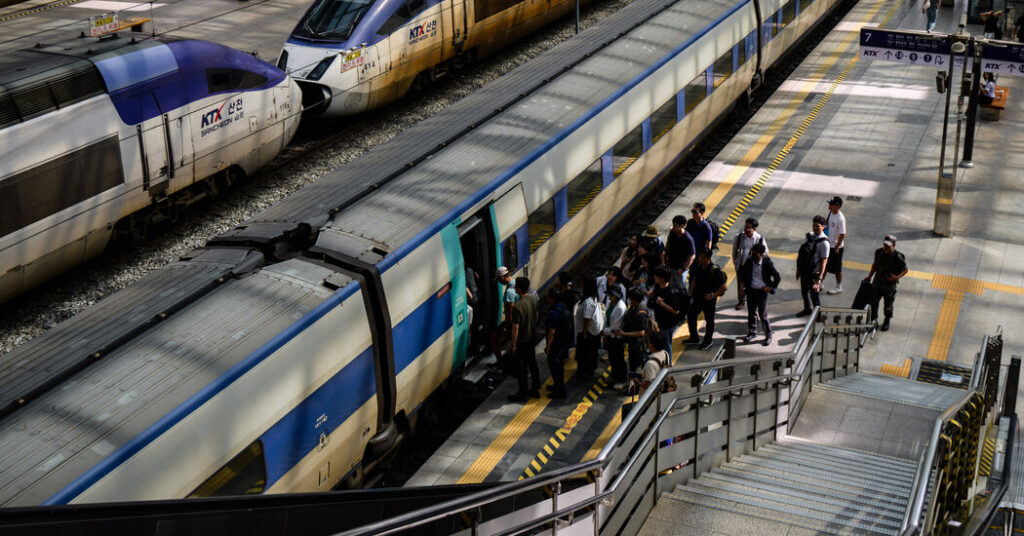
South Korea started a nationwide energy-saving campaign on Tuesday, urging people to take shorter showers, ride bicycles for short trips and avoid charging phones and electric vehicles at night.
Like other nations, South Korea has become increasingly concerned about disruptions to oil and gas supplies because of the U.S.-Israeli war on Iran. The country imports all of its oil and gas. Nearly 70 percent of its crude oil supply passed through the Strait of Hormuz, which borders Iran, until the war brought that tanker traffic to a near standstill.
Rising oil prices and South Korea’s weakening won against the dollar are dealing a double blow to its economy, which depends heavily on its energy-intensive manufacturing industries.
Presiding over a cabinet meeting on Tuesday, President Lee Jae Myung appealed to the public to join a national 12-step drive to save energy. He invoked the patriotism South Koreans showed during the Asian financial crisis in the late 1990s, when families sold necklaces and other gold jewelry to help raise badly needed hard currency, and during the pandemic, when people faithfully followed government-imposed social distancing and Covid testing rules.
“We desperately need the cooperation from the people,” he said. “We can surely overcome this crisis if we put our minds together.”
The Ministry of Climate, Energy and Environment encouraged people to use washing machines and vacuum cleaners only on weekends, to switch to energy-efficient home appliances and lighting, and to use public transportation as much as possible. Such steps were voluntary.
For its part, the government said it would require all agencies to operate their vehicles only four out of five workdays. (For instance, government cars with license plate numbers that end with a 1 or 6 will be taken off the road on Mondays.)
It asked the public to do the same, adding that restrictions on private vehicles could become mandatory should the energy crisis worsen.
The government also said it would accelerate work on five of the 10 nuclear power plants currently under maintenance so they could restart them earlier. (It has 16 others operating now.)
Businesses were also asked to come up with conservation measures, such as turning office lights off during lunch breaks and encouraging workers to use the stairs instead of elevators.
The government placed price caps on gasoline, diesel and heating kerosene on March 13 — the first time in 30 years. It also promised to create a supplementary budget worth $16.5 billion to ease the impact of exchange rate fluctuations and high oil prices, particularly on low-income households.
It also planned to distribute cash vouchers to all households to stimulate the local economy.
Choe Sang-Hun is the lead reporter for The Times in Seoul, covering South and North Korea.
The post Take Shorter Showers: South Korea Kicks Off an Energy-Saving Drive appeared first on New York Times.