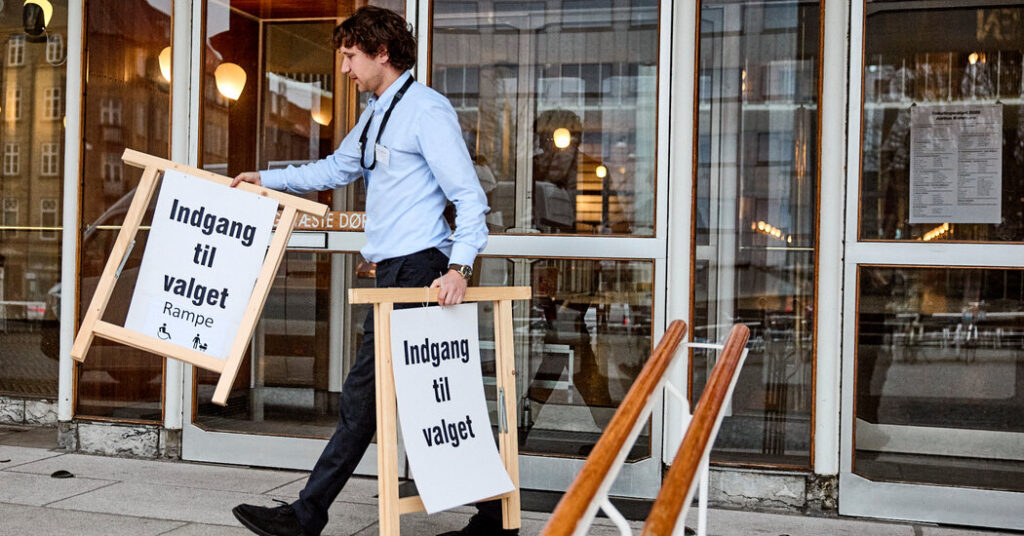
Danish voters were heading to the polls on Tuesday to vote in a closely contested parliamentary election that has been shaped in part by President Trump’s obsession with Greenland. The six million people of Denmark, which has among the highest living standards in the world, face a complicated political landscape of more than 10 political parties.
Here is what’s at stake:
The election seems to be Mette Frederiksen’s to lose.
The incumbent, Prime Minister Mette Frederiksen, appears to be the front-runner.
She has made a name for herself outside Denmark by standing up to President Trump and blocking his efforts to take over Greenland, a gigantic Arctic island that has been part of Denmark for more than 300 years. She is one of the most dominant forces in Danish politics in decades — most Danes simply refer to her as “Mette.”
When Ms. Frederiksen took office in 2019, she etched herself into Danish history by becoming the youngest prime minister. Now 48, if she wins this third term and serves it out, she will be the longest-serving Danish premier since World War II.
Politically, she’s an exemplar of Europe’s new left. She is hawkish on foreign policy and tough on immigration, which both usually fall on the conservative side of the political spectrum, but she also believes in a big state, high taxes and a strong social safety net. She has been a lifelong member of the Social Democrats, Denmark’s leading workers’ party.
For the past four years, she has led a centrist coalition, but pre-election polling shows her party losing some support and both left-wing and right-wing parties gaining steam.
Leaders of other parties that allied with hers are also contenders.
Troels Lund Poulsen, the defense minister and head of Venstre, one of Denmark’s strongest conservative parties, is ranked No. 2 by many political analysts. Many voters give him credit, too, for standing up to American pressure.
This past week, information emerged that the Danish military had developed detailed plans to thwart an American invasion of Greenland, including blowing up airfields to prevent American troops from landing.
Mr. Trump has backed down on his threats to “get” Greenland “one way or the other,” and he’s clearly occupied at the moment with the war in Iran. Still, Mr. Poulsen is seen as an effective defense minister. His party historically enjoys strong support among Denmark’s farmers.
Lars Lokke Rasmussen, leader of the Moderates, is another key figure in this election. He is the ultimate swing vote. A former prime minister himself and now the foreign minister, he gave his support to Ms. Frederiksen during the last election and formed a coalition with her party and Mr. Poulsen’s.
Widely seen as an experienced, likable and avuncular figure, Mr. Rasmussen gets high marks from many Danes for the way he has handled delicate negotiations with the Trump administration over Greenland. Which way he throws his support this time could affect who becomes the next prime minister.
Other political figures include Alex Vanopslagh, the 34-year-old leader of the Liberal Alliance, a libertarian party, whose campaign took a knock recently after he admitted to using cocaine in the past. There’s also Pia Olsen Dyhr, leader of Socialistisk Folkeparti, also known as the Green Left. Neither is expected to get the top job.
Domestic issues are the focus.
Though the Greenland crisis has stirred up Danes, there’s not a huge difference in how the top candidates have handled it. So domestic issues have led this election.
One of the most contentious proposals is a wealth tax on Danes who have more than $3.8 million in assets. Ms. Frederiksen and the left-wing parties are pushing this as a way to raise money for schools. The conservative parties are strongly against it, calling it the “jealousy tax.” Titans of Danish industry, such as the heads of Maersk shipping and of Lego, say it could hurt business.
Another hot issue is the environment. The left-wing parties are advocating for stricter rules on Danish farmers, which the right-wing parties oppose. In some areas, there are concerns that nitrates from fertilizers have leached into the water system, and the more progressive parties have made this a talking point in pushing for expanded agricultural regulation.
Danish voters are also focused on the rising cost of living and the retirement age, issues that tend to play well for parties on the left.
Some results should arrive today.
Polling began at 8 a.m. and will continue until 8 p.m. Preliminary results are expected a few hours later.
According to surveys done in the weeks before the election, Ms. Frederiksen’s Social Democrats were the top-ranked party with around 21 percent support, followed by the Green Left and then a mix of the libertarians, the Moderates and Venstre.
Jeffrey Gettleman is an international correspondent based in London covering global events. He has worked for The Times for more than 20 years.
The post Danes Vote, With Trump on Their Minds appeared first on New York Times.