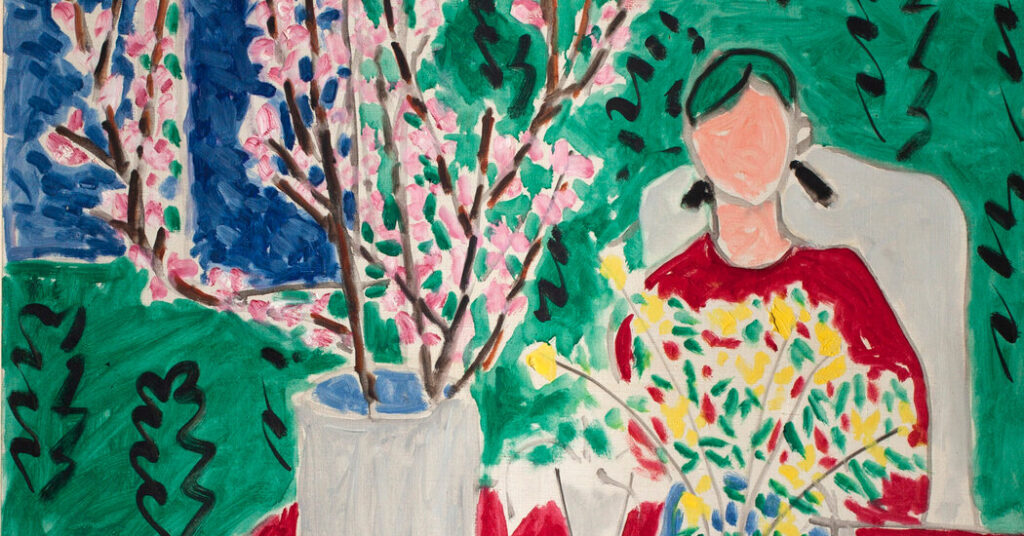
“I hope that, however old we live to be, we die young,” the French artist Henri Matisse said in 1950, aged 80. Although he would live for another four years, he had already felt for nearly a decade, since a close brush with death during a 1941 operation for intestinal cancer, that he was in a new period of profound creative growth: “a second life,” as he called it in a letter to his son Pierre.
It is this epoch of the artist’s work that is on bright and breathtaking display in “Matisse: 1941-1954,” a collaboration between the Centre Pompidou (whose central Paris home is closed for renovations until 2030) and the Grand Palais in Paris, where the exhibition is on display through July 26.
The show includes more than 300 works on loan from around the world (with some exhibited for the first time) that demonstrate how wide the French master’s oeuvre stretched beyond his best-known paintings — to innovative drawings, gouache cutouts, illustrated books, textiles and stained-glass windows. It also challenges the conventional understanding of any artist’s “late” years as an inevitable tapering off. Here, we see a blossoming, a relentless drive to experiment in new mediums and a radical simplicity that only a lifetime of making could achieve.
The early 1940s were a fraught period for Matisse for reasons quite aside from personal illness. When the Nazis invaded France in June 1940, the artist was visiting Paris, but he quickly made his way home to the South of France, which at that time was still a free zone. He remained in the picturesque seaside city of Nice until 1943, when the looming German threat drove him north to the hills, where he found respite in a rented villa called Le Rêve, “the dream.”
Surrounded by lush greenery and light that reminded Matisse of an earlier influential trip to Tahiti, all was still not well: In the spring of 1944, the Gestapo arrested his wife, Amélie, and daughter, Marguerite, for acts of resistance. Amélie was imprisoned for six months, and Marguerite was tortured and deported.
Matisse, whom the Nazis had classed as a “degenerate artist,” refused to exhibit his work during the war, but also refused to leave France, a move that he felt would be an abandonment of the country and its future.
Nonetheless, Matisse continued working doggedly in private. The Grand Palais exhibition, which is hung chronologically, opens with luminous canvases that betray little of the chaos and danger that surrounded their creation. Still lives of flower vases on tables strewed with plump lemons are dominated by vivid red, green, yellow and ocher.
A sequence of interiors is awash in similar hues, painted in thick, simplified lines to show sun-drenched rooms with women reposing solo in striped chairs or sitting in pairs at a table. They read or share a meal, a window wide open behind them, foliage thick in the distance.
At the same time, the artist turned his hand to drawing and working on publications, which he referred to as “decorated,” rather than “illustrated,” books, believing the visual elements were equal to the text.
He drew prolifically, producing hundreds of portraits in which the same faces repeat with minor changes. Twelve hung in a grid in the show feature the writer Louis Aragon, drawn in the simplest of strokes, with a variety of poses, expressions and angles. Other groupings show a reclining woman or a still life, each image slightly different, like a cinematic frames elapsing.
These series, which Matisse called “Themes and Variations,” show the artist’s distinct, undulating line reduced to its barest means — confident single strokes of ink on paper — and also hint at the musical rhythms that define the collage work that occupied the artist’s final years.
The show devotes a round, darkened room, with a specially commissioned audio piece, to “Jazz” (1943-44), a series of 20 circus-themed prints made from paper cutouts painted with gouache, a water-based paint characterized by its matte finish and intensely saturated hues.
These jewel-toned works are relatively small in scale, but striking in form and color, alternating between simple, two-toned patterns and intricate, raucously ornamented designs of abstracted figures and symbols. One of these, “Icarus,” is one of Matisse’s most reproduced images: a black figure with arms outstretched and a small red dot for a heart, falling through a lapis sky studded with jagged yellow stars.
Only a few years later, by 1948, the walls of his studio at Le Rêve were covered with gouache collages of varying sizes, sometimes vast and often with imagery that evoked the natural world: palm fronds, coral, birds, fish, stars, the sun. For Matisse, the studio was a place of ceaseless productivity. (He called it “the factory”; eat your heart out, Andy Warhol.) A rare film from 1951 shows Matisse using large dressmaking scissors to cut shapes from colored paper, his motions fluid and instinctive, like brush or pencil strokes — a seamless extension of his work in other mediums.
“You cannot imagine how much, in the cutouts period,” the artist said in 1952, “the sensation of flying that was unleashed in me helped me to refine the motion of my hand when it guided the path of my scissors.” This quote features in one of the final spaces of the exhibition, through which this sense of flying colors is unleashed in a series of dazzling sightlines, with one big, bright work leading to the next and the next.
The overlapping color squares of “The Snail” give way to the flowing leaves of “Acanthus” and the radiating fronds of “The Sheaf” and, finally, to the sinuous figures of “The Acrobat” and four “Blue Nude” works.
In these final works, a woman’s nude form ripples through various poses, masterfully delineated in one radiant tone and just a few pieces of cutout paper pasted on bare canvas. It is vivifying, and oddly consoling, to see how hard-won simplicity can be: the work of 84 years making art.
Matisse: 1941-1954 Through July 26 at the Grand Palais in Paris; grandpalais.fr.
The post The Final, Flying Colors of Matisse’s ‘Second Life’ appeared first on New York Times.