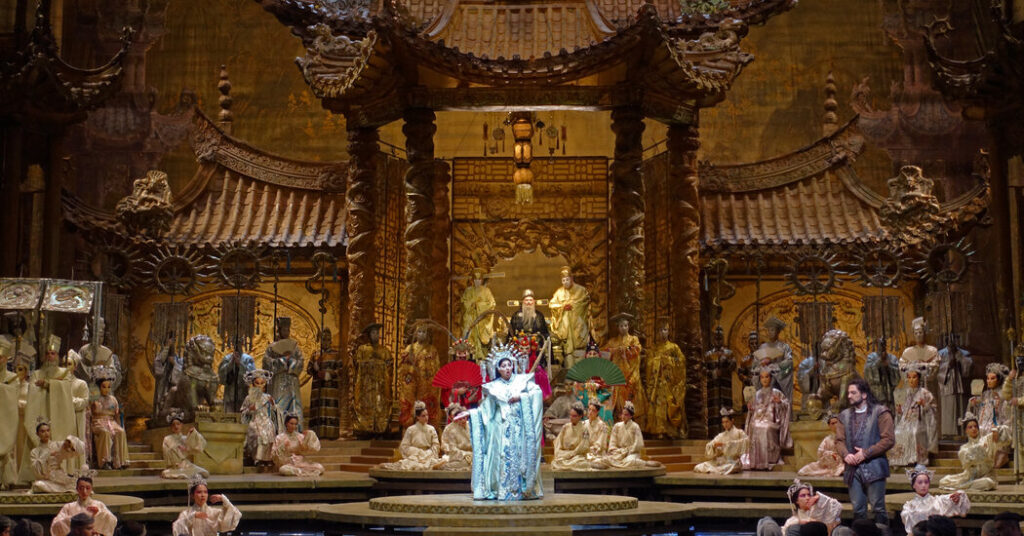
Even if you don’t know Giacomo Puccini, you know his aria “Nessun dorma.” From the opera “Turandot,” it has been used as a sports anthem, propelling the Three Tenors to stardom at the FIFA World Cup in 1990 and serving as Luciano Pavarotti’s final performance before his death, at the Winter Olympics in 2006.
“Nessun dorma” resurfaced at the Olympics this year in the free skate routine by the Japanese figure skater and silver medalist Yuma Kagiyama. Those who saw him might have noticed that Puccini’s score sounded a little different. That’s because it wasn’t Puccini — or not entirely. It was a new completion of “Turandot” by Christopher Tin, a Chinese American composer better known for composing music for the Civilization video games.
“Turandot,” set in a mythical ancient China, tells of a princess who demands that her suitors answer three riddles or face death. Prince Calaf is the first to solve them, and in response poses a challenge of his own: If Turandot can find out his name by morning, he will die. “Nessun dorma” depicts Calaf full of anticipatory triumph, but soon after, Turandot’s ministers capture his father and his servant, Liù — who, facing torture, stabs herself.
This is where Puccini’s score stops. He died before he could finish the opera, which gave rise to the tradition of completions like Tin’s.
Some have read into Puccini’s inability to complete “Turandot,” drawing parallels with his troubled marriage and the suicide of his maid Doria Manfredi, following accusations of an affair with him. Puccini was also unhappy with the librettist Giuseppe Adami, who could not resolve the story satisfactorily after Liù’s death. Puccini had a creative block that lasted for six months, and by the time he resumed work on the opera, he had been diagnosed with throat cancer and died, in November 1924.
When “Turandot” eventually premiered, in 1926 at Teatro alla Scala in Milan, the conductor Arturo Toscanini ended the opera where Puccini’s work stopped, leaving Turandot and Calaf’s fate uncertain. But Puccini’s publisher Ricordi had commissioned his colleague Franco Alfano to complete the score, and subsequent performances, including most today, have used his version.
Alfano added roughly 20 minutes of music, filling in Adami’s libretto and Puccini’s extant vocal sketches with text and music of his own. Toscanini was adamant that the completion include nothing not directly written by Puccini, though, so the completion was truncated. It’s musically choppy and deferential, with an abrupt capitulation to Calaf by Turandot. He kisses her against her wishes then gives her his name, leaving his fate in her hands. But love has transformed Turandot, and she weds him to a blaring orchestral reprise of “Nessun dorma.”
There were other attempts to complete the opera. In 2001, Puccini’s publisher commissioned the avant-garde Italian composer Luciano Berio to write his own version, but his dissonant harmonies and ambiguously dark ending baffled audiences. Then the centennial of Puccini’s death inspired Francesca Zambello, the artistic director of Washington National Opera, to think about another new ending.
“As a director I’ve always been frustrated by the ending,” she said. She described Puccini’s vocal writing for the title character as unrelentingly high and combative, and Adami’s libretto as affording her little agency. “I wanted to take away that ice princess aspect and help her realize her own humanity.”
“Turandot” is full of pitfalls, like the questionable consent of Calaf’s kiss and the Orientalist fantasies of the plot and score. The characters of Turandot and Liù are archetypes, one the dragon lady and the other a subservient slave, that recur in classic Hollywood films. The thorny issue of representation did not escape Zambello’s notice.
“I knew that I wanted to have an Asian American composer and writer,” Zambello said. She had previously commissioned “An American Soldier” and “Written in Stone” from the composer Huang Ruo and the playwright David Henry Hwang, and Hwang suggested Susan Soon He Stanton, known as a writer and producer of “Succession,” for the new “Turandot” libretto.
Tin was selected as the new version’s composer through a comparatively fortuitous route. Zambello’s son is fan of video games, and one day she was surprised to hear what sounded like classical music emerging from his bedroom. It was a video game with a score by Tin. So she introduced herself to him.
“He loves singing and the voice, and a lot of contemporary composers aren’t as focused on the voice,” Zambello said. Tin harbored dreams of becoming an opera conductor in his youth, though his composition career led him into film and video games, which he said, are not far-off from opera. “That film-scoring aesthetic,” he said, “emerged out of opera composers of the turn of the century: Puccini, Richard Strauss, Wagner.”
The influence of Puccini’s score, which incorporates Chinese folk melodies and uses gongs and xylophones to evoke ancient China, can indeed be heard in generations of soundtracks. “Those little orchestrational devices have become sonic shorthand,” Tin said. “James Bond gets into a kung fu fight, you have pentatonic xylophones and gongs galore.” (Tin was careful to give Puccini credit as well: “He did do his research, and I applaud Puccini for how well he handled a lot of the Chinese material.”)
Stanton’s reworking of the libretto included renaming the three ministers: Ping, Pang and Pong, whom her version refers to simply as the chancellor, major-domo and head chef. She also made some minor edits to the text; Adami’s description of Turandot’s skin “as white as jade actually sounds very blotchy!” she said. Her bigger task was to make sense of Turandot’s change of heart, contextualizing the character’s “ice princess” persona and her dramatic and emotional arc. “I was looking at Turandot’s origins, and what is she lying to herself about?” Stanton said. “What is she lying to others about? And that was the genesis of my way in.”
She reversed the sequence of events: Calaf gives his name before Turandot makes the decision to kiss him. “The way she changed the plot really maximizes the drama,” Tin said of Stanton. “It was a pleasure to work with her words because they painted one long buildup until the big musical payoff of ‘Nessun dorma’ at the end that feels justified.”
“Poi Tristano,” Puccini wrote in the sketches for the final scene. It’s a note that has intrigued scholars: Did Puccini intend for Turandot and Calaf to find the ecstatic, metaphysical bliss of Wagner’s “Tristan und Isolde”? Tin’s score includes a wink at that idea. The orchestral buildup to Turandot and Calaf’s kiss quotes the famous “Liebestod” from “Tristan,” in which Isolde achieves transcendental bliss. “That,” Tin said, “was me having a little bit of fun in the compositional process.”
Tin and Stanton’s completion premiered at Washington National Opera in 2024, and a studio recording of the finale was recently released. (It will also travel to opera companies in Dallas and Montreal next season.) The soprano Christine Goerke, who sings Turandot on the album, said that Tin writes “so gorgeously for the voice.” This is one of the most fearsome roles for a dramatic soprano, famous for its exposed high C’s, and at just 20 minutes of music also poses a dramatic challenge. Seeing her character’s redemption arc, “which was never really there to begin with, was magical, and I’m so grateful,” Goerke said.
But asking Asian American artists to fix an Orientalist work brings its own complexities. “I think we do spend a lot of time tiptoeing around cultural issues, but sometimes don’t actually ask the people whether they’re actually offended,” Tin said.
And the story of “Turandot,” Stanton said, “didn’t necessarily feel Asian to me.” Indeed, its origins are not Chinese at all; it’s thought to be based on a Persian story, which was subsequently adapted by the Italian commedia dell’arte playwright Carlo Gozzi and later re-adapted by Friedrich Schiller.
“We’re both just in this to make the best possible project at all times, but there might be certain circumstances where we bring a certain level of insight to a project based on our cultural background that might be useful,” Tin said. “I don’t want people to perform our ending because we’re Asian. I hope that people perform it because it’s a good ending.”
But amid wider calls to broaden representation in opera, there can be pushback from those who consider classics like “Turandot” untouchable. For Hwang, whose operas have dealt with contemporary Asian American subjects, and whose Tony Award winning play “M. Butterfly” directly confronted Orientalism in opera, the issue of identity is complicated. Sometimes when we confront these works, “there is a certain assuagement of white guilt,” he said. “But at the same time it pisses off a lot of white people.”
There’s also the trap of Asian American artists being limited to projects that draw on their ethnicity. “I don’t want to be finishing operas based in China for the rest of my life,” Tin said. “I have much more to say than just that.”
His wish seems to have come true: Washington National Opera has commissioned him to write a new opera for next season. And this time, its theme will have nothing to do with Asia.
The post Is It Possible to Solve the Ending of Puccini’s ‘Turandot’? appeared first on New York Times.