The Brooklyn Museum has one of the oldest institutional collections of African art in the United States, but it hasn’t always been apparent. When Anne Pasternak became the director of the museum in 2015, she said in a recent interview that she made it a priority to create new permanent galleries for these masterworks. The galleries at the time “were on the ground floor in these low-ceilinged spaces; it was not a dignified place.”
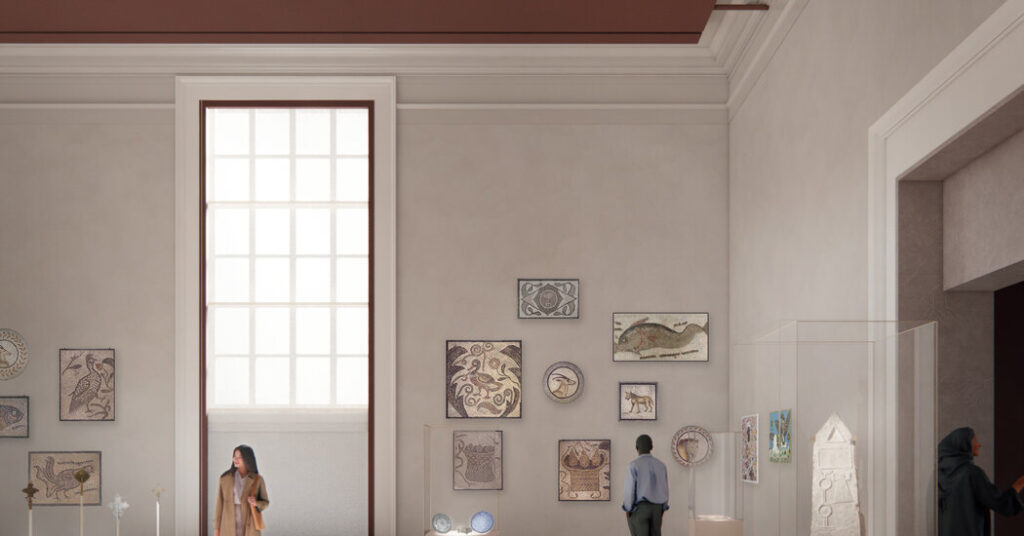
This spring, the museum will break ground on a $13 million renovation project to create a new, 6,400-square-foot home for its African collection, expected to open in fall 2027. The Brooklyn-based architectural firm Peterson Rich Office will lead the project.
Unlike at most other museums in the country, they will be physically connected to the museum’s Ancient Egyptian art collection on the third floor, adjacent to the Beaux-Arts court. The move is meant to correct a longstanding art historical segregation of Egypt from the rest of the continent.
“It’s always bewildering to me that those collections are so separate” Pasternak said, adding, “I think in especially in a place like Brooklyn, that framing reads as racist.”
When the galleries reopen in fall 2027, they will be filled with about 300 works from the museum’s more than 4,500-piece collection of the Arts of Africa, covering 2,500 years of history.
The display is being planned by Ernestine White-Mifetu, a curator and scholar of modern and contemporary African art from Cape Town, South Africa, and Annissa Malvoisin, a scholar of ancient African art specializing in Egyptian and Nubian art, both of whom joined the museum four years ago. The new installation will emphasize Africa’s centrality in a global network that connected the continent with Asia, Europe and the Americas. It will include contemporary works alongside historical ones, as well as works from the African diaspora — including from places to which enslaved African people were taken.
“The diaspora is Africa’s story,” White-Mifetu said. “We can’t just focus on the African part and negate that important journey that millions of people took.”
In deciding what to include in the display and how to organize it, the curators engaged with outside curators and scholars, community organizations and colleagues in the education and visitor engagement departments to get a sense of what objects were most valued by visitors. “It really has been a collaborative effort from the beginning,” White-Mifetu said.
Works will be organized geographically, but not according to present-day borders, which were largely the result of European colonization in the 19th and 20th centuries. Instead, the Atlantic Ocean, Mediterranean Sea, Loango Coast, Sahara, and Nile and Niger Rivers will provide the framework.
“We wanted to highlight transcultural interactions — what happens when different communities and cultural entities were talking to each other,” Malvoisin said.
Ancient Nubian art will be brought into conversation with Ancient Egyptian art, and North African with what used to be called “sub-Saharan.” The Sahara will be recognized not as a boundary between north and south, but as a thriving zone of trade and cultural exchange. Islamic and Christian visual traditions will also be on display. Carthage — here represented in the form of mosaics from a sixth-century synagogue — will be seen in the context of Africa, rather than, as is usually the case, part of the Classical world.
“It was really intentional to bring all of these things together to show that Africa has always been a multiethnic, multifaith continent,” Malvoisin said.
Alongside African court art, including a late-19th-century Yoruban beaded crown, or ade, the curators plan to incorporate modern images, one by the Nigerian photographer J.D. ‘Okhai Ojeikere of a woman’s elaborate braided hairstyle, and another by the Brooklyn-based artist John Edmonds of a man sporting a durag — another type of crown.
The new galleries are essentially reclaimed space in the 576,000-square-foot building — areas that have been used to store thousands of textiles and “bulky, ugly furniture,” Pasternak said. Experts went through these objects to determine what should remain in the collection, what should be conserved and what should be donated to other museums or be sold to support conservation work.
Over the last 10 years, the museum has invested almost $100 million in capital projects for the 1893 McKim, Mead & White building — “mostly unsexy things,” Pasternak said, “but necessary.” The new African art galleries will be paid for by funds from the City of New York, federal grants, private foundations and individuals.
The project comes as the Brooklyn Museum, like most institutions in New York City, is facing budgetary challenges, and recently laid off some of its staff. But Pasternak said she believes the project makes sense. “The more people have to see at the museum, the more reasons there are to keep coming back, and the more reasons there are for people to celebrate and support the Brooklyn Museum.” She also noted that the funds that have been raised for capital projects cannot be used for operating costs.
“I’m a big believer in less storage, more galleries,” she said. “People deserve to see masterpieces, and they deserve to see their cultures represented with dignity.”
The post A Grand New Space for African Art, Uniting the Continent appeared first on New York Times.