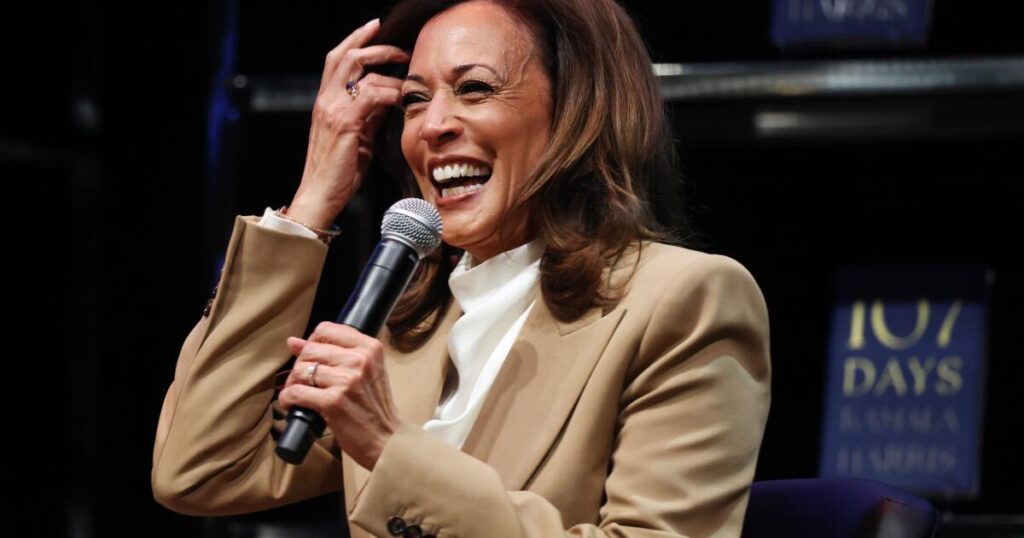
When I read all the hype being heaped on Kamala Harris’ lead in early polls for the 2028 Democratic nomination, I have to chuckle to myself.
The release of a Rasmussen Reports poll in February was titled, “Kamala Harris Still Leads 2028 Field for Democrats.” One headline in the Hill predicted, “Kamala Harris may yet be the Democratic nominee in 2028.” A Washington Examiner piece about polling warned, “Democrats won’t get rid of Kamala Harris that easily for 2028.”
I chuckle not because I don’t believe the numbers, but because I don’t believe any poll this far out in an open contest is meaningful, let alone determinative. I’ve seen this movie before, and it didn’t end well.
In 2003, after managing the successful 2002 reelection campaign of California Gov. Gray Davis, I signed on as an advisor to the presidential campaign of Connecticut Sen. Joseph Lieberman — who, I needn’t remind anyone, had been the Democratic nominee for vice president in the 2000 election, which he and Al Gore lost in a nail-biter to George W. Bush.
Based simply on his high name identification from that hellzapoppin’ race, and the fact his name had been on the ballot in all 50 states just two years before, Lieberman initially led the Democratic field quite handily in almost every national poll.
An ABC News/Washington Post survey in January 2003 found Lieberman leading the Democratic field with 27%. A Gallup poll from that same month also placed him first, ahead of both John Kerry and Richard Gephardt.
A Pew poll in the summer of 2003 also found Lieberman atop the field, as the best-known candidate at 85% name recognition, and 58% support, ahead of Kerry, Gephardt and Howard Dean.
Boy, did we brag about Lieberman’s lead at every stop and in every press release. But in the end, the promising early numbers meant nothing. When actual votes were cast, Lieberman totally flamed out, receiving a measly 8.9% of the vote in the critical first primary in New Hampshire, finishing dead last, and dropping out of the race in February 2004, having lost every primary and caucus up to that point.
Why? A lot of reasons, including mistakes made by the candidate and campaign. But fundamentally because, when Democrats started to take a close look at and assess the full field, they relegated Lieberman to the status of a loser, and they wanted to move on. We heard a lot of, “He had his chance and lost.” Does Harris come to mind?
The fact is, we Democrats tend to put defeated presidential nominees in the rear-view mirror pretty quickly. Think of Michael Dukakis, Gore and Kerry. And let’s not forget, Harris obtaining the nomination in 2024 was a fluke; she didn’t compete in one primary or receive one primary vote. The first time she ran for president, in the 2020 cycle, she also didn’t win one primary or receive a single primary vote, because she ran a bad campaign and hightailed it out of the race before a single vote was cast. Two strikes and you’re out?
We Democrats just don’t renominate losers. The last time we did it was exactly 70 — yes, 70 — years ago, with Adlai Stevenson in 1956 after he had lost the 1952 presidential race to Dwight Eisenhower. Stevenson rewarded Democrats for this recycling effort by losing to Eisenhower a second time — by an even worse margin. Democrats learned their lesson: Reheating doesn’t work with failed candidates.
And, come on, Harris not only lost to Trump, not only lost all seven swing states, but was the first Democratic presidential nominee in 20 years to lose the popular vote. And her weak showing also helped Republicans wrest control of the Senate from Democrats. We’re supposed to imagine that’s a credible record on which to run again for the nomination?
All of these breathless stories about Harris leading the field nationally also never mention her perilous standing in her own home state of California. A Berkeley IGS survey in August revealed that by a margin of 18 percentage points, even her fellow Democrats in California did not want her to run again. A Politico poll this month showed Gov. Gavin Newsom with a 2-to-1 lead in California among voters leaning toward voting in the 2028 Democratic primary.
So have fun, Kamala Harris, enjoying your name-ID high while it lasts (although maybe a mite longer than your 107-day presidential effort).
Garry South is a Democratic strategist who has managed four campaigns for governor of California and played significant roles in three presidential campaigns, including that of Al Gore.
The post Kamala Harris is polling well, which signifies nothing appeared first on Los Angeles Times.