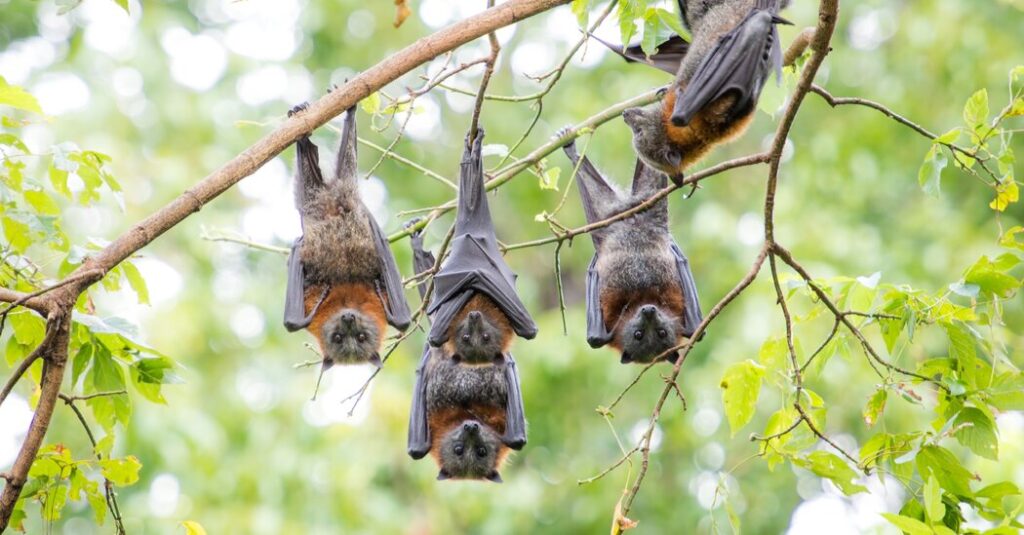
The grey-headed flying fox is one of the world’s largest bats. It can weigh more than two pounds and have a wingspan of more than five feet. And as it migrates along Australia’s eastern coastal regions, watch out for what bat scientists call its seed rain: The animals defecate in the air without stopping to roost.
Bats don’t have the best reputation — the flying mammals have been blamed for pandemics like Ebola and Covid. Flying foxes have had this problem, too.
Australian authorities once considered them to be pests and used napalm to kill their colonies, which can get as large as “several hundred thousand,” according to Justin Welbergen, an animal ecology professor at the Western Sydney University.
But people may need bats like the flying fox more than they realize. In a study published Tuesday in the journal Scientific Reports, a team of scientists has quantified the economic benefits the animals provide to the timber industry in Australia.
The study was based on data from over 1,200 flying fox roosting sites gathered by the Commonwealth Scientific and Industrial Research Organisation, Australia’s national science agency. Researchers calculated that the flying foxes were responsible for the creation of more than 91 million trees, a majority of them eucalypts. For Australia’s economy, that means somewhere in the range of $195 million to $673 million per year contributed by the bats.
This is only the third-known study worldwide — and the first in Australia — to quantify the economic benefits that derive from the world’s approximately 1,500 bat species. Other studies have shown that the benefits of bats range from protecting cotton and corn crops in Texas to safeguarding the tequila industry in Mexico.
As with many bat species, Australia’s flying foxes benefit the ecosystems they inhabit because they serve as pollinators while roosting and feeding on trees, and as seed spreaders when they release their waste or otherwise drop the seeds as they fly.
Many of Australia’s tree species have in this way become dependent on flying foxes in what an author of the study, Alfredo Ortega González of the University of Sydney, described as “a co-evolution pathway between certain bat species and certain plants.”
“Flying foxes are mega-dispersers,” said Alexander Braczkowski, also an author of the study who has long studied conservation issues related to bats. “When compared with other Australian pollinators, such as birds and bees, they fly significantly longer distances on average. But they can also handle proportionally much larger seed sizes.”
The researchers coined the term “the bat ripple effect” to describe the flying foxes’ impact across multiple ecosystems as they travel hundreds of miles in a few days. Experts say this is especially important as Australia’s natural landscape is affected by wildfires and human activities.
“Australian flying foxes are the quintessential Australian character — they range across the landscape of droughts and flooding rains,” said Dr. Welbergen, who was not involved in the new study. “With their extreme mobility, bats are a glue that keeps the increasingly fragmented Australian forest landscapes together.”
He added that the flying foxes preserve “the genetic integrity of Australia’s forests. This is especially important as landscapes recover from fires that are becoming more frequent.”
Although flying foxes are unlikely to disappear entirely anytime soon, they remain vulnerable to habitat loss, fire and extreme heat events.
“A single hot afternoon can result in mortality on a regional scale and in biblical proportions, with tens of thousands of dead flying foxes,” Dr. Welbergen said.
He added that conservation concern about the animals should be comparable to that afforded to the world’s bees, which face major threats.
Mr. Ortega González agreed. Without flying foxes, he said, the effects on nature “would not necessarily be immediate. The effect would be gradual. But it would reach a point where certain tree species would not be able to even grow, or get their seeds across the landscape.”
Or as Dr. Welbergen put it: “We have been taught to fear bats from a very young age. But even the most despised animals in the world have roles to play.”
The post We’ve Been Underestimating Flying Foxes appeared first on New York Times.