The sprawling military compound in the heart of Buenos Aires where thousands of people were tortured and disappeared during Argentina’s military dictatorship half a century ago has become a memorial — a monument to the country’s commitment to truth and justice.
But deep cuts to the federal budget made by President Javier Milei after he took office three years ago have hobbled the memorial.
The site’s museum closes three days a week. Many staff members have been laid off. Projectors that once displayed the faces of junta generals on the walls sit broken with no one to repair them. The site’s cultural center is closed.
“It makes me so angry,” said Carlos Muñoz, a political activist during the dictatorship, as he walked through the rooms where he was held and tortured. “It is very hard to overcome depression and a feeling of defeat.”
On Tuesday, Argentina marks the 50th anniversary of a military coup that ushered in a brutal seven-year dictatorship that kidnapped, brutalized and killed thousands of people.
But instead of being a moment of collective tribute, the anniversary has become ensnared in a partisan struggle.
As relatives continue searching for the bodies of the disappeared and at least 300 children the military stole from them and gave to others to raise, they are colliding with a government that is defunding the groups conducting the searches and that is promoting a revisionist account of the dictatorship.
Mr. Milei’s government and its allies argue that for decades the left had distorted the history of the dictatorship, overemphasizing state crimes while ignoring the violence of leftist guerrilla groups.
The president’s office did not respond to a request for comment. On the campaign trail Mr. Milei described the military dictatorship’s crimes as “excesses’’ amid a war.
The Milei government downgraded the secretariat of human rights’s role in the government and slashed its financing. The government also stopped funding various rights groups, including the most prominent, the Grandmothers of the Plaza de Mayo, founded by relatives of the disappeared.
Groups and survivors say the government is chipping away at the foundation of Argentina’s modern democracy — threatening a social pact erected on truth, memory and human rights.
“It is an insult to the construction of the most luminous thing this country was able to make out of the most sinister and dark things we endured,” said Manuel Gonçalves Granada, whose father was disappeared and whose mother was killed by the military junta.
Last week, human rights experts with the United Nations expressed “serious concern” over “regressive measures in Argentina that risk undermining four decades of exemplary progress in memorialization, truth and justice.”
Argentina’s military seized power in a 1976 coup, ostensibly to end a spiral of violence between leftist guerrillas — who were engaged in bombings and kidnappings — and government-backed death squads.
The dictatorship’s methods quickly evolved into systematic state terrorism. The military opened hundreds of secret concentration camps across the country where people were tortured and killed, including political activists, students, teachers and union workers.
Women gave birth in captivity and their babies were taken from them and often raised by generals overseeing the repression.
Twenty years after the country’s return to democracy in 1983, in the early 2000s, a leftist government revitalized trials of the dictatorship’s perpetrators and sentenced more than 1,000 to prison. It apologized to victims on behalf of the state and embedded remembrance into state policy.
The mothers of the disappeared, who in 1977 had began protesting in Buenos Aires’ Plaza de Mayo demanding answers from the junta, became international human rights icons.
Because the dictatorship’s repression was clandestine and many people were dropped alive from aircrafts into an Argentine estuary, the Río de la Plata, or buried in secret mass graves, the exact number of victims is unknown. Human rights groups placed the figure at 30,000.
Mr. Milei has argued for a much lower figure of 9,000 from a 1984 report by a government commission that human rights organization say was only preliminary.
When he was running for president, Mr. Milei attacked the “scam of human rights” and accused a leader of Grandmothers of Plaza de Mayo of being “totalitarian.”
After becoming president, Mr. Milei laid off much of the staff at a government agency set up to help find children taken from the disappeared, cut a large part of the budget for the memorial sites and reduced the government’s participation in the trials of defendants involved in the dictatorship.
While many of these policies fall under general budget cuts, the federal government has also stopped communicating with the Grandmothers of Plaza de Mayo, members of the association said, and is promoting a revisionist discourse emphasizing the crimes of the guerrillas.
Mr. Milei’s vice president, Victoria Villarruel, the niece of a military colonel who served during the dictatorship, has called the sentences against military members “unfair.”
In 2024, a group of lawmakers from Mr. Milei’s party visited military officials imprisoned for crimes against humanity and posed for a photo together. After facing a backlash, some lawmakers said they were tricked into the visit, while one called it a humanitarian gesture.
During the last two anniversaries of the coup, Mr. Milei’s administration has released videos questioning the official death toll and casting state repression as a war.
“We do not say the dictatorship was good. We do not say there were no human rights violations, nor do we deny the disappeared,” said Agustín Laje, an Argentine intellectual who is featured in the latest video. “We say that on the other side, the left also committed human rights violations.”
Mr. Laje was recently at a right wing festival where Mr. Milei spoke. Another speaker, Nicolás Marquez, a far-right pundit, took aim at the mothers of the Plaza de Mayo. “We are celebrating that the mothers of the terrorists were left without funding,” he said. “Their memory scam is over.”
Though many survivors of the dictatorship say they are confident most Argentines do not embrace a reinterpretation of that traumatic era, some still said they feared the promotion of an alternative account in official state discourse.
Claudia Poblete Hlaczik, 48, who was raised under a different name by a lieutenant colonel after her parents were kidnapped, said that until she was 21, her household’s narrative described the mothers of Plaza de Mayo as “crazy” women “seeking revenge” and the disappeared as terrorists.
“The discourse with which they raised me is very similar to the discourse the government is holding today,” she said. That rhetoric, she added, prevented her from seeking her true identity despite having doubts about the advanced ages of the couple who were pretending to be her parents. Now she worries about others like her.
“If all these policies are dismantled and the public discourse denies reality, what are those who have doubts supposed to do?”
Despite losing public funding, the Grandmothers of the Plaza de Mayo is raising money and still finding the children of the disappeared born in captivity, now grown men and women.
This month, an Argentine forensic team recovered the remains of 12 dictatorship victims buried in mass graves in the Argentine city of Córdoba. About a dozen criminal cases against alleged perpetrators are still ongoing.
Yet those seeking the truth about what happened under the dictatorship, an effort long supported by leftist governments, are now casting the state not as an ally, but as an obstacle.
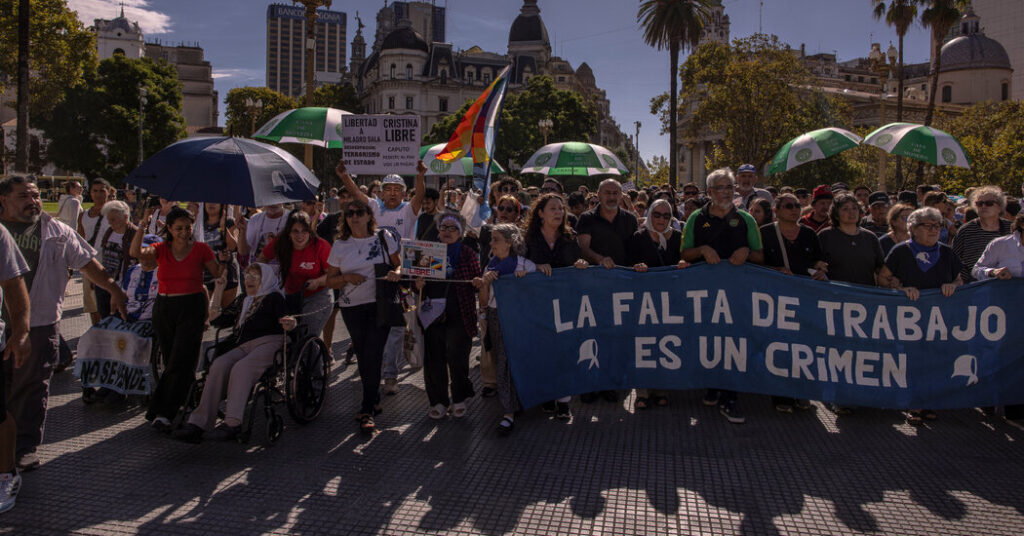
For nearly 50 years, the Mothers of the Plaza de Mayo have gathered every Thursday in the square demanding news of their still missing children. They recently sang “Milei, trash” as they marched.
Pina de Fiore, 94, whose son, a factory worker at Peugeot, was arrested and disappeared in 1977, sat on a wheelchair. She has attended these marches for over four decades, wearing the Mothers’ trademark white head scarf.
“We haven’t found my son yet,” she said, adding: “This government is not helping.”
Emma Bubola is a Times reporter covering Argentina. She is based in Buenos Aires.
The post Government Cuts Gut the Memory of Argentina’s Dirty War appeared first on New York Times.