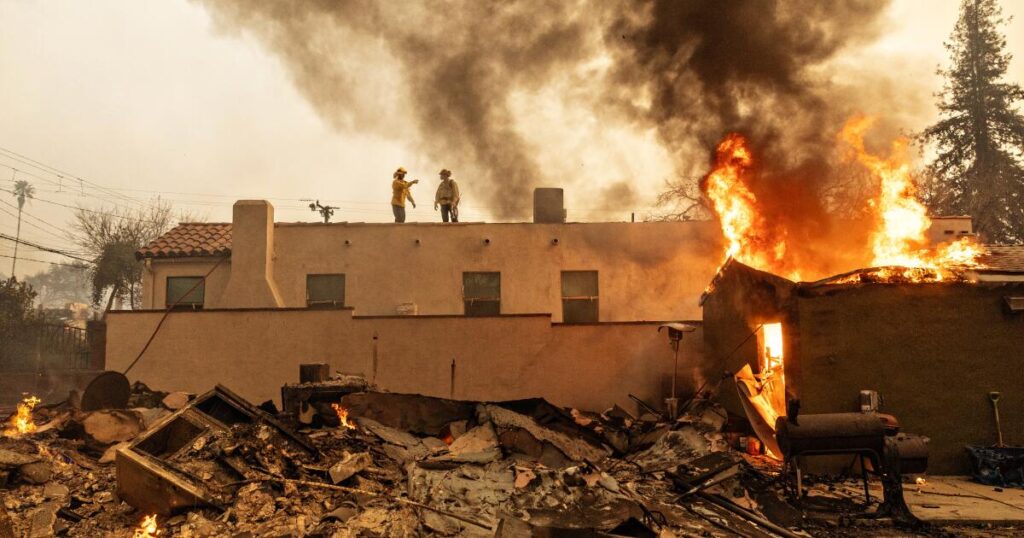
Almost two hours before the Eaton fire broke out in the San Gabriel foothills Jan. 7, 2025, Los Angeles County emergency management officials had been pushed to send out an emergency alert to warn residents that increasingly high winds would pose a significant risk.
But no such alert was sent.
The residents of west Altadena did not receive an emergency alert until 3:30 a.m. the next day, nine hours after the fire started — and almost 12 hours after an emergency management employee urged a prefire alert. All but one of the Eaton fire’s 19 deaths occurred in west Altadena.
Working side by side with National Weather Service officials, an emergency management staffer around 4:30 p.m. had called for a cellphone blast across the Interstate 210 corridor — a stretch of foothill communities that includes Sylmar, Altadena and Sierra Madre — to warn people that they needed to prepare for dangerous winds. Even if a fire didn’t spark, trucks could topple. Limbs would certainly come down. Power lines could endanger residents. And if a spark did catch, it could quickly mirror the inferno that was engulfing Pacific Palisades, or worse.
It’s not clear what difference a prefire preparedness alert sent to residents before the Eaton fire would have made. But it could have added another element of urgency as perilous fire weather was beginning to overwhelm the region.
In the wake of the January firestorm, the idea of prefire alerts during dangerous conditions is getting more attention as officials grapple with how to better prepare communities, especially when fire weather conditions are being forecast with increasingly precise timing and location.
In a statement, L.A. County’s Office of Emergency Management defended its decision not to send out a prefire wireless emergency alert, saying it was not warranted before the fire started because the wind event was not a “specific life-safety incident requiring an immediate protective action,” for which such alerts are reserved.
The late alerts in west Altadena, revealed by The Times in January 2025, have become the subject of multiple investigations at the state and local levels, including a civil rights inquiry launched last month by the California attorney general. The 3:30 a.m. alert ordered people to immediately evacuate, but at that point, flames and smoke had been threatening the area for hours.
That section of town, which would end up among the most devastated, never received an evacuation warning. Many residents have blamed the late alerts for chaotic and dangerous evacuations, and some, for family members’ deaths.
For Nick Vaquero, the emergency management employee who pushed for the alert before the Eaton fire started, he can’t help but wonder how an earlier alert — even one that wasn’t a traditional evacuation warning — might have helped residents prepare.
“We had multiple options to be able to alert that community in Altadena,” Vaquero said in an interview with The Times. “Sending something out before cell towers went down, before people went to bed … it’s hard to say for certain, but it could have saved lives.”
For decades, wildfires were considered a reactive emergency, but more disaster experts are looking for ways to apply proactive messaging, deployment and warning systems to fires — systems more akin to hurricane preparedness.
“It’s a work in progress,” said Mark Ghilarducci, the former director of the California Governor’s Office of Emergency Services. He helped bring to life the state’s Wildfire Forecast and Threat Intelligence Integration Center in 2019, which he said was partly modeled after the National Hurricane Center. That center, he said, has been transformative in how the state assesses and forecasts fire risk, which has improved resource pre-positioning and agency coordination. But he acknowledged there’s still a lot of work to be done, especially when it comes to public communication.
“The extreme wildfires we’ve been seeing really didn’t get started until 2016,” said Ghilarducci, who is now chief executive of Emergent Global Solutions, a crisis management consulting firm. “So I think that we’re at the beginning of the journey. … There is so much more that can be done in the wildfire space to get our communities prepared.”
In his experience, officials generally utilize only the geographically targeted cellphone alerts, known as wireless emergency alerts, when there’s an extreme threat, Ghilarducci said. But he remembers deciding to send out one such cellphone blast alert to much of Southern California in 2017 about elevated fire conditions. The weather service had issued widespread, heightened red flag warnings, several fires were already burning across the state and nighttime was approaching. He still thinks that was the right call but said such decisions must be made judiciously.
You have to think about “public perception … whether it gets overdone and people don’t take it seriously or pay attention to it,” Ghilarducci said of the alert. That concern is particularly heightened if a fire doesn’t materialize — less of an issue for hurricanes.
“I tend to want to always err on the side of sending out more information than less,” Ghilarducci said. Even if it’s the same information that’s been in the news and all over social media or pushed out by the weather service, he said the alert is “putting a finer point on it because it’s coming directly to their phone, it’s waking them up, it’s more proactive.”
He pointed to a 2022 wireless emergency alert that successfully urged Californians to reduce stress on the power grid. But he also noted that the alerts are most helpful when you have a specific action for people to take, such as turning off lights or evacuating.
Vaquero, an associate director for the Office of Emergency Management, realized the use of a prefire wireless emergency alert would have been relatively novel. The county typically utilizes such cellphone blasts for evacuation warnings or orders, but Vaquero felt strongly that meteorologists were describing a situation that could quickly become catastrophic.
According to records reviewed by The Times, Vaquero texted his boss, Kevin McGowan, the director of the county’s Office of Emergency Management at 4:31 p.m. Jan. 7, 2025: “Do you want to discuss the 210 corridor alerts?”
McGowan never responded to that text message, but Vaquero said he brought up the suggestion of a preparedness alert when McGowan returned to the emergency operations center about an hour later. But the idea was dismissed, Vaquero said.
L.A. County Office of Emergency Management officials acknowledged the text message from Vaquero and said it related to an earlier discussion among emergency management partners and the weather service about possibly sending a weather preparedness notification. But office officials said in a statement that the alert system is not designed “for broad situational awareness messaging.”
“Weather alerts are intended to raise awareness of hazardous conditions, while emergency alerts issued by local authorities are used to communicate immediate protective actions tied to a specific incident,” the statement said. The threshold to use an emergency alert was only met once the fire started and began to threaten communities, the OEM statement said.
“Because the forecasted wind conditions did not involve a specific life-safety incident requiring an immediate protective action, a [wireless emergency alert] was not needed,” the statement said. OEM officials also said that an early alert to the 210 corridor could “create confusion and non-compliance,” given the high likelihood that those areas could later get an alert to evacuate.
The county pointed out that Altadena and the entire Eaton fire footprint had been warned for several days in advance of the fire about “particularly dangerous” red flag conditions by the weather service, through official county communications and the news media.
But that isn’t always enough, one expert said.
“The missing thing for the public is, ‘So what? What am I supposed to do?’” said Thomas Cova, a geography professor at the University of Utah in Salt Lake City who specializes in environmental hazards and emergency management. He said the idea of pre-disaster warnings, especially for wildfires, is generally under-researched.
OEM officials said they haven’t changed the policy on pre-disaster alerts, but said they have continued to “strengthen how we communicate risk and prepare communities.”
The statement said the county has “implemented changes to our alert and warning practices, including issuing evacuation warnings to all directly adjacent zones when an evacuation order is issued.”
The post Officials considered warning Altadena before Eaton fire, but no alert was sent appeared first on Los Angeles Times.