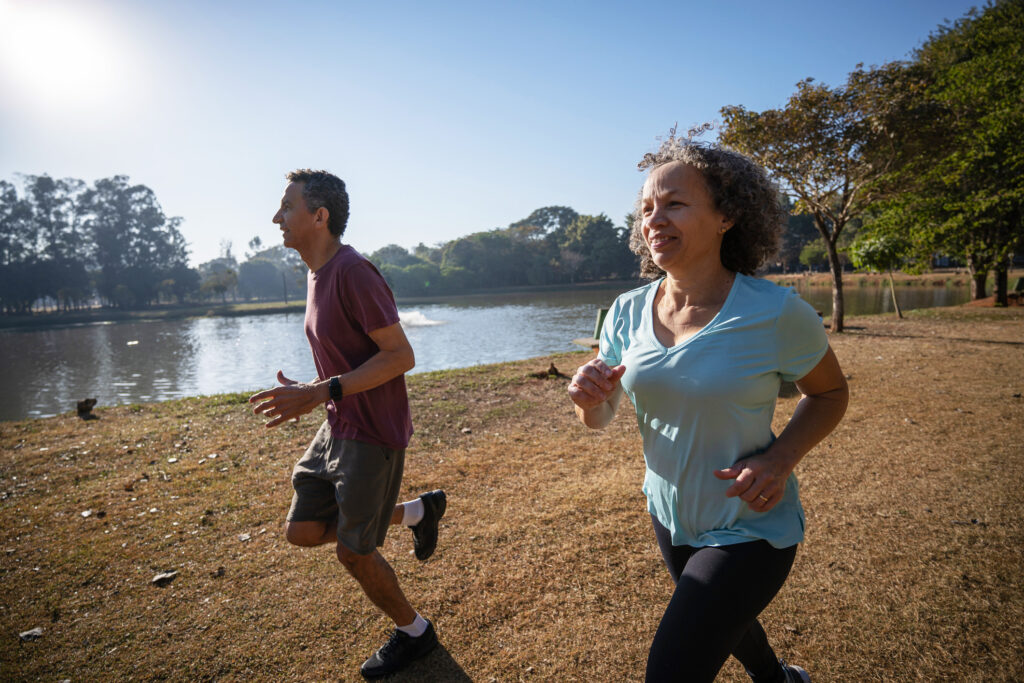
Exercise can strengthen a leaky blood-brain barrier, which may improve brain health and potentially fight dementia, according to an ambitious new mouse study of exercise and neurodegeneration published this month in Cell.
In rodents and people, the blood-brain barrier — a narrow layer of cells that protects the brain from toxins and pathogens — typically weakens with age, contributing to neuro-inflammation and other problems, including heightened risks for dementia. But the study’s authors found that during and after exercise, at least in mice, the liver releases a specialized protein that travels to the brain and helps repair the protective cellular barrier there.
The effects of the exercise protein were especially striking in older mice with a form of Alzheimer’s disease. Their memory and learning abilities improved substantially when levels of the protein rose in their brains.
The researchers found the same protein in the bloodstreams of physically active people.
“These results provide compelling evidence in animal models that exercise-related signals from the liver can improve brain function by acting on the blood-brain barrier,” said Michelle Voss, a professor and director of the Health, Brain and Cognition Lab at the University of Iowa. She studies physical activity and the brain but wasn’t involved in the new study.
The study’s findings may help us better understand how, at a cellular level, exercise staves off cognitive decline with age, in both animals and people. But they also raise provocative questions about whether it might soon be possible, worthwhile — or wise — to isolate and offer the protein as a kind of partial substitute for exercise to improve brain health in people for whom movement is a struggle.
How does exercise protect the brain?
The idea that exercise helps aging brains is hardly new. Decades of research have shown that activities like walking, swimming, cycling, running and weight training contribute to healthier, more youthful brains and better thinking abilities in older animals and people.
But why? What’s going on during exercise that changes minds and brains?
Years ago, Saul Villeda, a professor of biomedical sciences at the University of California at San Francisco and senior author of the new study, began suspecting this was due to something called exerkines.
Exerkines are substances, such as hormones, proteins, peptides or other molecules, released into the bloodstream during and immediately after exercise. Most come from working muscles, which pump out hundreds and even thousands of exercise-related molecules when they contract during exertion.
Exerkines surf through the bloodstream to other organs, jump-starting complicated biochemical reactions there that contribute to improved insulin sensitivity, better blood pressure, lower cancer risk and other aspects of health and physical performance.
Villeda thought exerkines probably also bulked up brains and, in a 2020 experiment published in Science, set out to see how.
Running changes minds in mice
He and his colleagues first encouraged mice, both young and old, to run for six weeks, then transfused plasma from their bloodstreams into other aged but sedentary animals. Afterward, these older mice performed substantially better on thinking tests than same-aged control animals, whether their transfusions came from older mice or young. All that mattered was that the mouse donors ran.
Something in the exercising animals’ bloodstreams after exercise had improved cognition, Villeda decided. Now, to find it.
His team used a technique called mass spectrometry and other methods to identify dozens of molecules unique to runners’ blood. Most were already well-known, but one, an obscure protein known as GPLD1 (short for a long and forgettable scientific name), hadn’t been studied much before, so it was worth isolating, Villeda thought. Also, unlike most other exerkines, it was produced by the liver.
Might it somehow be working, subsequently, in the brain?
Using genetic engineering, the scientists prompted the livers of older sedentary mice to start producing extra GPLD1. Later, those mice, still sedentary, aced rodent memory tests. Portions of their brains also teemed with healthy, newborn neurons, a marker of robust brain health.
But there was a problem. The researchers could find no signs of GPLD1 inside the brain tissue of the engineered mice. The protein was bettering their brains but wasn’t entering them.
How was that possible?
The role of the blood-brain barrier
For the new study, the baffled researchers decided to take a large step back and mull what GPLD1 usually does. And the answer is, it cleaves. Its normal function is, in fact, to roam the body, snipping certain types of proteins from the outside of cells, affecting how those cells then work. It’s the Edward Scissorhands of microbiology.
Was it snipping proteins in or around the brain, the scientists wondered, and if so, to what end?
Those questions brought them, almost inexorably, to the blood-brain barrier.
The blood-brain barrier consists of tightly packed, specialized cells found in almost all mammals, including people, that surround the many blood vessels snaking their way through the brain and spinal cord. Its role is to repel substances that shouldn’t cross into the brain. But it tends to get tattered, leaky and less effective with age.
Earlier studies of exercise and the brain had rarely considered the blood-brain barrier. Now, closely examining cells from geriatric animals’ blood-brain barriers, the researchers noticed that a damaging protein, known as TNAP, proliferated on the surface of those cells in far greater numbers than on cells from young animals, making the barrier more porous. Old animals that exercised, though, had much less TNAP dotting their blood-brain barriers than sedentary mice.
Similarly, blood-brain barrier cells from older, sedentary men and women preserved in brain banks showed heightened levels of TNAP, compared to tissue from younger people.
But — and this was the point of the study — when they genetically upped the release of GPLD1 from the livers of older, inactive mice, as if they were exercising, that protein pruned away much of the excess TNAP, leaving the animals’ blood-brain barriers in far better shape. Those mice, including a group with rodent dementia, then outperformed other same-age rodents on learning tests and began sprouting new neurons in portions of their brains, presumably because their brain tissue was better protected now by a rejuvenated barrier.
Can scientists create artificial exercise?
Together, the data suggest that exercise almost certainly aids brain health in part by repairing aging blood-brain barriers, Villeda said — at least in mice and potentially in people.
And the amount of exercise likely needed to see benefits isn’t daunting, added Gregor Bieri, who led the study as a post-doctoral researcher in Villeda’s lab. They found higher levels of GPLD1 in the bloodstreams of older people who regularly walked.
But this is a mouse study, and “many promising exercise-related pathways in mice turn out to be more complicated in humans,” said David Raichlen, an evolutionary biologist at the University of Southern California, who often studies exercise and the brain. He wasn’t involved with this research. Still, he said, the study is “an important step forward” in better understanding the complex mechanisms by which exercise remodels brains and thinking.
Villeda and his colleagues hope soon to study this process more directly in people and even to begin experimentally increasing GPLD1 in people who have profound difficulties being physically active, such as many dementia patients. In effect, they’d be providing them with artificial exercise. (After the study was completed, Villeda and UCSF founded a company to patent a form of GLDP1, with seed money from the National Institutes of Health. He said this venture did not affect the research in any way.)
Villeda said he hopes human experiments might start within five years.
But he’s quick to add that his group’s aim is “not to replace” exercise for most people. No pill or procedure will ever replicate the full benefits of exercise, he continued, which involve a complicated orchestration of hundreds of exerkines, affecting the entire body and not merely the brain. His group’s research might someday aid people with difficulty moving to gain a small portion of the benefits of moving. But for most of us, “if you can, exercise,” he said. “It’ll always be one of the best things you can do” for the sake of your health.
Do you have a fitness question? Email [email protected] and we may answer your question in a future column.
The post Exercise can lower Alzheimer’s risk. Scientists may have discovered why. appeared first on Washington Post.