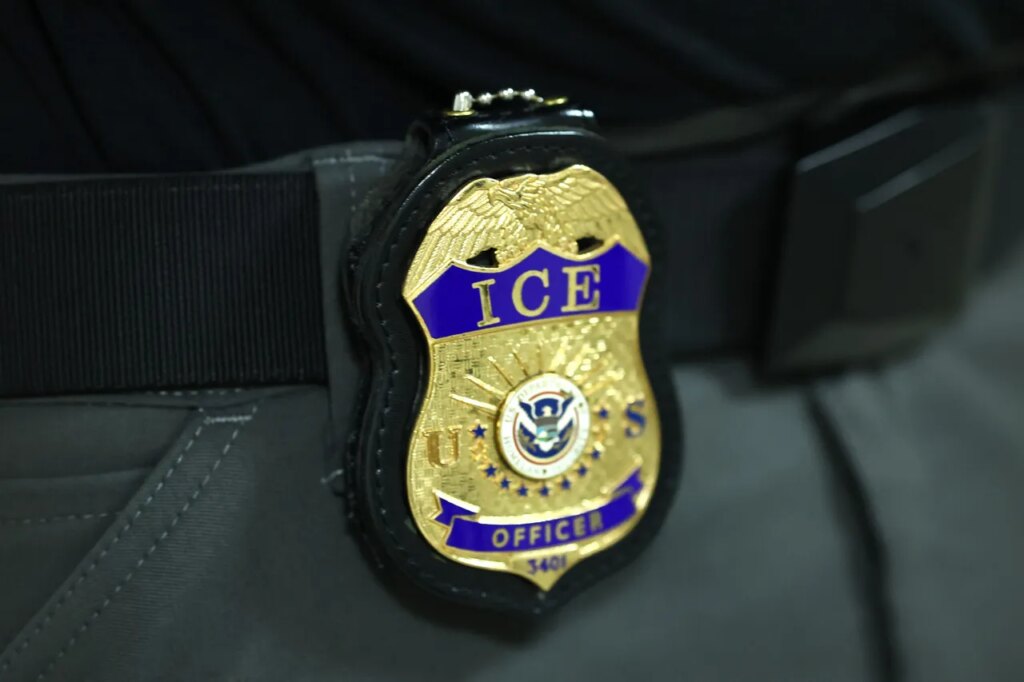
On March 2, the town of Carroll, New Hampshire, population 820, received a $122,515 wire transfer from the Department of Homeland Security, making it among the first wave of local governments reaping the financial benefits of the Trump administration’s efforts to build out a network of local officers assisting in federal immigration enforcement.
WIRED has made this article free for all to read because it is primarily based on reporting from documents obtained via public records laws. Please consider subscribing to support our journalism.
Four months before the payment, the town had signed up as part of DHS’s “Task Force Model,” which is part of the department’s so-called 287(g) program. By signing up, Caroll’s police department essentially pledged that its officers would aid in federal immigration enforcement at the direction of Immigration and Customs Enforcement. All four of the town’s full-time police officers—a chief, his lieutenant, and two patrol officers—signed up as task force officers. In return, DHS pledged to cover the costs incurred by their services, including salaries.
Records suggest that this agreement is not unique, and while Carroll may be one of the first local police departments to receive significant payments under such an agreement, it will not be the last. As of March 17, 900 law enforcement agencies have signed up for this program, including 431 town, village, and city police departments, according to data posted by ICE and analyzed by WIRED. (In Florida, four port and airport authority police departments and 19 university police departments signed these agreements.)
Emails from ICE to the police chief in Carroll, obtained through a public records request, offer some window into the financial nature of the administration’s recruitment effort for this program. In September, around the time that the department started submitting paperwork to join the 287(g) program, ICE offered up to $7,500 for equipment for each officer that completed task force training, along with $100,000 for a new vehicle purchase for every department that submitted a new memorandum of agreement.
“Thank you for your steadfast commitment to our shared mission to Defend the Homeland,” the agency wrote in its recruitment message. “Together, we are safeguarding the American people, working to strengthen the security and resilience of our nation, and upholding the rule of law.” In October, ICE increased the financial incentives, pledging to cover officers’ annual salaries, up to a quarter of those salaries in overtime costs and quarterly financial awards between $500 and $1,000 based on each officer’s percentage rate of “successful location of aliens provided by ICE.”
Two months later, Carroll assisted in taking seven individuals into ICE custody “after a criminal investigation from multiple DUI crashes,” according to Ian MacMillan, the department’s lieutenant.
ICE also appears to be targeting lower-level officers in its efforts to form partnerships with local law enforcement, with a fact sheet and brochure about the program appearing on the agency’s website under the title “How Can I Convince My Chief or Sheriff to Participate in 287(g)?” (Last year, law enforcement organizations like the National Sheriffs’ Association criticized ICE for recruiting officers from among the ranks of their sheriffs deputies.)
On the same web page, ICE has released links to specific memoranda of agreement reached with local law enforcement agencies, including Carroll. Records obtained by WIRED, however, reveal that as part of the payment registry process, ICE and Carroll agreed to a separate, nonpublic “service agreement” that included language specifically about liability.
DHS did not provide comment ahead of publication.
The public agreement between Carroll and ICE stated that if Carroll officers are named in a lawsuit related to federal immigration enforcement, they “may” request representation from the Department of Justice. The private agreement contains an additional pledge: If Carroll is named as part of a lawsuit by an immigrant challenging their immigration status or detention, ICE “will request that DOJ be responsible for the defense of any suit.”
The two agreements also contain different language about confidentiality and access to records. The public agreement between Carroll and ICE states that Carroll “must coordinate” with ICE’s public affairs office before releasing information to the media about its work under the agreement. The agreement further states that “nothing herein limits” Carroll’s ability to comply with state public records laws. (WIRED obtained records by filing a request with Carroll under the New Hampshire Right-to-Know Law.)
The private service agreement, however, states that information “obtained because” of the agreement is “under the control of ICE” and is subject to disclosure only under federal records requests, regulations, and executive or court orders. Such requests are often fulfilled by federal agencies under much longer timelines compared with state requests, functionally limiting the public’s prompt access to records. DHS’s records policies were also recently called into question after top CBP privacy officers said they were ousted after they objected to being asked to mislabel records to block their public release.
If Carroll receives a request under the state law, the agreement says that it “shall promptly notify the ICE FOIA Officer and inform the requester to submit a FOIA request directly to the ICE FOIA Office.” Should Carroll decide to release the private agreement or any information relating to it, the private agreement says that Carroll “agrees to coordinate with the ICE FOIA Officer prior to such release.”
The private agreement also states that Carroll must notify ICE’s Office of Congressional Relations if it receives any requests for information from members of Congress. And though Carroll can notify local media about newsworthy events involving its work for ICE, it must clear press releases and other statements with ICE’s public affairs office before releasing them to the public.
Records suggest that the language in this private agreement is already having an effect in delaying access to records. WIRED requested records under state law from eight municipalities in New Hampshire that have reached task force agreements with ICE. Five days after a request was filed with Auburn, a lieutenant in the town’s police department wrote in response that the department would need to work in “coordination with the Department of Homeland Security” before making the town’s records available for release.
The post ICE Is Paying the Salaries of This Town’s Entire Police Force appeared first on Wired.