

Since losing his job in 2023, Scott had applied to 1,600 jobs, completed 78 interviews, and depleted his savings just to stay afloat. The constant rejection had become so unbearable that he went on antidepressants. So when a recruiter from a staffing company called with a job offer last December, he hung up, walked upstairs, told his wife the news, and cried. “It finally happened,” he remembers thinking.
The triumph, though, was bittersweet. The position was a six-month contract as a technician, two steps down from his previous role as senior manager. He’d have no guarantee of work once the contract ends. And he’d be earning only half what he made before. “Accepting this is going to set my career back five years,” he told me. “I know I’m really good. I want a chance to prove myself.”
We’ve all heard about how grueling the white-collar job search has become. But the market is so tough right now that even the people landing jobs often aren’t the success stories they appear to be. Revelio Labs, an analytics provider, recently looked at the data it collects from across the internet, and found that an alarming share of people are settling for roles that pay less than the ones they had before.
Among all white-collar workers who changed jobs at the end of last year, 40% took salary cuts of more than 10%, Revelio Labs’ analysis showed. That’s the highest share in at least a decade. The share of professionals getting similarly large raises is also at its lowest level.
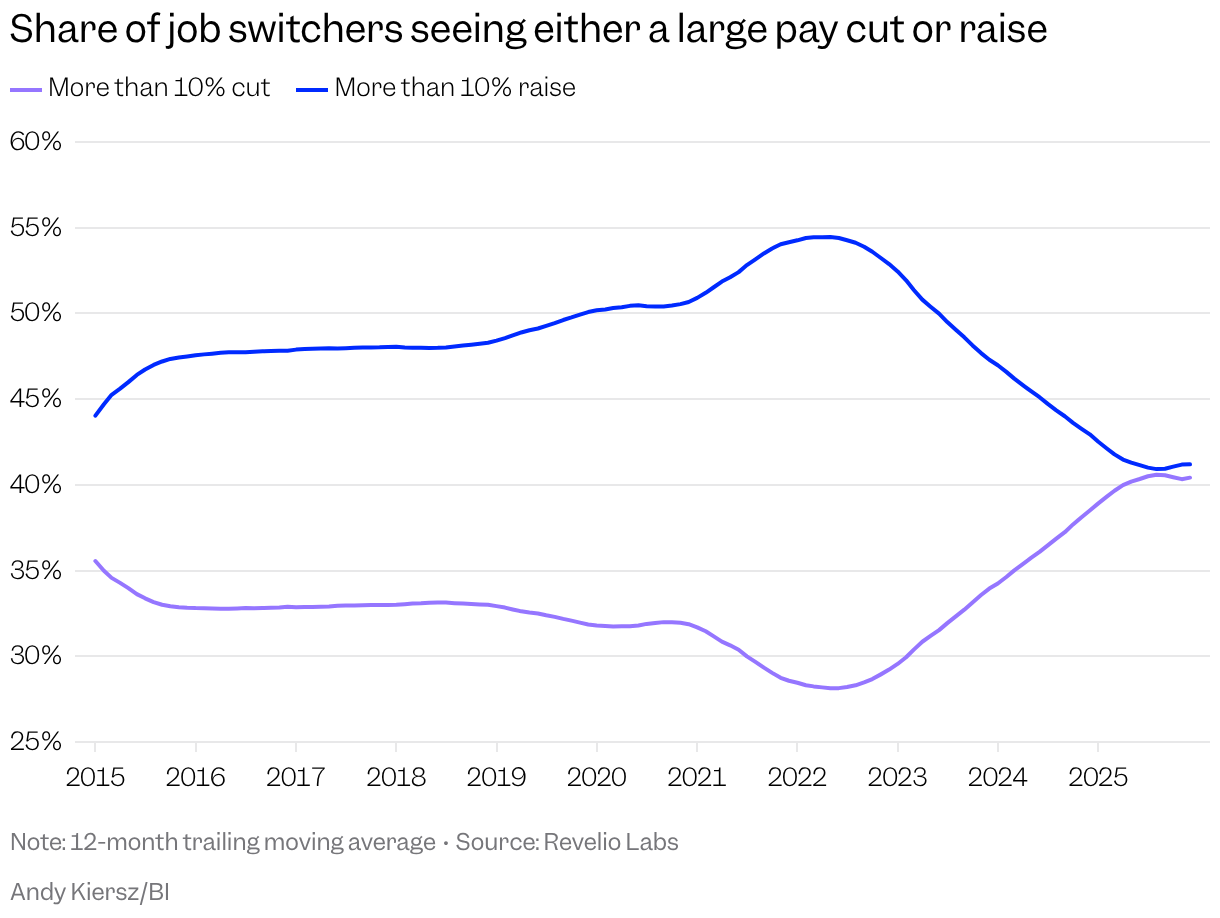
The finding suggests the labor market may be weaker than it appears. Only 4.4% of the US workforce is unemployed — low compared to historical averages — but that may be masking how hard it’s been for the people who’ve lost their jobs to find new ones. For example, the number of people who’ve been unemployed for at least 6 months — considered long-term unemployment — has nearly doubled over the last three years, according to government data. After protracted searches, people like Scott are accepting jobs they couldn’t have imagined taking at the outset.
Workers are taking these pay cuts because companies just aren’t hiring much right now. In December, when Scott accepted his job, he was one of 7.5 million unemployed Americans competing for 6.6 million job openings.
Because of that imbalance, employers have gotten pickier about who they hire. One way that’s showing up is in job postings. Companies are requiring more years of experience for their open positions, Revelio Labs’ analysis shows. That’s been especially true for mid-career roles that now ask for 10% more experience than they did three years ago, and senior roles that ask for 11% more.
All of that could have lasting consequences for workers like Scott. If he stays at his current company, future raises will start from a low base; if he interviews elsewhere, employers will anchor their offers to what he’s likely making right now. By taking the pay cut that he did, he risks earning less for years to come — a phenomenon economists call wage scarring. But with the job market so weak, the bigger risk for him was probably staying unemployed.
The best hope of minimizing that scarring is a rebound in the white-collar job market. So far, that hasn’t materialized; if anything, things are getting worse. Companies from Block to Atlassian have cut staff in recent weeks in moves they attributed to AI, and Meta is reportedly preparing to eliminate 20% of its workforce — a decision that would flood the market with about 16,000 additional unemployed tech workers. In February, the US economy unexpectedly lost 92,000 jobs.
For now, Scott is doing what he can to impress his new bosses. He’s already making some headway: He’s up for a promotion at his company that would come with a small pay bump. He’s also interviewing for a couple of roles with other employers that would come with an even bigger increase.
He’s not holding his breath — after so many rejections, he doesn’t want to get his hopes up — and none of the roles would get him back to his pre-layoff salary. But any one of them would get him a little closer to the career path he was once on. “I know I can impress people if they give me a moment,” he says.
Aki Ito is a chief correspondent at Business Insider.
Read the original article on Business Insider
The post He applied to 1,600 jobs. He finally got one, but it came with a 50% pay cut appeared first on Business Insider.