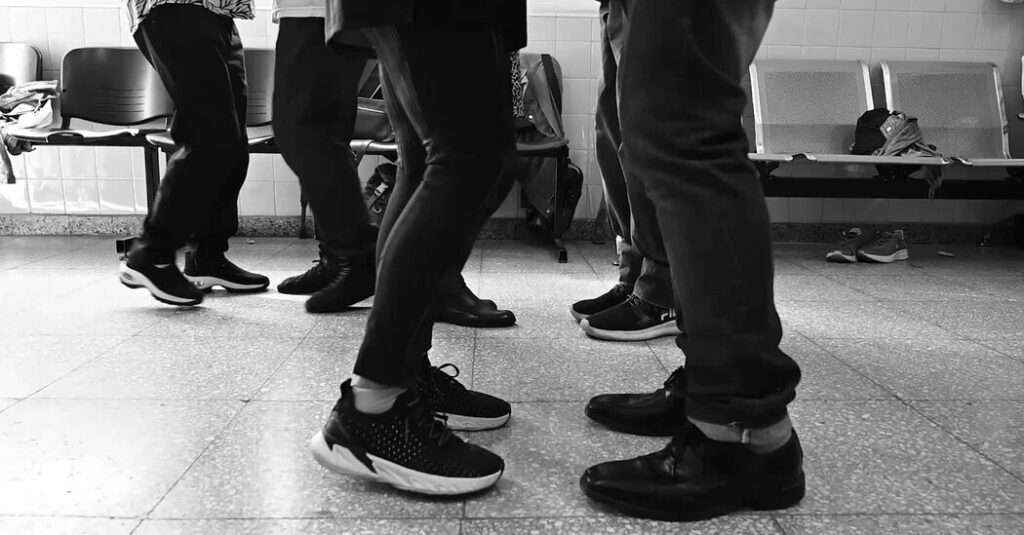
Tango is the national dance of Argentina, known for its passion, precision and heart. In a hospital in Buenos Aires, it has another purpose: as a therapy for patients with Parkinson’s disease. Once a week, about a dozen patients come to Ramos Mejía Hospital to dance — a session that uses the movements of tango to help address issues of balance, stiffness and coordination. The goal is to give them approaches to movement that they can use in their daily lives, as well as a social and emotional boost from moving to music.
The program began about 15 years ago, inspired by a patient who had danced tango since childhood and found it offered strategies that improved her mobility and gait problems, said Dr. Nélida Garretto, a neurologist who helped spearhead the sessions.
Dr. Tomoko Arakaki, another neurologist leading the program, said Parkinson’s patients can struggle with the stop-and-start motions of walking and can benefit from practicing the “slow, short steps” and pauses of tango. Dr. Garretto said that because tango involves “multitasking with motor stimuli, visual stimuli and auditory stimuli,” it can help patients execute the series of small movements in everyday activities.
First, warm-up exercises, usually in a circle, “try to tune everyone in, to prepare the body, to awaken the body,” said Manuel Firmani, a professional tango dancer leading the workshops. Some are done standing, some seated, depending on “the state people are in,” he said.
“Every day is different for their bodies.”
After exercises focusing on posture, balance and other skills, dancing begins. Each patient is paired with a partner who doesn’t have Parkinson’s, often friends, relatives or volunteers.
Dance therapy is used for other medical conditions, including multiple sclerosis and Alzheimer’s. Débora Rabinovich, a psychologist and researcher who helped create the Argentine program, said her research has found that “tango uses the same kind of movements that people with Parkinson’s disease tend to lose.”
She said many tango steps involve walking backward, which can be difficult for Parkinson’s patients, who often fall backward when they lose their balance. “It forces your brain to focus, partly on these backward movements, but also just any kind of detailed movement,” she said.
Some tango steps seem especially helpful. The sanguchito, or “sandwich,” a classic move in which one dancer’s foot slides between the partner’s feet and pauses, offers Parkinson’s patients clear cues to guide their bodies, Dr. Rabinovich said.
“Another fundamental tango element is shifting weight from one foot to the other” said Mr. Firmani, who encourages patients to use that move for activities like stepping up on curbs or entering doorways. He said that the sidestep in tango could help with opening a refrigerator, and that “torso rotation” could apply to pivoting while washing dishes.
Tango “places the body in a certain position and moves it in specific directions,” he said. Parkinson’s can disrupt the orderly patterns of everyday movements. “Tango restores order.”
Sometimes, patients who came to class using canes gain such confidence that they leave without their canes.
Liliana Garay, 59, was diagnosed with Parkinson’s two decades ago and started the program in 2011, with no tango-dancing experience. She said it has helped her stiffness and with weakness she feels when her medication’s effect ebbs. At home, when symptoms arise, she practices an eight-step tango movement, pivoting her feet to trace “the number eight on the floor, like the infinity symbol.”
When she freezes and gets stuck while bending to pick up something, she will breathe and move her leg backward, sideways and forward, as they do in tango class. “That helps the stiffness pass, and I can walk again,” she said.
“The class is an amazing place because they don’t make you feel different,” she said. “They demand the same from us. They don’t say, ‘Oh, you have Parkinson’s, poor thing.’”
There are other tango therapy programs for Parkinson’s patients, including in the United States. The Buenos Aires program, which has served about 100 patients, draws on the social and cultural significance of tango in Argentina, focusing on classic moves and music that resonates with the patients, Dr. Rabinovich said.
That connection gives participants an emotional boost. “For people who have a sense that their bodies are kind of betraying them, it gives you the possibility to feel your body in a completely different way,” she said. “You can be barely moving, but you feel like you danced.”
For Ms. Garay, who travels a long distance on public transportation to get to the workshop, its benefits are so powerful that she has started tango parties, or milongas, in her town, Ciudadela. At the hospital’s workshop, her favorite tango music is by Osvaldo Pugliese “because his music has very strong rhythms for dancing,” she said.
The experience is transformative, she finds. “People come in wheelchairs, with crutches, and we all dance, and an amazing atmosphere is created,” she said. When the class ends, she feels different.
“Tango, for me,” she said, “is health.”
Pam Belluck is a health and science reporter for The Times, covering a range of subjects, including reproductive health, long Covid, brain science, neurological disorders, mental health and genetics.
The post Tango Therapy: How the Dance of Passion Is Helping Parkinson’s Patients appeared first on New York Times.