The arrival of Art Basel Hong Kong, which this year runs from Friday to Sunday, sets the city’s cultural pulse racing. As the great and the good of the global art world assemble, art institutions, museums and galleries across Hong Kong swing open the doors to their new shows. Here are some of the exhibitions on offer.
Lee Bul
Years before there was a Korean wave, there was Lee Bul. Over her decades-long career, the multidisciplinary artist has interrogated the demands that contemporary society places upon the human body — women’s bodies, in particular — at the same time focusing international attention on South Korea’s creative scene. In 2024, she commanded New York’s attention when she was commissioned by the Metropolitan Museum to create sculptures to fill the niches on the institution’s facade.
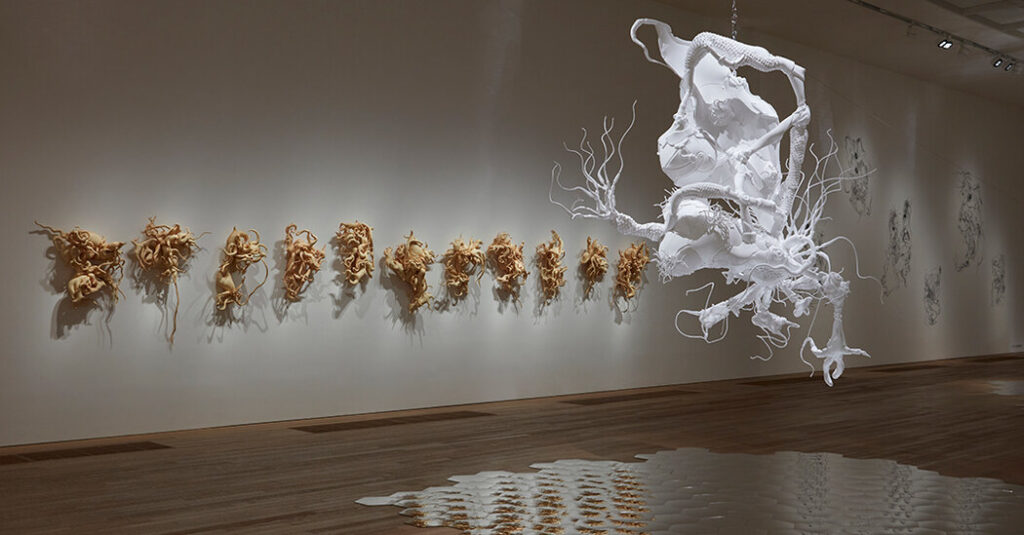
The expanse of Lee’s practice is examined at M+, which bills itself as a museum of visual culture, in a comprehensive survey featuring more than 200 of her works on display through Aug. 9. The exhibition includes architectural installations and artworks that explore the aspirations (and often follies) of utopian endeavors, along with pieces from Lee’s seminal “Cyborg” series.
These sculptures, which disturb expectations of an idealized classical form with sci-fi elements, thrust Lee into the global spotlight when they were showcased in the late 1990s. In the years since, the reflections these works provoke on gender and beauty in a technologized world have only become more relevant.
Mary Weatherford
For Mary Weatherford’s first solo show in Asia, the Gagosian brings the American artist’s large-scale neon-infused abstractions — some of which are held in the permanent collections of institutions including the Museum of Modern Art in New York and Tate Modern in London — to its Hong Kong gallery. Titled “Persephone,” the exhibition, which opens on Tuesday and runs through May 2, has been some time in the making.
“I have been thinking over a show in Hong Kong for a while, with works reflecting the city,” Weatherford said in an email interview. “In 2019, I flew there just to walk around Mong Kok at night,” she added, referring to an area in the city’s Kowloon neighborhood renowned for its neon-dripped streets. “Along with Paris and Las Vegas, Hong Kong has the most beautiful collection of vintage neon.”
Light, both literal and figurative, plays an integral role in the paintings on display and in the space that exhibits them, which has been reimagined by the Los Angeles architectural firm Johnston Marklee to unfold as a journey from darkness to illumination. It recalls the journey undertaken by the Greek mythological figure who gives the show its name, Persephone, who was forced to spend part of the year underground before emerging into the radiance.
Jutta Koether
The German artist, musician and critic Jutta Koether, also showing in Asia for the first time, has considered light in an altogether more material way for her exhibition at Empty Gallery: Her paintings will hang on black walls in a darkened room, with the only light in the gallery illuminating the works themselves.
Undaunted by this idiosyncrasy, Koether has made a series of works that engage directly with the interior of the gallery itself, proposing that the gallery space become part of the creative presentation. Thematically, Koether’s paintings — whether smaller canvases or large-scale triptychs — evoke a sense of loss (her longtime partner, Tom Verlaine of the band Television, died in 2023) while hinting at renewal; emotions explored through the visceral and poetic brushstrokes for which critics know her. The show opened on Sunday, and it runs through June 20.
“Site-seeing”
One of Hong Kong’s most important independent art spaces, Para Site, turns 30 this year, and to kick off the celebrations it is revisiting the theme of its inaugural exhibition.
“Site-seeing,” the title of the show then and now, addresses ideas about memory within an urban space and contemplates the ways artists respond to the ceaseless development in pursuit of newness that underpins much of modern city life. Ko Sin Tung, a multidisciplinary artist from Hong Kong who has placed these concerns at the center of her practice, is among the nine artists and artist groups whose works are on display through June 14.
Art Central
After Art Basel held its first Hong Kong edition in 2013, it did not take long for complementary events to pop up. Started in 2015 to provide a platform for emerging contemporary artists who were perhaps too early in their careers to be shown at Art Basel (and the galleries displaying them), Art Central has grown into a cornerstone of what is widely referred to in Hong Kong as “art week.”
The fair, which takes place from Wednesday to Sunday, highlights moving-image and performance works at the intersection of art and technology.
Among them is a commissioned installation by the Hong Kong artist Kaitlyn Hau that feeds a source code inspired by the artist’s psychological states into a computer to produce an animation that changes in real time.
Pavilion
Pavilion Hong Kong joins art week proceedings for the first time, debuting in Hong Kong as an alternative to the more established fairs.
It was conceived by the husband-and-wife duo of Willem Molesworth and Ysabelle Cheung, who founded the Hong Kong gallery PHD Group, and it was inspired by other alt-fairs like Basel Social Club and Hong Kong’s own Supper Club. Pavilion brings together 25 galleries from across Asia, Europe and the Americas on two floors of a high-rise in the center of the city through Saturday.
The intention is making the experience of viewing and buying contemporary art more approachable and more relaxed.
Perhaps the most convincing way it hopes to achieve this is by doing away with booths, and instead displaying works in a more organic way.
Mercedes Hutton is an editor for the international print edition of The Times, based in Hong Kong.
The post Beyond Art Basel Hong Kong, Cyborgs, Neon Abstractions and More appeared first on New York Times.