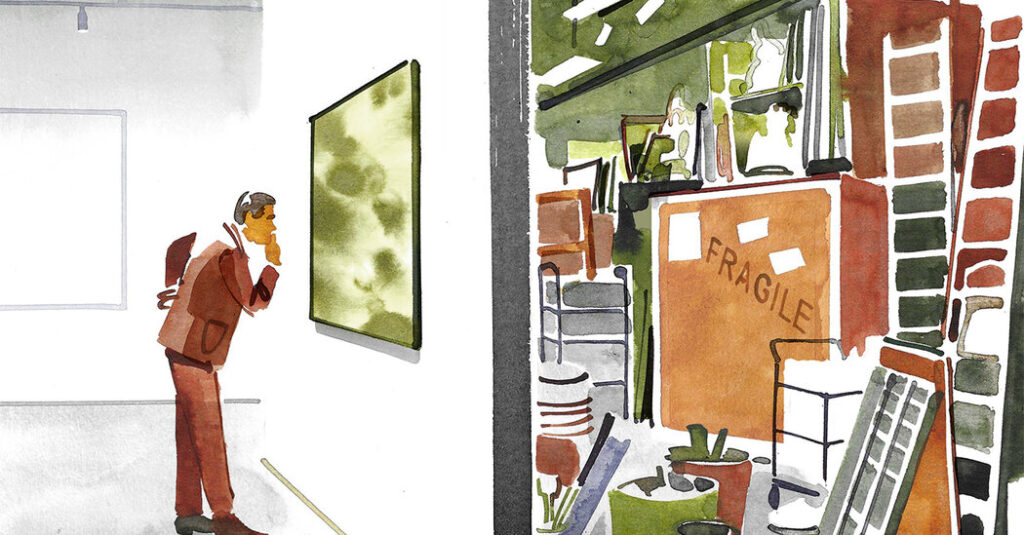
Some 90,000 visitors are expected to converge on Hong Kong this week for the March 27 opening of Art Basel Hong Kong, arriving by private jet, luxury yacht or other modes of transportation. They will scour around 240 gallery booths, looking for something to take home. Their finds will often head home by jet as well and sometimes sit for months in cold storage.
Art fairs, while a key element of today’s art economy, contribute to environmental damage because the events create CO2 emissions and generate unnecessary waste by using building and packaging materials that are used for a short time but take decades to degrade.
For the last five or six years, galleries, fair organizers and other art service organizations have created partnerships to address some of these problems. The British-based Gallery Climate Coalition, an international nonprofit founded in 2020, for example, now has more than 2,100 members in 65 countries, including Art Basel.
“We want the art world to thrive, we want more art to be brought into the world, and we acknowledge that it has to be internationally connected,” said Heath Lowndes, director of the climate coalition.
“Our primary goal is to make the art sector climate-literate. It’s not about blaming, it’s about shifting. We want to create change through setting industry standards, community building and collaboration.”
Another element of the art sector is harder to reach: the collectors.
“Collectors, for us, are the final frontier,” Lowndes said. “They are highly influential, but they are the hardest group for us to access.” He added, “They’re very private and shielded behind advisers and galleries. But we would warmly welcome them to join the conversation and the coalition. There’s a huge untapped potential there.”
While it may take time to implement systemic changes on a global scale, art buyers can do things now, at a fair like Art Basel this week, to address their own impacts on the environment. If they ask questions and seek environmentally friendly options, Lowndes added, “we could quickly change the standards of the industry.”
For conscientious art collectors who want to reduce their carbon footprint, especially when they attend far-flung art fairs like Art Basel Hong Kong, resources can be hard to find. Here is a list of eco-friendly suggestions, compiled with the help of a number of climate-conscious art organizations.
Travel
One of the most important choices you make about your carbon footprint begins long before you arrive at the fair: How will you get there?
The largest climate impact in the art world is related to three areas of activity, according to the Gallery Climate Coalition’s 2025 report: “freight, flights, and energy.” Together, these three elements account for 80 to 95 percent of its members’ total operational emissions, the report stated.
“Aviation is huge, it’s a massive part of the industry’s emissions,” Lowndes said. “Private aviation as well as very intensive air travel.”
Anika Schroter, a co-founder of Art Switch, a New York-based nonprofit group focused on climate-forward art practices, said that art collectors could immediately reduce the impact of their travel by choosing low-emission options, such as arriving by ground transportation or flying economy.
“Private jet travel has the largest ecological impact,” she said. “First class and business class have the biggest impact on commercial planes, and it goes down from there.” (Because they occupy more space, first-class seats on long-haul flights result in more carbon emissions than an economy seat, according to research from the BBC.)
Art Choices
Cliodhna Murphy, the global head of environmental sustainability at Hauser & Wirth, a London gallery with locations worldwide, said collectors could also focus on buying art by artists who address ecological concerns.
“Thematically, are the artist’s ideas pushing the needle on climate change?” Murphy said. “People often start with sustainability and the art world from the operational perspective, but the art itself is why we want to be involved in this work in the first place.”
“Another entry point for collectors to look at are what are the material choices an artist is making,” she said. “Look at the decisions that have been made in the construction of this artwork, because the artwork itself has a carbon footprint.”
Shipping
Once you’ve chosen a work of art that you love, consider how to get it home.
Research conducted by Julie’s Bicycle, a London nonprofit that promotes climate consciousness in the culture sector, found that sending art by sea can reduce carbon emissions by an average of 55 percent, and that it could be higher.
“Can you accept that the art will get to you in a few months rather than right away?” said Schroter of Art Switch. “You could reduce your footprint by as much as 60 percent that way. You might even find out if there are other works being shipped to your region, and make a collective shipment, instead of a single shipment.”
Although your airline might offer carbon-offsetting options, such as financing environmental projects, Graciela Melitsko Thornton, the creative green program lead for Julie’s Bicycle, said, they do not feel that it is helping much. “There’s not enough land in the world to do carbon offsetting based on what the art sector has produced,” she said.
Packaging
In recent years, art shipping specialists have developed reusable crates to replace single-use packaging that often involves materials that take a long time to decompose. Reusable or recyclable crates can significantly reduce art shipping waste.
Lowndes said eco-conscious options included Rokbox crates, which were produced in conjunction with Sustainability Tools in Cultural Heritage, an online platform dedicated to reducing the carbon footprint of cultural preservation; Turtle crates, which are used by museum professionals and have climate neutral certification; and Earthcrates, constructed from rigid plywood board that can be recycled.
Storage
Some types of art that involve delicate materials, like paintings or paper-based works, require a climate-controlled setting, but many works, like antiquities and sculptures, do not always need air conditioning and humidity controls.
Art collectors tend to default to museum climate-controlled settings, but these can require environmentally damaging levels of energy use. Find out first what your artworks really need, said Lowndes.
“Because of standard agreements, collectors are, without knowing it in many cases, insisting that they be kept in the fridge, essentially, and that’s high carbon intensity,” he said. “Not every work needs it.”
Starting the Conversation
Beyond the logistics, expressing your interest in sustainable collecting while you are shopping for art can also help encourage better practices in the art procuring market.
“I can tell you anecdotally that the galleries and advisers sometimes fear to raise questions about sustainability for fear of losing sales,” Lowndes said.
Most galleries already have information about sustainable options. “The gallery has the most logistical knowledge and they’re aware of all the different options for transporting and storing art,” said Johanna Rietveld, a co-founder of Art Switch. “They have the power to offer more sustainable options.”
When collectors drive the conversation, the galleries can help. “It’s about starting with the conversation,” Lowndes said. “The bigger impact is in signaling a willingness to adapt.”
The post How to Reduce the Environmental Impact of Collecting Art appeared first on New York Times.