In a cavernous room on a recent morning in Hong Kong, construction workers and contractors in hard-hats and utility vests maneuvered through a tangle of dangling wires, plastic floor covers, wooden ladders and walls waiting to be installed.
The room, with a soaring ceiling, is the home of a new contemporary art space opening this month with the hope of recreating a concept shaped by French art salons of the 18th and 19th centuries and, in particular, Gertrude Stein’s renowned early 20th-century Paris salon.
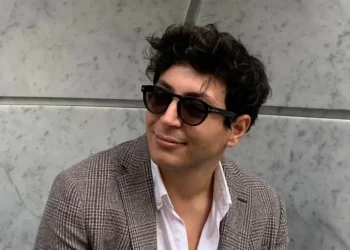
“We call it a salon because it has a nice history, an idea of people being vibrant, exchanging ideas and pushing boundaries,” said Tobias Berger, the curatorial director and co-founder of Serakai Studio, the company behind the space, called Gold.
Like Stein’s salon from a century ago, which welcomed artists such as Pablo Picasso and Henri Matisse, and writers including F. Scott Fitzgerald, Ernest Hemingway and James Joyce, Berger said that the space is “interested in the idea of bringing different people together.”
The new 3,200-square-foot salon will not only be a place for art, design and fashion exhibitions by local, mainland Chinese and international artists, but also a venue for music and performance. And it will serve as a site for public discussions on the arts and as a platform for the wider community.
The space sits in the center of Hong Kong’s burgeoning art district of Wong Chuk Hang, an enclave of old factory buildings that is home to a growing number of new shops, residential towers and a mix of both large and independent galleries. “We all know we have to grow together,” Berger said in an interview, “it’s not you against me.”
Berger, who has held positions at major art venues in Hong Kong, including M+, a contemporary art museum, and has been curator for a variety of exhibitions, including the Hong Kong pavilion at the Venice Biennale, envisions a place “to take risks, to experiment, to fail sometimes.” The studio will open its door to artists with new ideas who are pushing boundaries. “We call it a research and development place,” he said.
Building trust with artists, galleries and audiences in the studio’s first years of operation will be crucial, Berger said. An important marker for Gold’s creative success, he added, will be measured in the number of visitors who return for exhibition openings.
Audiences who continually attend openings, he said, believe in an institution and want to support it. On the business side, Berger hopes to attract gallery partners in Hong Kong and abroad to collaborate on projects and exhibitions.
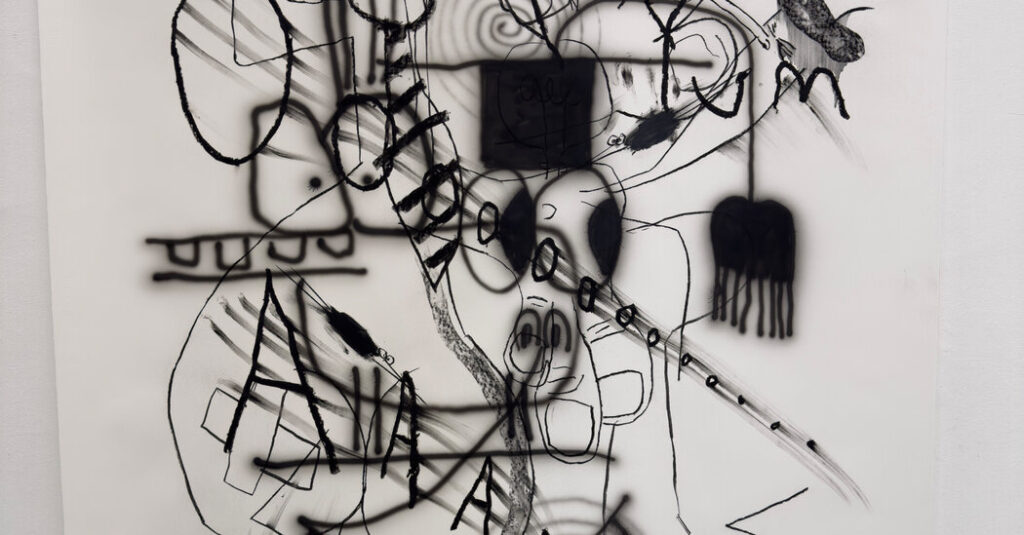
For Gold’s first exhibition, the American minimalist composer La Monte Young and his work “Composition 1960 #10” serves as a muse, with Young’s directive: “Draw a straight line and follow it.” The show, “Certainly,” takes a paradoxical look at uncertainties and includes works from artists in Asia and farther afield.
“Uncertainty offers opportunity,” said Berger.
Those taking up the concept include the New Zealand artist Peter Robinson. “The invitation to be part of an exhibition about uncertainty was impossible to resist,” Robinson said. “So much of my practice is about setting up a system or a structure — a set of rules, if you like — and then seeing what happens when I introduce an element of chaos, or when the material itself starts to push back,” Robinson said in an email interview.
“It’s a process of following a line, yes, but the line is never perfectly straight. That’s where the life of the work is,” he added.
Serakai Group, the parent company of Serakai Studio, was founded by the property investor Benjamin Cha. It concentrates on urban neighborhoods connected with culture and art. Serakai Studio is the cultural think tank and R & D hub of Serakai Group, with a long-term goal of becoming financially self-sustaining.
Berger said that Serakai Studio aims to open studios similar to Gold in Tokyo and Bangkok, although he did not specify a time frame.
In 2024, Serakai began publishing Cong, an annual journal of ideas on culture and urban imagination. Cong takes its name from an ancient Chinese object with a square exterior and a circular interior that is used in rituals. “We like that idea of how do you square a circle,” Daniel Szehin Ho, the publication’s executive director, said in an interview.
The voluminous and colorful publication (the first issue has a neon green cover, while the second issue is electric purple) explores “how culture interacts with daily life,” Ho said, particularly in cities. “They are really changing faster than we realize,” he added, “rather than focus on a new artist or a new scene, it asks, What is this phenomenon.”
More immediately, though, artists are preparing for the studio’s opening.
“In Gold, that conversation is an exploration of what unfolds when you commit to a mark and follow its consequences, allowing for accident and improvisation,” Robinson said. “It’s about the space between control and freedom, which is exactly the space Certainly is celebrating.”
The post A New Space Built to Replicate an Old-Fashioned Art Salon appeared first on New York Times.